
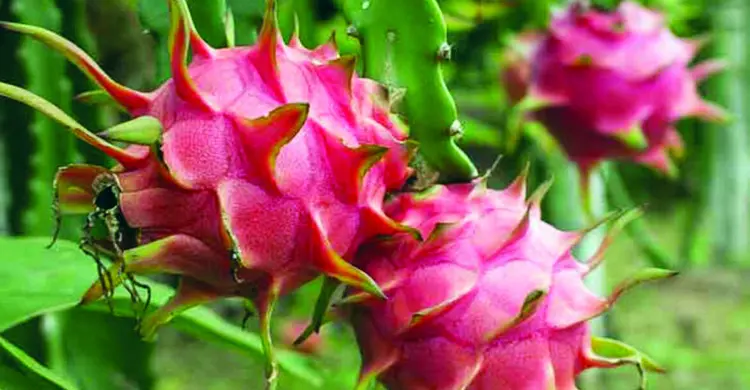
Dragon fruit is now available all over the country. Recently, however, the use of hormones or tonics to produce large dragon fruit has come under discussion, and a negative campaign about it is under way on social media.
In this situation, the Department of Agricultural Extension (DAE) has said large dragon fruit is not unsafe. The gibberellic acid or tonics used as plant growth regulators are scientifically sound, so there is no risk to health.
At the same time, agriculture experts believe the country's agricultural research institutes should do more research on dragon fruit grown in Bangladesh.
From private plots to a national crop
Dragon fruit cultivation began in the country through private initiative after 2010. In 2014, commercial cultivation began under the DAE's Year-Round Fruit Production for Nutrition Improvement Project.
Dr Mehedi Masud, director of that project, told Jago News that farmers had lately been using hormones or plant growth regulators to make dragon fruit bigger. "The most widely used plant growth regulators are gibberellic acid, auxins and indole acid. These are recognised by science. These plant growth regulators have no harmful effect. They are natural phytohormones, and in some cases they may even be beneficial."
Dr Mehedi Masud said dragon fruit has four grades. The lowest grade is 200 to 250 grams, medium 251 to 350 grams, large 351 to 450 grams, and XL anything over 451 grams. "Anyone who wants to produce XL dragon fruit must use hormones, meaning phytohormones, natural hormones and plant growth regulators. There is no risk to health from this," he said.
BARI to analyse chemicals
Dr Md Ubaydullah Kaysar, chief scientific officer (fruit division) at the Bangladesh Agricultural Research Institute (BARI), said: "There was no problem with dragon fruit before. Chemicals (hormones and tonics) are now being applied to it, and we are taking steps to analyse those chemicals. Unapproved chemicals or tonics are now coming in from abroad. We started work once this came to our notice. There will be research on the way the size of the fruit is changing."
According to the DAE, dragon fruit cultivation in the country has grown 116-fold and production 390-fold in just nine years. In 2014-15, dragon fruit was grown on 18 hectares, producing 66 tonnes. By 2022-23, the area had reached 2,095 hectares and production 25,760 tonnes.
Source: Jagonews24. First published in Bengali on The Agro News.


Comments
(0)