
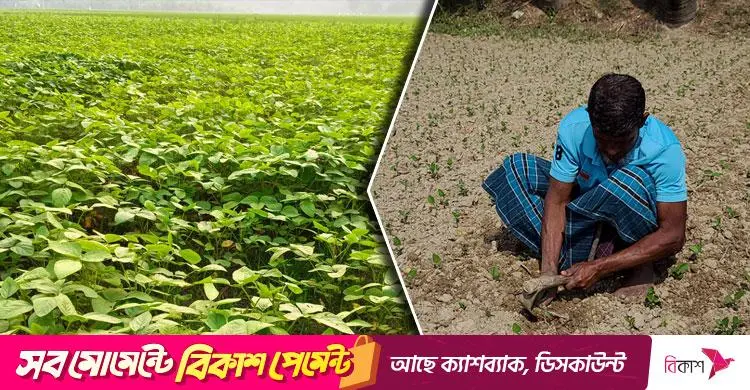
On the wide chars of coastal Lakshmipur on the Meghna, known as "Soyaland", farmers' hopes now sway in green soybean leaves. The fields are full of leaves, flowers and clusters of pods, and the long-awaited crop should be harvested within a month to a month and a half. Preparations on a large scale are under way.
Because the weather and soil suit it, about 70 to 80 per cent of the country's soybean is grown in this area. The district agriculture department says this year's crop could generate trade of about Tk 400 crore. When the crop is harvested, the chars and surrounding villages do well economically.
Farmers say soybean needs little water and grows even on saline land. It costs less and earns more than paddy and other crops, so more of them are turning to it every year. In the current rabi season soybean has been sown on more land than targeted: 43,600 hectares in four upazilas of the district. People involved believe every farmer's home will be festive this year if there is no untimely rain.
Why farmers choose soybean
Talking to at least 30 farmers in Char Kachia, Char Lakshmi, Char Badam and Char Ali Hasan, it emerged that soybean is grown on land where boro rice is not possible. Paddy and other crops cost more to grow, while soybean costs less. Other crops reduce soil strength, whereas soybean increases fertility, and other crops also do well on soybean land. Soybean fetches a higher price than paddy, selling for up to about Tk 3,000 a maund.
Fertiliser and pesticide are needed at most twice, whereas paddy needs more. Weeding once while the plants are young is enough. Natural disasters caused by climate change sometimes cause losses, so the agriculture department is encouraging farmers to grow climate- and salt-tolerant, short-duration soybean varieties.
Area and production
According to the district Department of Agricultural Extension (DAE), the target for this season was 42,000 hectares, but cultivation exceeded it by 1,600 hectares. About 2 tonnes of soybean are produced per hectare, so a production target of about 88,000 tonnes has been set for the 43,600 hectares sown.
Ramgati and Kamalnagar grow the most soybean in the district, with 17,000 hectares in Ramgati and 12,000 in Kamalnagar. Sadar has 7,500 hectares and Raipur 6,650. Last season about Tk 350 crore worth of soybean was produced; this year the target is Tk 400 crore. It is one of the district's main cash crops.
Nur Alam, a farmer in Char Ramani Mohan union of Sadar upazila, said: "Soybean needs fertiliser once before sowing and once when the plants flower. Beyond that, pesticide is applied only as the situation requires."
Firoz Alam of Char Lakshmi village in Raipur said: "Soybean land does not need irrigation. It is profitable, but there is a risk from heavy rain. If water stands in the field the soybean is ruined and we face losses. Soybean earns more than paddy, with less cost and labour."
Akhtar Hossain, sub-assistant agriculture officer for South Char Bangshi union in Raipur, said: "It will take another month to a month and a half to harvest. Rain now would be good for the crop. Some farmers are losing crops because they did not follow advice on applying pesticide."
Calls for industry
A local public representative, speaking on condition of anonymity, said: "Crores of taka change hands here around soybean. Government and private banks also give loans. The lives of char people are changing. But despite the huge potential, no soybean-based industry has been set up in the district in a planned way. The administration is indifferent."
Sohel Md Shamsuddin Firoz, deputy director of the Lakshmipur DAE, said: "Coastal land contains salt. Other crops cannot tolerate salinity, but soybean can. Highly saline land harms any crop. We supply farmers with improved soybean varieties."
He said: "The varieties BINA 5, BINA 6, BARI 4, BARI 6, BU 3, BU 4 and BU 5 have large, heavy grains and so give higher yields. They tolerate water and climate stress and escape early storms. The crop duration of soybean has now been shortened, so that farmers sow early and can harvest quickly."
Source: Jagonews24. First published in Bengali on The Agro News.

Comments
(0)