
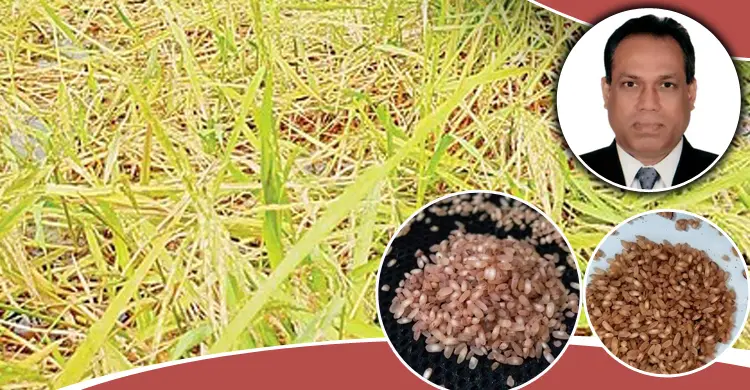
The benefits of red rice are immense, and eating it is said to cure various diseases because it is high in fibre. Lakshmidigha is the name of a locally grown rice variety with a life cycle of 110 days, the writer says. Lakshmidigha has disappeared from the body of modern rice. Modern varieties have no names any more, only numbers: BRRI dhan28, 29, 42, 76 or 96, just as prisoners have numbers instead of names. Modern agriculture is a prison, the writer says, and "I have found this vanished rice for you."
When and how to grow it
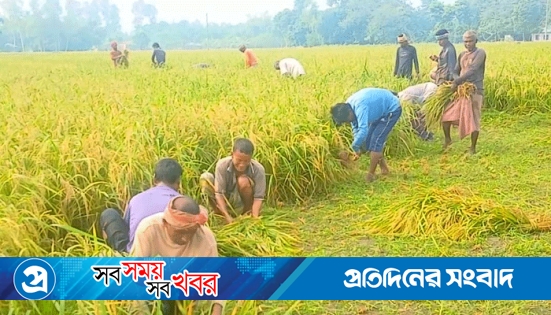
After the Boro harvest, around the month of Baishakh, the land is ploughed once and the seed is broadcast. There is no need even to harrow, and if the soil is soft no ploughing is needed at all: the seed is simply scattered. It needs no fertiliser or pesticide and grows by itself. The beels fill with about 6 feet of water, and the rice plants grow taller still. The crop is cut around the month of Kartik, with a yield of 12–15 maunds per bigha.
For eight months acre upon acre of char land used to lie fallow, drowned under water as deep as a person is tall, and people had seen it that way for generations. For the past two or three years that familiar scene has changed a little: green rice ears now sway above the water, and with them the farmers' hopes.
Farmers in Barishal, Gopalganj, Faridpur, Naogaon and Gaibandha are finding promise in Lakshmidigha, a nearly lost native rice. It does not drown but grows to keep pace with the water. The idea of sowing this variety's seed from Gopalganj in beel land across the country has spread. When farmers waded into their fields and pulled up a clump of rice, the plants reached above their heads, showing that the rice would not drown even when the beel water was as deep as a person is tall.
Pointing to the Lakshmidigha in the beel, farm women now say: "This beel is cultivated in one Jaistha and then stays under water until the next Jaistha. What hardship for people! With this Lakshmidigha rice, the people of the beel will survive." Demand for this rice has since multiplied, and growers have sold Lakshmidigha rice online at Tk 75 a kg.
Finding the Lakshmidigha seed
Hasan Zaman studied diploma engineering, but agriculture is his passion. He had been interested in farming since childhood and never pursued a job. He began as a contractor and then became involved in agriculture. While working, he thought of cultivating the fallow land of the beels and began looking for rice seed that grows in water.
He found a lead to such rice with a farmer in Nilphamari, and later got the rice he wanted from another farmer, Arifuzzaman, in Gopalganj. Hasan Zaman brought 120 kg of Lakshmidigha paddy from him. That it was indeed Lakshmidigha was confirmed by Yusuf Molla of Tanore, Rajshahi, a collector of lost rice seed and recipient of the President's award.
Hasan Zaman then explained to farmers that their land lies idle for eight months a year. He would trial a new rice on it, and if it succeeded he would give them seed so they could grow it themselves. The farmers agreed. "We are grateful to brother Hasan Zaman. The nation will remember your field trial and successful expansion," the writer says.
In 2014, at a programme on agriculture, Prime Minister Sheikh Hasina mentioned that Bangabandhu Sheikh Mujibur Rahman liked rice made from Lakshmidigha. Fresh research then began. The rice was grown on higher land instead of low land, and growers expect almost double the yield.
Benefits of red rice
Nutrition scientists say Lakshmidigha is more nutritious. According to them, the grain is red, and because it is grown organically it fetches a higher price. It is rich in fibre. More fibre means food is digested slowly in the gut, which slows the conversion of carbohydrate into sugar and so lowers blood sugar. Because of its low glycaemic index, the rice is recommended for people with diabetes and heart disease.
They say it reduces the risk of blocked blood vessels and heart disease and lowers blood fat and sugar levels. Eating one cup of red rice a day cuts the risk of diabetes by up to 60 per cent, they say. Red rice makes people feel less hungry, meets 10 per cent of daily fibre needs, helps control weight and prevents obesity.
Nutrients in Lakshmidigha rice
Besides fibre, red rice contains plenty of zinc, iron, calcium, magnesium, vitamins B1, B2 and B6, manganese, selenium, protein and potassium, the writer says.
- Iron is needed to make haemoglobin in red blood cells, which carries oxygen in the blood.
- Zinc and manganese help blood to clot and wounds to heal; manganese also takes part in the body's metabolism.
- Calcium and magnesium keep bones healthy and strong.
- Vitamin B6 regulates balance and helps make the hormones serotonin and norepinephrine, which control mood.
- Potassium regulates the body's chemical balance, lowers blood pressure and keeps the heart healthy.
- Vitamin B2 helps break down food to produce energy.
- Selenium protects the body from harmful free radicals and helps make DNA.
Anthocyanin is found in red rice as well as black rice and all red and blue foods such as blueberries and raspberries.
The glycaemic index of red rice is only 55, against 70 for white rice. So red rice prevents and controls diabetes and keeps weight in check, the writer says. It is also said to enhance the skin: the anthocyanin in red rice reduces wrinkles and keeps skin youthful, and its antioxidant properties protect the skin from the sun's harmful ultraviolet rays, guarding against skin cancer and other skin diseases such as psoriasis. Red rice is described as healthy for pregnant and breastfeeding mothers, as reducing and preventing asthma, and as good for the bones.
Does red rice have any downside?
Some studies have shown that red rice contains phytic acid, which is harmful to the human body because it hinders the absorption of iron and calcium in the gut. This can be a problem if red rice is eaten with foods rich in calcium and iron, so it is better not to eat iron- and calcium-rich foods with red rice, the writer says.
The writer is a lead agriculturist based in Dhaka.
Source: Jagonews24. First published in Bengali on The Agro News.
Comments
(0)