
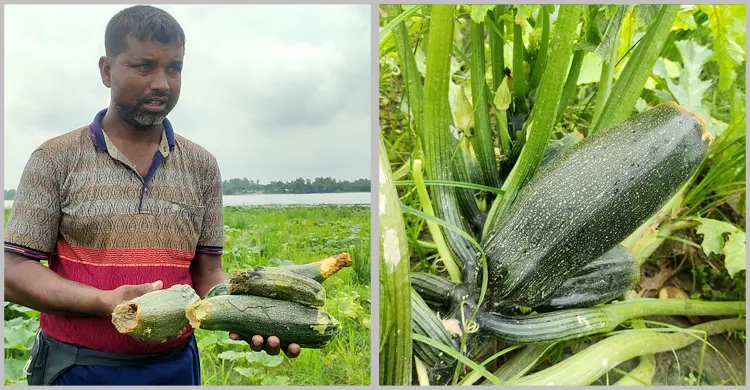
Farmer Saidul Islam is in trouble after growing squash, a desert crop, on a sandy char of the Dharla river in Kurigram. He is the son of the late Iyaj Uddin of Araji Palash Bari village in Holokhana union of Sadar upazila. His winter squash plants carried plenty of flowers and fruit, but heavy rain brought on mosaic disease.
The disease, described as fungal, destroyed the squash field. Representatives of fertiliser and pesticide companies gave advice on saving the crop, but the district office of the Department of Agricultural Extension (DAE) has not been in touch, and so far it has not stood by the affected farmer. Saidul Islam has voiced frustration and anger.
Four bigha of squash on the char
On the sandbank that has risen on the bank of the Dharla, green crops stretch as far as the eye can see, with many kinds of vegetables grown over a wide area. Alongside bitter gourd, pumpkin and tomato, Saidul Islam grew squash on 4 bigha. The crop is grown abroad but has become well known in Bangladesh, and many people have become self-reliant by farming it. He took it up after seeing squash succeed in several districts, but bad weather has left him facing losses.
Saidul Islam said he turned to farming instead of chasing a job, and began growing squash alongside conventional vegetables and crops. In all, he spent Tk 25,000-30,000 a bigha. The yield was good, but heavy rain turned the plants and leaves yellow, the tips of the squash began to rot, and within a few days the crop in the field was ruined.
"I grew squash with great hopes. Seeing the plants yield well, I thought I would make a profit. But sadly, the field has been ruined and I have lost a lot. I don't know how I will get over this loss. I have not received any government help so far, and no advice from the Kurigram Department of Agricultural Extension," he said.
Neighbours and officials
Moslem Uddin, a farmer from the same village, said: "Saidul was the first to grow squash here. I was going to start growing it next year. Suddenly I learned that Saidul's squash field had been ruined. I couldn't understand why the plants started rotting at harvest time. If the agriculture department had stood by Saidul, he would not have faced these losses."
Biplab Kumar Mohanta, deputy director of the DAE in Kurigram, said: "Squash is a foreign vegetable variety. Many people in our country are now becoming self-reliant by growing it. Squash gives a good yield with intensive care. But I was not aware of Saidul Islam's losses; I learned of it through you. I will be able to say more after looking into it."
Source: Jagonews24. First published in Bengali on The Agro News.
Comments
(0)