
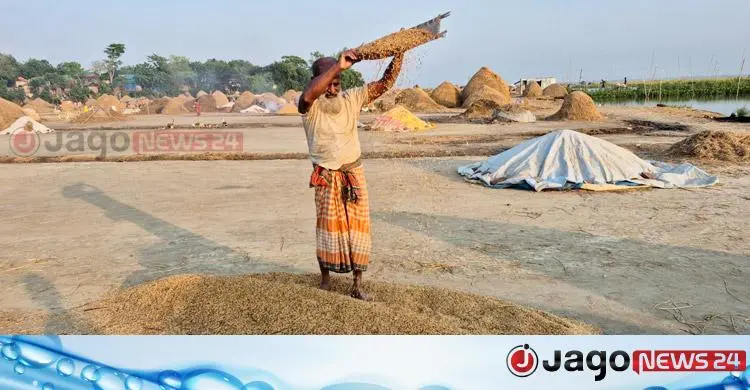
Sunshine has finally returned to the haor region of Kishoreganj after several days of continuous rain and upstream flash floods. With clear skies from the morning of Tuesday, 5 May, the haors came back to life, and farmers are now busy drying paddy from flooded fields and heaps piled in the threshing yards (kholas).
On the Itna all-weather road and in the kholas on higher land, the familiar bustle has returned. Paddy is being dried on both sides of the road, threshed in some places and winnowed in the wind in others. Men, women and children are all drying and gathering paddy, leaving farmers with no time to rest.
Rivers still rising
But the sunshine has brought new worries. Rivers have risen over the past 24 hours, and fears remain. The haor area of Itna upazila was hit hardest by the heavy rain, and much low-lying land is still under water.
Farmer Rahim Mia, busy drying paddy on the all-weather road at Mithamain Zero Point, said: "Because it has been sunny since morning, everyone is busy drying the paddy kept in the kholas and on the road. In some places we still have to cut paddy in water. If the sun stays for a few days, some of the crop can be saved."
Khayer Kha, a farmer at the Joysiddhi khola, said: "Without the sun, everything would have been lost. Now we are trying to save what is left. Many people's paddy has already rotted."
Because water is standing in the fields, harvesters cannot be used, so demand for labourers has grown and so have wages.
Labourer Sabur Ali, who has come to cut paddy, said: "We have to work in chest-deep water. We cut paddy despite the cold water and leeches, so we are charging a bit more."
Officials monitoring
Farmers' worries have not eased as rivers rise, but they hope that if the weather stays favourable they can at least save the paddy in the kholas in the next few days.
The Nikli weather office said 4 millimetres of rain was recorded in the past 24 hours, and more rain is possible today.
Md Sajjad Hossain, executive engineer of the Kishoreganj office of the Bangladesh Water Development Board, said the situation is under constant watch and the local administration and farmers have been asked to stay alert.
Dr Sadiqur Rahman, deputy director of the district Department of Agricultural Extension (DAE), said about 12,500 hectares have gone under water so far, affecting 49,000 farmers. Itna and Austagram upazilas are worst hit, and a list of affected farmers is being prepared.
Source: Jagonews24. First published in Bengali on The Agro News.


Comments
(0)