
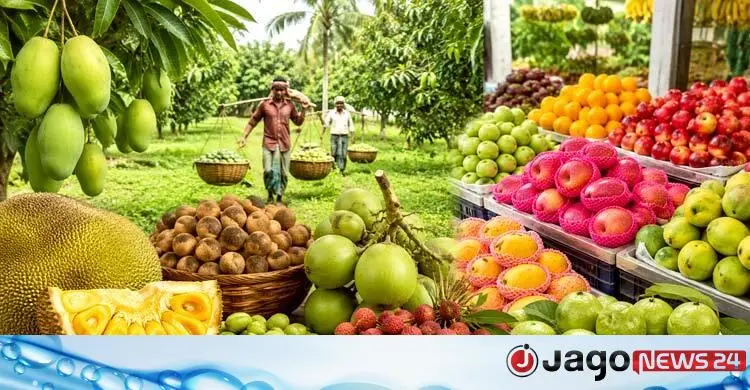
Khulna's fruit sector has no storage facilities, no investment for lack of markets, and is losing its potential for want of entrepreneurs.
More than 80,000 tonnes of fruit are produced a year on about 25,000 hectares of land in Khulna. Yet despite this output, no commercial fruit sector has developed in this coastal region. Salinity, waterlogging, lack of storage, shortage of modern technology, lack of investment and a weak market system keep this promising sector confined to local markets. Farmers are deprived of fair prices, and Khulna is losing a big opportunity for fruit-based industry, jobs and exports.
45 kinds of fruit, 80,000 tonnes
According to the district office of the Department of Agricultural Extension (DAE), 45 kinds of fruit were grown on 24,988.16 hectares in various upazilas of Khulna district in the 2024-25 fiscal year, producing a total of 80,322.21 tonnes.
Mango was the most widely grown, with 12,930.38 tonnes from 4,884.66 hectares. In addition, 8,840 tonnes of jackfruit were produced on 272 hectares and 19,921 tonnes of coconut on 1,803 hectares.
Other fruit included 1,121 tonnes of jam (black plum) on 116 hectares, 5,548 tonnes of guava on 422 hectares, 1,908 tonnes of kul (jujube) on 455 hectares, 1,925 tonnes of betel nut on 692 hectares, 8,000 tonnes of palmyra palm on 280 hectares, about 8,500 tonnes of dates on 229 hectares and about 7,000 tonnes of tamarind on 1,753 hectares.
People in agriculture say farmers have recently become more interested in growing local malta, dragon fruit, watermelon and mango. But most of the fruit produced cannot get beyond local and retail markets, and Khulna still has no organised commercial fruit market or marketing system.
In their view, fruit production could be raised further with improved varieties suited to the coastal environment, modern farming technology and planned investment. With storage, processing, fair-price markets and export opportunities, Khulna could develop a strong fruit-based industry, creating new entrepreneurs and many jobs and letting the region contribute more to the national economy.
No market, no investors
Talks with the Khulna Chamber of Commerce and Industry, the Export Promotion Bureau (EPB) and local traders show that no commercial fruit market has developed in Khulna despite it being an agricultural district. Seasonal fruit grown in the district mostly stays in local and retail markets. With no organised collection centres, wholesale marketing system or export supply chain, big investors show no interest, so fruit production is not becoming commercial and farmers miss out on fair prices.
Those involved say that with planned investment, modern storage, grading and packaging, and a processing industry, Khulna's fruit could reach other regions and international markets. Without this infrastructure, farmers are forced to sell quickly in local markets.
Md Kabir Hossain Khan, assistant director of the EPB's Khulna regional office, told Jago News that fruit is highly perishable, so modern storage, a cold chain and fast transport are essential for export. Because of the lack of these facilities and of commercial production, no fruit has yet been exported from Khulna district.
A trader named Kamrul Howlader said local fruits such as green coconut, coconut and betel nut are not produced commercially. What is produced does not get past the retail market and stays at the consumer level, and exports are a distant prospect. But if a commercial market for these local fruits could be created, foreign investors would come, he said.
Khulna's fruit traders say that because the district's own output is limited, seasonal mango, jackfruit, litchi, watermelon and other local fruit are brought in from other regions and sold to local retailers and wholesalers. Khulna still has no modern wholesale fruit market, storage or processing centre, so traders must sell quickly, reducing their chances of profit.
Traders said imported apples, oranges, malta and other foreign fruit are not imported directly into Khulna either. Local traders buy them from importers and market them, but without cold storage or modern storage the scope to expand the business is limited.
Khulna wholesaler Ikramul Haque told Jago News: "We mainly trade in seasonal fruit, bringing mango, jackfruit, litchi and watermelon from various districts and selling to traders in Khulna and nearby. But so far we have had no business link with any exporter."
He said there is no modern storage or processing centre in Khulna for fast-perishing fruit such as mango and jackfruit, which is why big investors and large traders show no interest. If the necessary infrastructure were built, a big fruit market could be created in Khulna too, he said.
Climate and soil against the region
Professor Md Abdul Mannan of the Agrotechnology Discipline at Khulna University told Jago News that the Khulna region lags in commercial fruit farming for geographical and climatic reasons. Its weather is not as suitable for fruit as that of the northern region. Because of coastal salinity, waterlogging, a high groundwater table, storms and pest attacks, much fruit falls before it matures. Mango in particular cannot tolerate salinity, so although there is potential, nature's adversities prevent the desired yields.
Weak infrastructure has also held the sector back, he said. Khulna lacks modern agri-entrepreneurs, skilled farmers, cold storage, processing centres and fast transport, so fruit cannot be stored for long and farmers are forced to sell cheaply in season. With better storage and markets, there would be export opportunities as well as domestic supply.
Some fruit, such as coconut, do well in the region because of the coastal environment, he said, but trees such as jackfruit cannot tolerate waterlogging and may die if water stands at the base for several days. Mango needs dry, warm weather, which is more favourable in the north.
Long-term salinity has damaged the quality of the region's soil and water, he added, and many rivers have lost their navigability, which is also harming agriculture. To overcome this crisis there is no alternative to controlling saline water, improving river and water management, spreading modern farm technology, developing skilled entrepreneurs, raising investment and building an effective market system. With coordinated action, Khulna's fruit sector could become a promising industry even in an adverse environment, the professor believes.
Government plans
Officials said new government initiatives are being taken to overcome the crisis and make the Khulna region more productive.
Nazrul Islam, deputy director of the DAE in Khulna, told Jago News: "No fruit has been exported from Khulna yet. Exports are not possible from small orchards; they are possible from commercial orchards. So we are trying to develop entrepreneurs and build agriculture around modern farming." He hoped that good entrepreneurs would create a promising market.
Mosa. Shahnaz Begum, deputy director of the Department of Agricultural Marketing in Khulna division, told Jago News that work is under way in the division on implementing a project through a partner approach for commercial production. The project is running in Satkhira and activities have started in Khulna, where work on commercial fruit production through the partner approach has begun and committees are being formed. Visible activity will start very soon, she said.
Source: Jagonews24. First published in Bengali on The Agro News.
Comments
(0)