
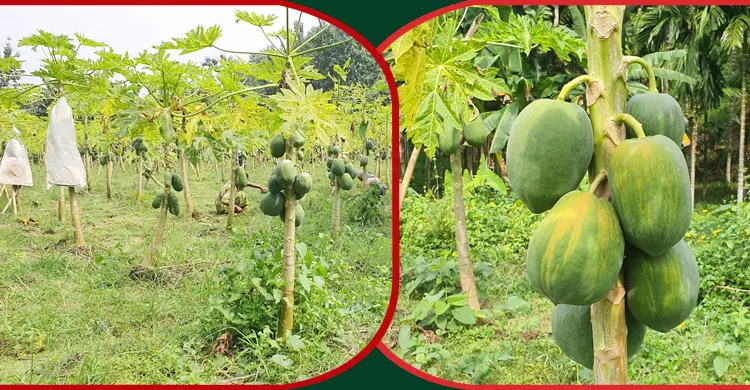
Papaya growers in the hill district of Khagrachhari are facing financial losses because of a continuous blockade. Unable to send their fruit out, they are forced to sell at half price, and papayas are rotting in the orchards, the growers say. The agriculture department has sought the administration's help to move farm produce without disruption.
According to the agriculture department, papaya has been grown on 571 hectares this season in Khagrachhari, a district known for improved varieties. Production has been good, but with vehicles off the roads because of the blockade, growers cannot get their fruit to market.
Half the normal price
In normal times papaya sells at Tk 40–50 a kg, but now it has to be sold at Tk 20–25. Many orchard owners cannot market their papayas at all, and the fruit is going to waste in the orchards. Abdul Karim, a papaya grower in Dighinala, said hill papaya is supplied to Dhaka, Chattogram, Noakhali and Cumilla. "Because of the continuous blockade, we cannot send the papayas, so they are rotting in the orchards," he said.
Amal Bikash Tripura, a grower in Bailyachhari, Guimara, said: "Before, we sold at Tk 40–50 a kg; now it sells at Tk 20–25. We have suffered a big financial loss. So we demand that transport of perishable produce be kept outside the blockade."
The Department of Agricultural Extension (DAE) has said papaya growers will be hurt by the blockade. Seeking the administration's help so that growers can sell without disruption, Kishore Kumar Majumder, deputy director of the DAE in Khagrachhari district, said: "The way farmers are being harmed is very worrying. Papaya worth Tk 40–50 has to be sold for Tk 20–25. If the administration helps transport this highly perishable produce, growers will be able to recover their losses."
Saying security has been stepped up, Khagrachhari deputy commissioner Md Sahiduzzaman said: "The administration is working in coordination with various departments so that the supply chain is not disrupted."
Source: Jagonews24. First published in Bengali on The Agro News.
Comments
(0)