
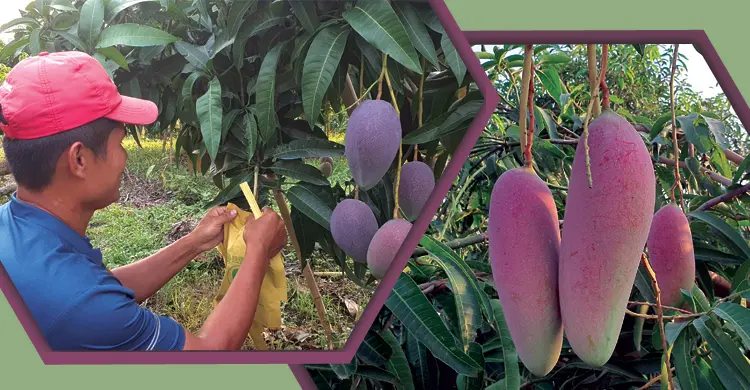
Khagrachhari's Amrapali mango is known across the country. After its success, hill farmers are turning to colourful foreign mangoes, which sell here for Tk 600 to 900 a kg. Colourful mangoes now hang in clusters on Khagrachhari's rolling hillocks, and hobby growers hope for success with them.
Farmer Hlashimong Chowdhury succeeded in growing Miyazaki, or Suryadim, which holds the title of the world's most expensive mango, for the first time in Khagrachhari. The mango's journey here began with him in 2016, after which foreign mangoes came to dominate the green hills. At least a hundred foreign mango varieties are now grown in Khagrachhari.
The varieties grown in the hills include Miyazaki or Suryadim, the American Palmer, Kent, the Italian Austin, the Australian Kensington Pride, Keitt, Red Ivory, Red Emperor, Banana Mango, Katimon, Kiojai, Red Lady, Apple Mango, R2E2 and Thai Kachamitha. They sell for several times the price of common local mangoes.
Growers and prices
Foreign mangoes were hanging in clusters on the trees. After Hlashimong Chowdhury, a National Agriculture Award winner for colourful mangoes, young agri-entrepreneur Mongshitu Chowdhury has also succeeded. He left a government job to grow mangoes. Of the 42 foreign varieties in his orchard in the Bhuachhari area of Khagrachhari Sadar, 22 have fruited, and he hopes to sell at least Tk 15 lakh worth of mangoes this season.
In Matiranga, Khagrachhari, Animesh Saha, a chartered accountant at a private company, has planted an orchard of foreign mangoes alongside common ones. His orchard now has more than a hundred foreign varieties, many of which have fruited. He is working to get foreign mango saplings to local farmers.
While other mangoes sell for Tk 30 to 50 a kg, foreign red mangoes cost several times more. According to available information, Miyazaki sells for Tk 900 a kg, Red Ivory for Tk 700, Red Emperor or Chakapat for Tk 900, the Australian R2E2 for Tk 600 and Haniview for Tk 600. Because of the high prices, foreign mangoes are not sold in local markets, but hobbyist consumers across the country buy them online.
Research and extension
The Khagrachhari Hill Agricultural Research Station is studying the prospects for growing foreign mangoes, including the yield and sweetness of different varieties. Md Altaf Hossain, chief scientific officer (acting) of the station, said: "Several colourful foreign mango varieties have come to the hills through hobby growers. The varieties that have come here are very popular in their own countries and also high-yielding. Hobby growers are getting good yields from them."
Mangoes have been grown on more than 3,700 hectares in Khagrachhari this season, of which foreign varieties cover only 5 hectares. Kishore Kumar Majumder, deputy director of the Department of Agricultural Extension (DAE) in Khagrachhari, said: "Because of higher yields, farmers mostly grow the BARI-developed Amrapali, Rangguai and BARI Four. But because of the higher prices, aware farmers are turning to foreign mangoes."
He said: "To spread the foreign varieties, 2,500 Banana Mango and 3,000 Katimon saplings have been distributed. Interested farmers can collect saplings from here, and the scale will be expanded in future. Mango grower Mongshitu Chowdhury will be included in the list of farmers producing export-quality mangoes."
Source: Jagonews24. First published in Bengali on The Agro News.
Comments
(0)