
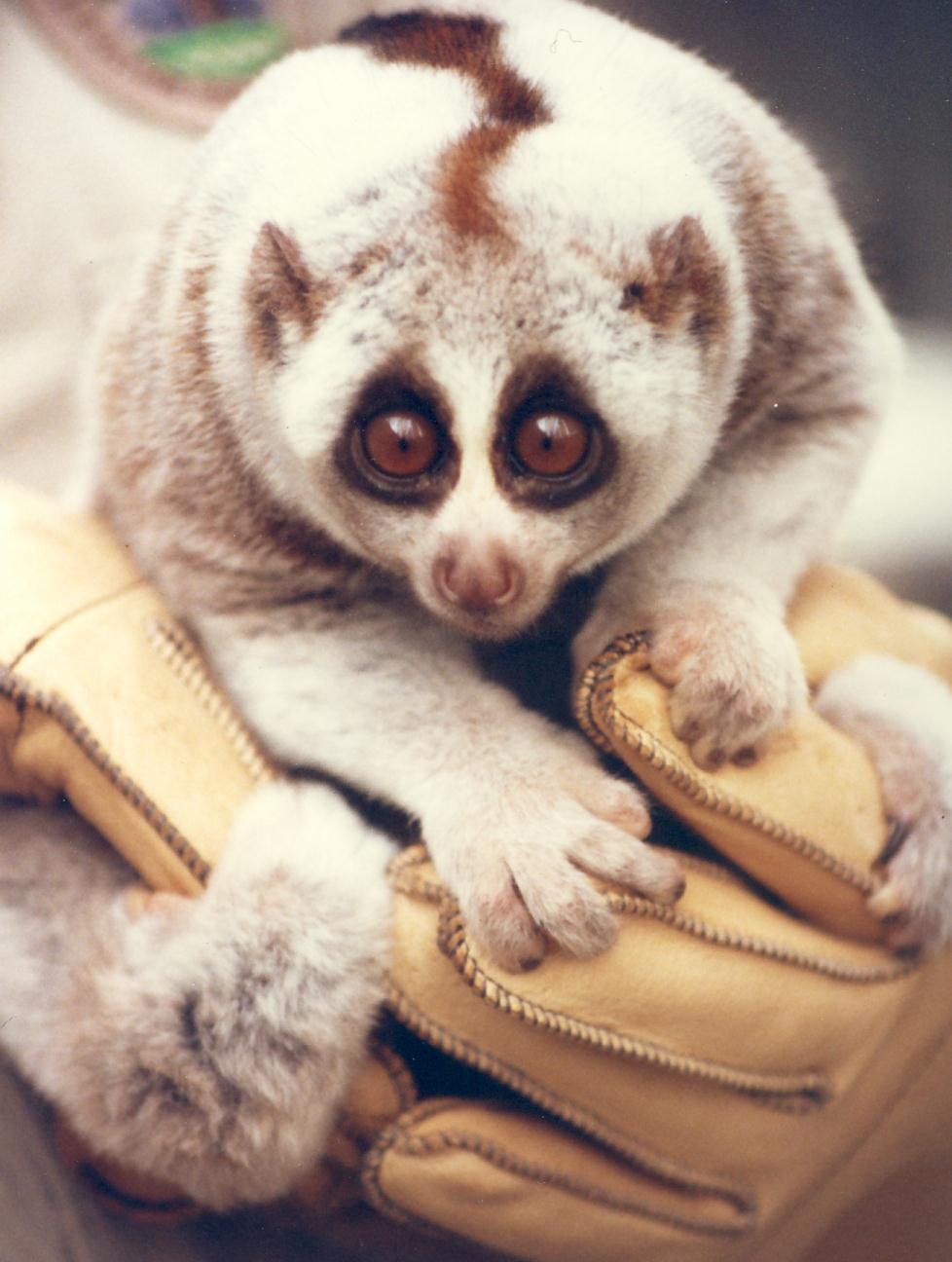
The Forest Department and a local wildlife rescue team rescued an injured slow loris, a rare and endangered primate, in Matiranga upazila of Khagrachhari district on Tuesday, 5 May 2026. The animal was found in the Shantipur area of Gumti union and was taken to an animal hospital for treatment the following morning, Jagonews24 reported on 6 May 2026. Farid Mia, divisional forest officer of the Khagrachhari Forest Department, confirmed the rescue.
How the loris was found in Shantipur
Md Ahsan, a member of the wildlife rescue team, told Jagonews24 that local people had seen the injured loris and informed both the rescue team and the Forest Department. The team then went to the spot and brought the animal back safely. The report did not say how the loris had been hurt or how long it had been lying injured before it was noticed.
Md Hasan, an employee of the Matiranga forest office, said the rescued loris was taken to the animal hospital on the morning of Wednesday, 6 May, and given treatment there. "It has injury marks on its eyes and in various places on its body," he said.
Hasan added that the rare animal was, for the time being, being kept in a safe place in the Pitachhara forest area, and that it would be taken back to the hospital for further treatment as needed. The report gave no further detail of the injuries or of the treatment given.
What the divisional forest officer said
Farid Mia described the slow loris as a very sensitive animal. Such lorises, he said, usually live in dense forest and avoid contact with people. He said the species was under threat because of illegal hunting and other human causes, that the Forest Department was treating the animal with the highest priority, and that once it recovered it would be released into its natural habitat.
The Forest Department also pointed out that the slow loris is listed as endangered on the Red List of the International Union for Conservation of Nature (IUCN). The slow loris native to Bangladesh is the Bengal slow loris (Nycticebus bengalensis), the species assessed in the national Red List of Bangladesh and named in the schedules of the country's wildlife law.
The Forest Department is the government agency responsible for protecting and maintaining Bangladesh's forests and wildlife. It was established in 1870, during British rule, and has its head office in Mohakhali, Dhaka.
The Bengal slow loris: a slow, nocturnal primate
The Bengal slow loris, also called the northern slow loris, is a strepsirrhine primate. It lives in Bangladesh, north-east India, Cambodia, Laos, Myanmar, Vietnam, southern China and Thailand, and its geographic range is larger than that of any other slow loris species. It was long treated as a subspecies of the Sunda slow loris (Nycticebus coucang) until the primatologist Colin Groves recognised it as a separate species in 2001.
It is the largest of the slow lorises, measuring 26 to 38 centimetres from head to tail and weighing between 1 and 2.1 kilograms. Its fur is dense and woolly, brown-grey on the back and white underneath, with a clear dark stripe running up to the top of the head. Like other slow lorises it has a round head, a flat face, large eyes, small ears, a wet nose and only a vestigial tail. Its eyes reflect a bright orange eyeshine, and a curved "toilet claw" on the second toe of each hind foot is used for scratching and grooming.
On the inner side of each elbow the Bengal slow loris has a small swelling, the brachial gland, which secretes a pungent, clear, oily toxin that the animal wipes on its toothcomb. A chemical study found that almost half of the several dozen compounds in this oil do not occur in the closely related pygmy slow loris, and its authors suggested the oil may also carry information about sex, age, health and status from one loris to another. Slow lorises are the only known venomous primates, and their bite can cause severe anaphylactic shock in humans, Mongabay India noted in a 2020 report.
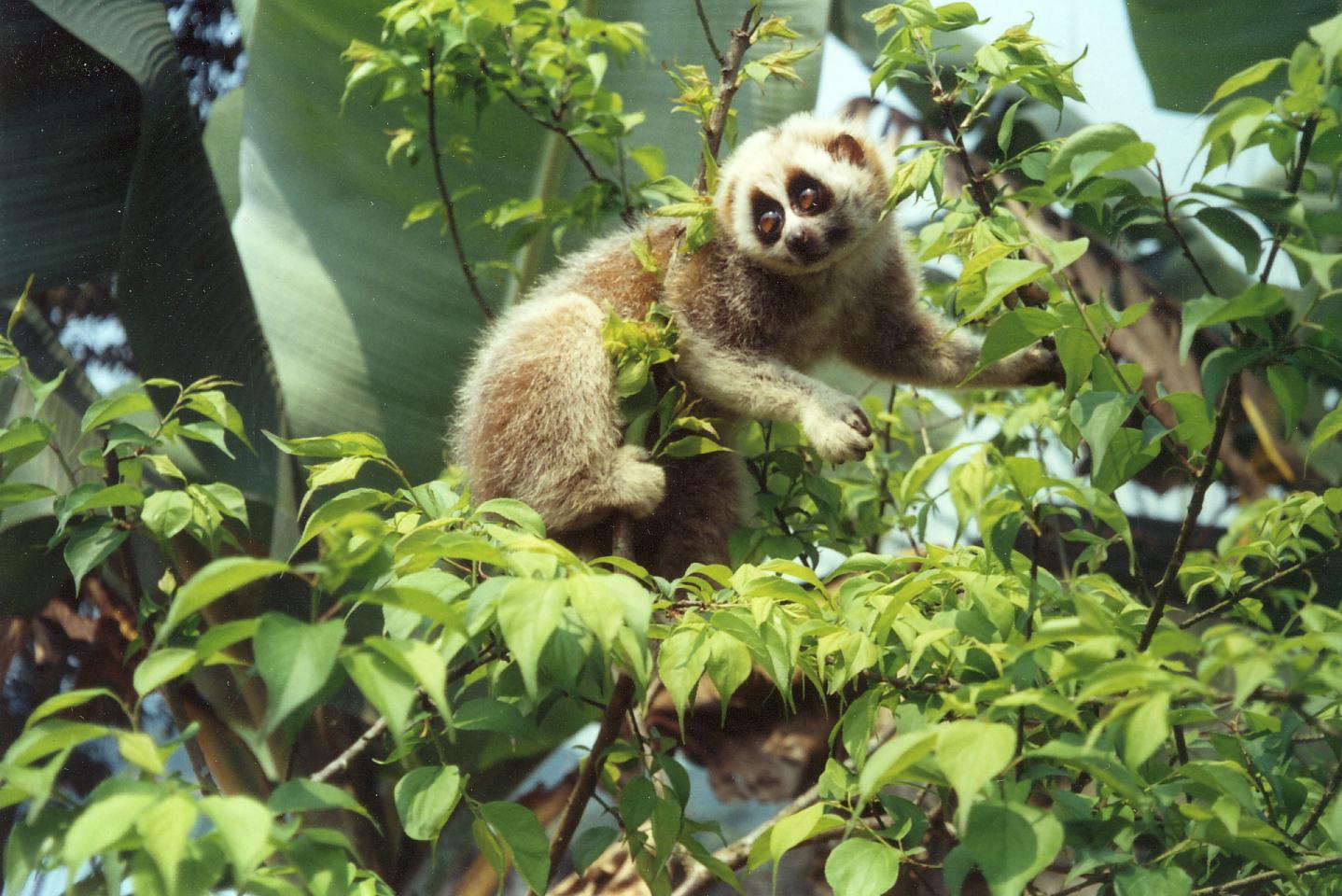
The animal is nocturnal and lives in trees. By day it sleeps curled up in a ball in dense vegetation or in tree holes. Because it does not leap, it depends on vines and lianas to move from tree to tree. It lives in small family groups, and males and females mark their territory with urine. It prefers evergreen and semi-evergreen forest with continuous, dense canopy and tall trees, which is why its presence is taken as a sign of a healthy forest.
Its diet is mainly fruit, but it also eats large insects such as katydids and crickets, tree gum, snails, small birds and reptiles. In winter it lives almost entirely on plant exudates such as sap and gum, which it gets by gouging the bark of trees; the bastard myrobalan (Terminalia bellerica) is a preferred source. In north-east India, Dilip Chetry of the wildlife organisation Aaranyak told Mongabay India in 2020 that the species is mostly found on trees that release gum or sap, such as Grewia microcos, Schima wallichii, Gmelina arborea, Delonix regia and Terminalia chebula. It disperses seeds and pollinates night-blooming flowers, and is itself prey for pythons and hawk-eagles.
The Bengal slow loris does not breed in a fixed season. Females give birth every 12 to 18 months after a gestation of about six months, usually to a single young. The mother carries her infant for about three months; the young reach sexual maturity at around 20 months, and the species can live up to 20 years. The national Red List of Bangladesh records that it breeds year-round and occurs alone or in pairs, feeding on insects, small vertebrates, fruits and gums.
An endangered species in Bangladesh
The Red List of Bangladesh, Volume 2: Mammals, published by IUCN Bangladesh in 2015, assessed the Bengal slow loris as Endangered in the country. The assessment, by Md Kamrul Hasan, said the species has a restricted distribution, only in the mixed evergreen forests of the north-east, east and south-east of the country. It inferred that at least half of the population had been lost over roughly the previous two decades, through the shrinking of its range, unprecedented changes in habitat quality and continuing exploitation. The species had been wiped out from its former range in the country's Sal forests. In the earlier national assessment of 2000 it had been listed as Critically Endangered.
The species has been recorded in the Chittagong Hill Tracts, the region to which Khagrachhari belongs. It is also found in Lawachara National Park in Moulvibazar district, a semi-evergreen forest declared a national park in 1996 that also shelters the western hoolock gibbon, Phayre's leaf monkey and the capped langur. Forest loss has been severe across the loris's range: by 2000 only 9 percent of Bangladesh's original forest cover remained, according to figures summarised in the species' encyclopedic entry.
Global status, the pet trade and traditional medicine
On the IUCN global Red List the Bengal slow loris was listed as Data Deficient as recently as 2006. It was assessed as Endangered in 2020. As of July 2020, Mongabay India reported, the listing reflected habitat loss combined with severe hunting pressure, which had reduced the population by more than 50 percent over three generations, about 24 years, and was expected to cause a further decline of more than 50 percent over the next three generations across the species' range.
International commercial trade has been banned since June 2007, when the 14th Conference of the Parties to CITES, the Convention on International Trade in Endangered Species of Wild Fauna and Flora, held in The Hague, moved all slow loris species to Appendix I. Before that, slow lorises had been on Appendix II since the 1970s, which required only an export permit. In India the species is protected under Schedule I of the Wildlife Protection Act of 1972.
The most severe threats are the wildlife trade, both for exotic pets and for traditional medicine, and deforestation, along with slash-and-burn farming and road building. In 2006 the Bengal slow loris was reported as one of the most common mammals in shops and stalls in Cambodia. In traditional medicine it is used for treatments after childbirth, for stomach problems, and for wounds and broken bones. Mongabay India described Mong La in Myanmar, on the Chinese border, as a major trading centre where lorises were killed, dried and sold in parts.
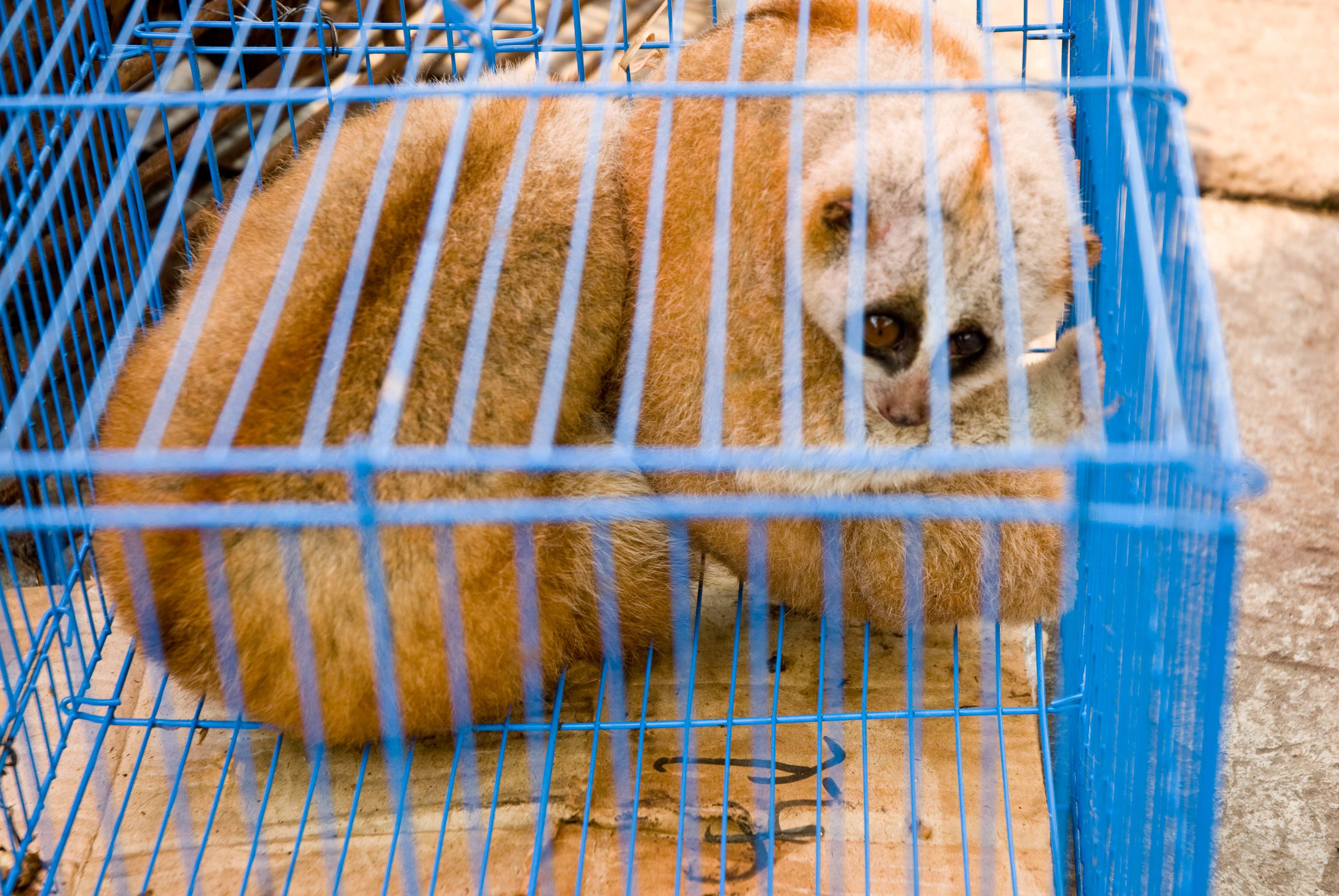
The trade is also cruel to the animals that survive it. Dealers cut or pull the front teeth of slow lorises to make them look tame, which causes severe bleeding and frequent dental infection that is fatal in about 90 percent of cases; without teeth the animals can never return to the wild. Slow lorises are very sensitive to stress and do badly in captivity. Of the slow lorises confiscated from smugglers bound for Japan, 76 percent died, many before they could be transferred to zoos. Viral online videos of pet lorises being tickled have spread the idea that they are docile, when their stillness is a defensive reaction to stress.
In north-east India, primatologists told Mongabay India in 2020 that hunting was mainly for local traditional medicine, and that the animal was often caught during firewood collection in the hills. "Mostly, the animal is rescued from kitchens in the villages after being trapped," said Jihosuo Biswas of the Primate Research Centre North East India. Researchers there recommended awareness drives with schoolchildren in villages around protected areas, and more scientific study of the species.
Roads and power lines inside the forest
Deaths on roads and electric lines are another documented threat in Bangladesh. A study by Hassan Al-Razi and Marjan Maria of Jagannath University and Sabir Bin Muzaffar of United Arab Emirates University, published in the journal Zoologia in October 2019, collected records of primate deaths from 2015 to 2017 at Lawachara and Satchari national parks in north-eastern Bangladesh. It recorded 27 deaths of five primate species: 15 from road accidents and 12 from electrocution.
Among them were Bengal slow lorises killed on the road at Satchari in January and in December 2015 and at Lawachara in October 2016, and two slow lorises electrocuted at Lawachara in February 2017. The authors explained that a slow loris moves slowly and may grip one wire and reach the next without letting go of the first, causing a fatal short circuit. At Satchari, they noted, 12 of 18 natural canopy bridges over the highway were cut in 2016 to bring in a power line, and primate electrocutions there were recorded only after the line was installed.
The researchers recommended avoiding roads and power lines inside forests, controlling vehicle speed, using insulated power lines and keeping natural canopy bridges or building artificial ones. They noted that 90 percent of Bangladesh's primate species are threatened and that their populations are gradually declining.
Matiranga and the Khagrachhari hills
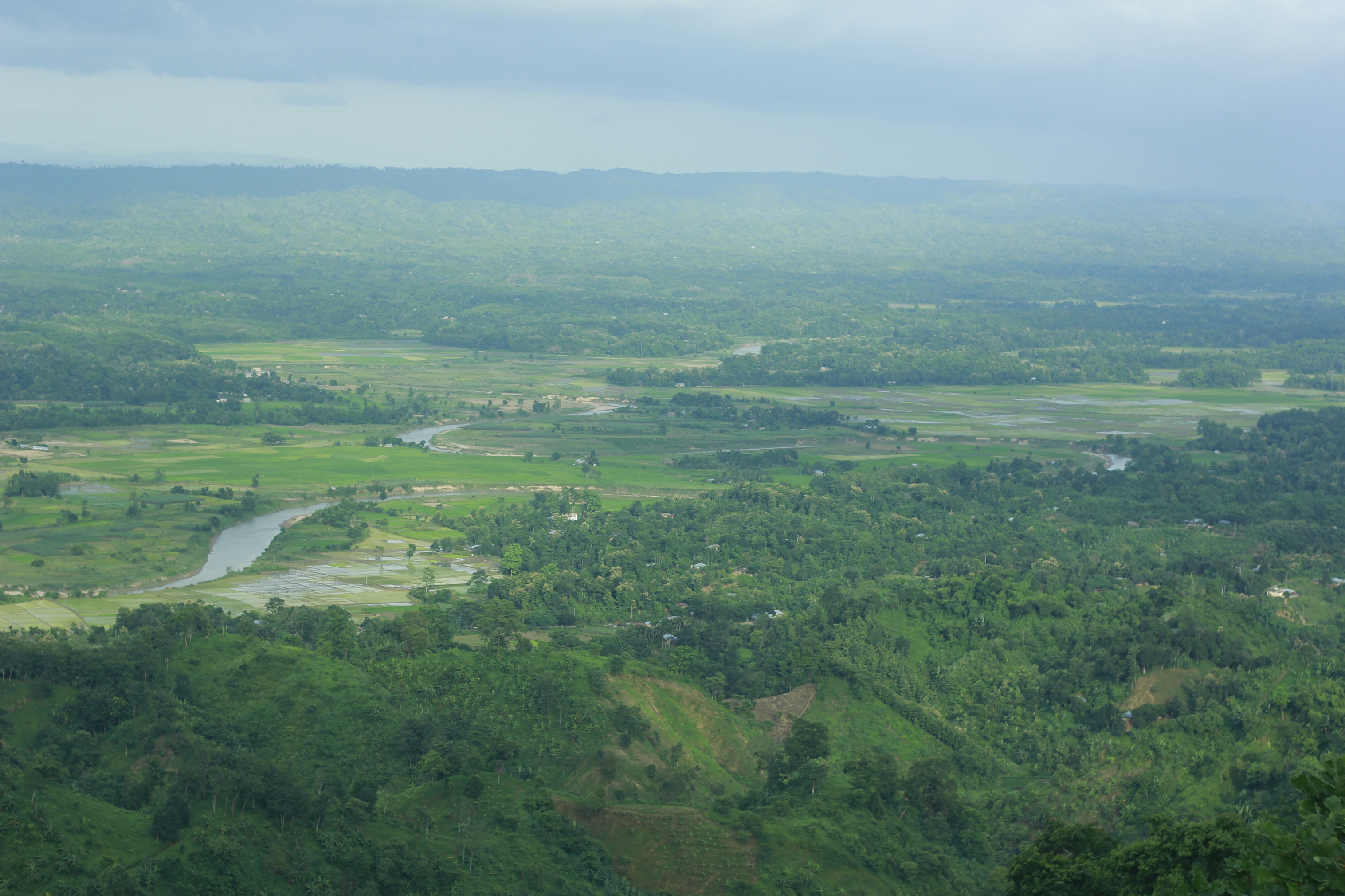
Khagrachhari Hill District lies in Chittagong Division and is part of the Chittagong Hill Tracts. According to Banglapedia it covers 2,505.73 square kilometres and is bounded by the Indian state of Tripura on the north, Rangamati district on the east, Rangamati and Chittagong districts on the south, and Chittagong district and Tripura on the west. Its notable hill ranges include Golamoon, Chotto Panchari, Karmi Mura, Lutiban, Kuradia, Bhanga Mura and Jopisil, and its rivers include the Chengi, the Feni and the Maini. Khagrachhari was one of the three subdivisions into which the Chittagong Hill Tracts were divided in 1900, and it became a district in 1983.
The 2022 census counted 714,119 people in the district, of whom 349,390, or 48.93 percent, belonged to indigenous communities. The largest of these groups were the Chakma (175,165), the Tripura (98,500) and the Marma (74,210).
Matiranga is one of the district's upazilas and lies on the border with Tripura, which bounds it on the north and the west. It covers 404.75 square kilometres and had 126,609 people in the 2022 census, of whom 30,257 belonged to indigenous communities, mostly Tripura (23,647), along with Chakma (3,950) and Marma (2,621). Gumti, where the loris was found, is one of its unions. Banglapedia lists the Gumti, the Pilac and the Feni among the upazila's rivers, and notes that Matiranga thana, now an upazila, was formed in 1980.
Farming is the main livelihood: Banglapedia gives agriculture as the main source of income for 60.50 percent of the upazila's people. Its main crops are paddy, rubber, sugarcane, potato, maize, cotton, arahar (pigeon pea) and vegetables, and its fruits include jackfruit, banana, mango, litchi, papaya, lemon and pineapple.
The law protecting the loris in May 2026
At the time of the rescue the animal was protected by the Wildlife (Conservation and Security) Act, 2026, Act No. 86 of 2026, dated 10 April 2026 on the government's Laws of Bangladesh website. It replaced the Wildlife (Conservation and Security) Act of 2012. The new framework first came as an ordinance: the interim government's advisory council approved the Wildlife (Conservation and Security) Ordinance in early December 2025, Prothom Alo reported on 6 December 2025, and the ordinance was published in the gazette on 7 January 2026, the state news agency BSS reported. It was then enacted as the 2026 Act.
The Act's Schedule 1(kha) names the Bengal slow loris, together with macaques, langurs and other mammals. Under section 41(3) no one may hunt an animal listed in Schedule 1(kha). The penalty is up to three years in prison or a fine of up to Tk 3 lakh or both, rising to up to five years or Tk 5 lakh or both for a repeat offence. Section 46 makes this offence cognizable and non-bailable. Under the 2012 law, Prothom Alo noted, only the killing of tigers and elephants was non-bailable; the new law extended this to about 250 species.
Section 10 bars anyone from rearing, keeping captive, possessing, buying, selling or transporting a wild animal without a licence, possession certificate or permit, and bans the sale of wild animals through social media advertisements or in markets. It declares all wild animals the property of the government and makes cruelty to wildlife a punishable offence. The law defines cruelty to include beating, teasing, blindfolding, needless captivity, frightening an animal, making it suffer in transport, killing it with an electric fence and publishing cruelty on social media. Breaking section 10 carries up to one year in prison or a Tk 1 lakh fine or both, and up to two years or Tk 2 lakh for a repeat offence.
Two sections deal directly with rescued animals like the Matiranga loris. Section 14 says that rescued, seized or captured wildlife must be released into a suitable natural environment, but may be kept captive if there is a risk of spreading disease or if it needs nursing. Section 34 allows the Forest Department to set up rescue centres to give wild animals treatment, food, shelter and security, and to issue guidelines for releasing them into the wild. BSS reported in January 2026 that the law also provides for a Wildlife Wing under the Forest Department, a Wildlife Trust Fund to pay for rescue, nursing and conservation, and the treatment centres and veterinarians that wildlife needs.
In April 2026 wildlife researchers told the television channel iTV that the law had to be enforced strictly and made widely known. Dhaka University zoology professor Firoz Zaman said that if offenders were punished and the public learned of it, other people would become more careful about harming wild animals.
Photo: Helena Snyder / Wikimedia Commons (CC BY-SA 3.0)
Sources: Jagonews24, Prothom Alo, BSS (Bangladesh Sangbad Sangstha), bdnews24.com, iTV, Laws of Bangladesh (Legislative and Parliamentary Affairs Division), Red List of Bangladesh (IUCN Bangladesh, 2015), Mongabay India, Zoologia (Al-Razi, Maria and Muzaffar, 2019), Banglapedia, Wikipedia
Comments
(0)