
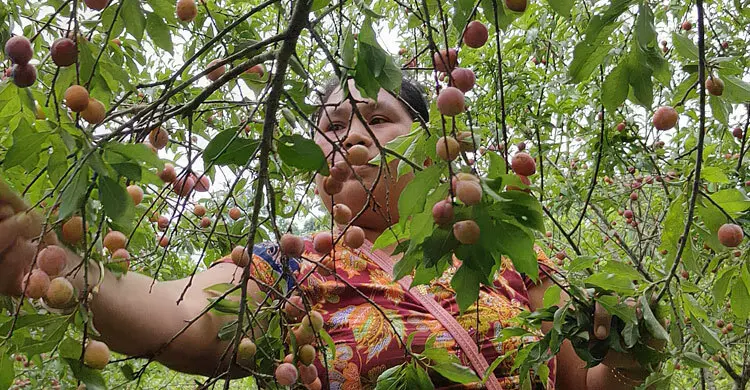
Aloo bukhara, a spice crop, is showing new promise in the hill district of Khagrachhari, known for ginger, turmeric, banana and jackfruit. Khagrachhari farmer Mrasathoai Marma has succeeded in growing aloo bukhara for the first time, and many others are now turning to the crop.
Yet although success beckons for the Arabian fruit in the hills, Mrasathoai Marma is frustrated. He has called for training in processing aloo bukhara, and believes farmers would profit from selling the crop if they were given advice and training.
Around 2019 he planted 120 aloo bukhara saplings under the Chittagong Hill Tracts Development Board's mixed spice cultivation project. He grows a high-value crop but does not know how to process it, and the fruit is going to waste under the trees in his orchard.
An imported fruit
Aloo bukhara is essentially a foreign fruit. It is used to make polao, biryani, roasts, salads, jam, jelly, pickles, borhani and other fine dishes. In Bangladesh it is usually imported from India. Improved varieties were developed in south-eastern Europe in the 17th century, and it is now widely grown in cold and mildly warm areas around the world.
It goes by different names in different countries; in Bangladesh and India it is called aloo bukhara. The BARI Aloo Bukhara-1 variety, developed at the Spice Research Centre of the Bangladesh Agricultural Research Institute (BARI), was approved in 2013-14. The tree is medium-sized, five to six metres tall.
Demand in Bangladesh is high and the fruit is imported every year to meet it, but because farmers do not know how to process it properly, aloo bukhara is being wasted in the orchards.
Call for training
Noting that the country depends on imports, Mrasathoai Marma said: "Since it can be grown in our hills, the country's money can stay in the country. Ordinary farmers must be trained and made skilled in processing. Then farmers will profit economically while meeting the country's demand." He also believes this would reduce dependence on imports.
According to agriculturists, the hill climate is very suitable for aloo bukhara. Growing it on fallow hill land would raise productivity, and it can also be grown in home yards. It boosts immunity and is valued for its high nutritional value, aroma and medicinal qualities.
Md Altaf Hossain, chief scientific officer of the Khagrachhari Hill Agricultural Research Centre, spoke of the crop's wide potential in the hills. "It starts bearing fruit from three years of age. The BARI-1 aloo bukhara variety developed by the agriculture department will be spread among farmers in stages. Then we will not need to import aloo bukhara." Farmers will be given the training they need to market and process aloo bukhara, the agriculturist said.
Source: Jagonews24. First published in Bengali on The Agro News.

Comments
(0)