
Kenyan farmers want about 120,000 day-old chicks of improved indigenous chicken breeds every month, but supply covers only about a quarter of that, roughly 30,000 chicks a month, according to the International Livestock Research Institute (ILRI). The Kenya Agricultural and Livestock Research Organization (KALRO) bred three popular improved breeds, KC1, KC2 and KC3, yet getting enough chicks to farmers remains the problem.
KALRO has largely kept production and distribution in its own hands, and an earlier attempt to bring in other multipliers ran into quality-assurance problems. "You can have a very good innovation, a very good breed, vaccine, feed, but as long as it fails to achieve impact, then you can't say this is a successful innovation," said Ijudai Jasada, a scaling expert at ILRI.
When ILRI, KALRO and public and private partners looked at the chick shortage in May 2026, they concluded that the answer was a different division of labour rather than simply more birds. KALRO would protect the breeds' genetic integrity and quality, while private hatcheries, multipliers and mother units expanded production, backed by certification and traceability, county governments, cooperatives, feed suppliers, lenders and extension services. Jasada calls it "controlled decentralization", and says delivery models, financing and quality assurance should be planned while an innovation is still being developed, not after.
The same lesson ran through the second ministerial deep dive on livestock at the Africa Food Systems Forum 2026 in Kigali. "Africa's livestock priority is no longer recognition. It is delivery," said Professor Lindiwe Majele Sibanda, co-chair of the Food Planet Prize.
Animal health shows a similar gap. Mucai Kunyiha, group chief executive of CKL Africa, which makes and distributes animal-health products including vaccines in East Africa, said a product needs regulatory approval, evidence of safety and efficacy, financing and distribution before it reaches an animal, and that temporary vaccination campaigns do not solve a farmer's continuing problem. Under Kenya's devolved system, he said, one county may vaccinate while its neighbour does not, though disease ignores county boundaries.
Farmers' perceptions matter too. Kunyiha recalled an antibiotic combined with a painkiller that some livestock keepers judged useless because their cows no longer kicked when injected. ILRI says its 2024-2030 strategy is built on developing livestock solutions together with the policies, partners and investment needed to put them to work. The article was written by Wangari Maru.
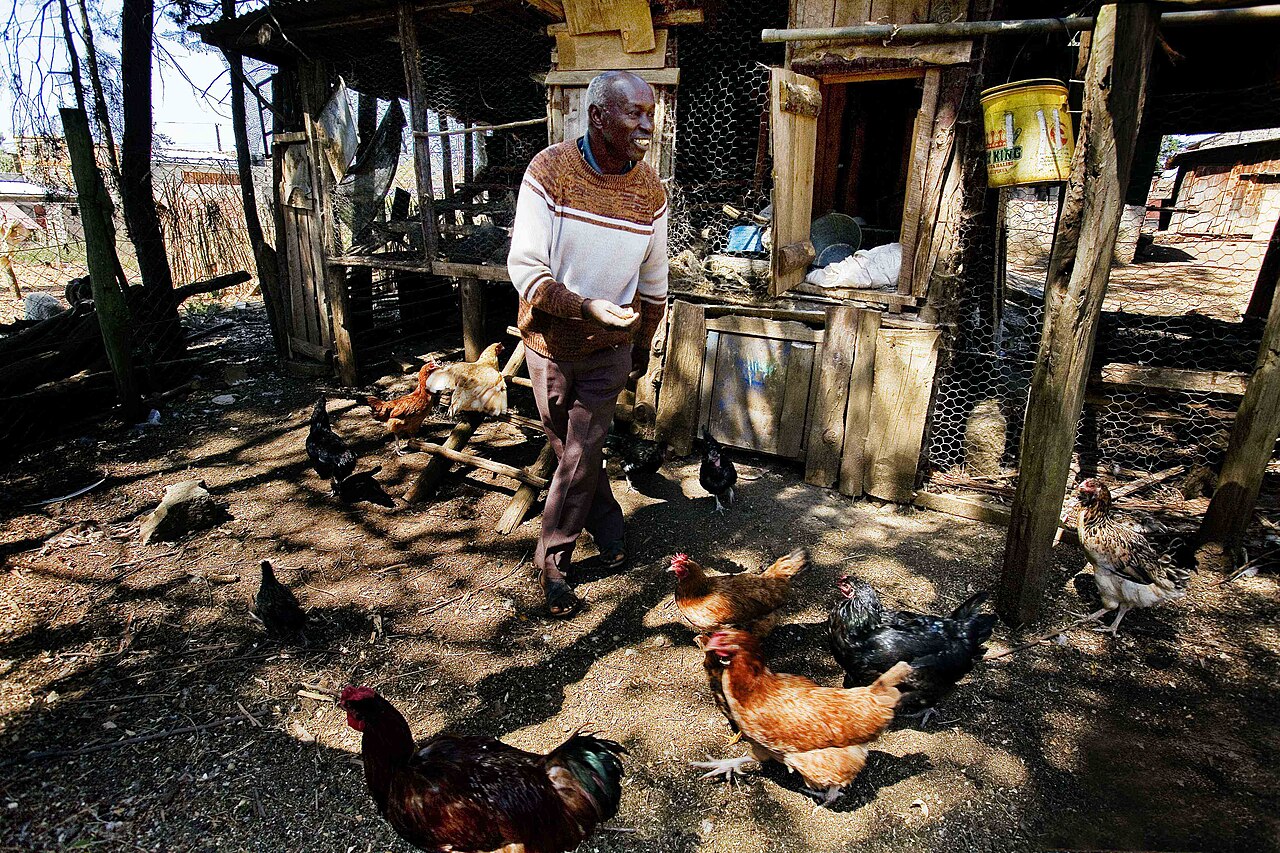
Photo: Francis Kimani Kibogi feeds his hens on his farm near Gilgil, Kenya, Kate Holt / AusAID / Wikimedia Commons (CC BY 2.0)
Source: ILRI
Comments
(0)