
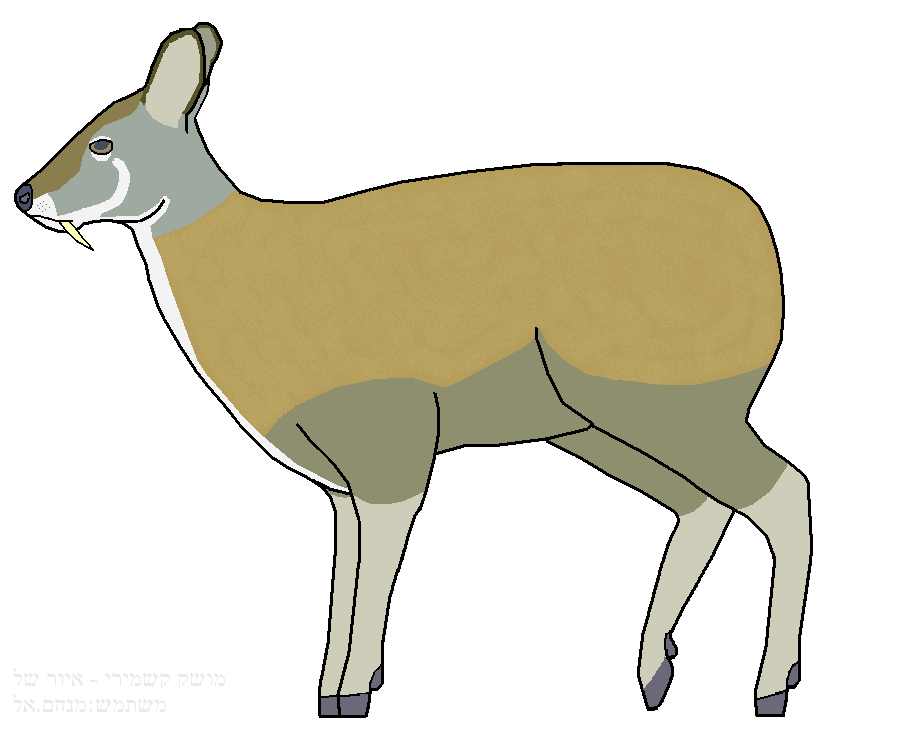
Climate change could take away most of the habitat left to the endangered Kashmir musk deer and cut the routes between its remaining patches, a new study from the Kashmir Himalaya has found. Under a very high-emissions scenario, suitable habitat could fall by 82.6% by the end of the century, Mongabay India reports.
The researchers, from the Department of Wildlife Sciences at Aligarh Muslim University (AMU), ran camera traps in five landscapes of the Kashmir Valley. Their final dataset had 184 stations; musk deer were detected at 90 of them, in more than 1,500 independent events. They combined these records with environmental data and modelled habitat for 2011-2040, 2041-2070 and 2071-2100 against a 1981-2010 baseline, under lower (SSP1-2.6), high (SSP3-7.0) and very high (SSP5-8.5) emissions.
At baseline the model found 5,003 sq km of suitable habitat, 22.4% of it inside protected areas. Under lower emissions the area stayed broadly the same. Under high emissions it first grew to 6,606 sq km, then shrank to 3,701 sq km by 2100. Under very high emissions it fell to 871 sq km by 2071-2100, and only 11.7% of what remained lay inside protected areas.
Connectivity suffers too. Potential corridors fell from 3,366 sq km to 1,653 sq km under the late-century very high-emissions scenario, a 50.9% cut, and movement could become harder between 161 of the 171 pairs of protected areas assessed. "Populations may still persist in individual refugial patches but become increasingly isolated," said Orus Ilyas, a professor at AMU and a co-author.
The refuges most likely to last lie mostly outside reserves. Areas suitable in all nine future projections covered 819 sq km, of which only 99 sq km (12.1%) is protected. Overa-Aru in Anantnag district and Thajwas-Baltal in Ganderbal stood out as refuges, while Kazinag mattered mainly as a corridor, with 65 sq km of reserve-level corridor area.
The deer, a small antlerless mountain species of the western Himalaya, is already threatened by poaching for its musk gland, habitat loss and disturbance. Mohsin Javid, the study's corresponding author, said the maps show relative suitability rather than exact forecasts, since elevation, forest cover and the human footprint were held constant, and that protecting the deer means protecting the wider Himalayan ecosystem and the communities that depend on it.
Photo: מנחם.אל / Wikimedia Commons (CC BY-SA 4.0), an illustration of the Kashmir musk deer
Source: Mongabay India


Comments
(0)