
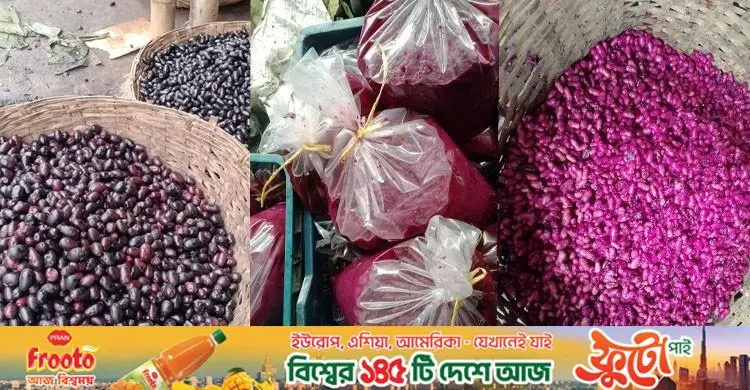
Dawn has not yet fully touched the city, but the day's bustle has already begun at Dhaka's Karwan Bazar. Black-purple jamun (black plum) is piled in bamboo baskets. In one place people are sorting ripe fruit by hand; in another, the fruit is being pressed into deep purple juice. A little further off is another sight: a basket full of pink-coloured seeds. Up close it becomes clear: bags of jamun juice are being stacked on one side and seeds collected on the other, as if one fruit had two different fates. The juice travels abroad, while the seeds stay in the country. But the seeds are not waste either; a separate market has grown up for them too.
Every monsoon, truckloads of jamun come to the capital from orchards in Rajshahi, Natore, Jashore, Kushtia, Meherpur and the hill districts. To most people, jamun means a seasonal fruit or a roadside sherbet. But in one part of Karwan Bazar the fruit has another identity: it is raw material, a business and a chain of labour.
Tonnes of fruit every day
Traders at Karwan Bazar say 8-10 tonnes of jamun arrive here every day. Part of it is sold directly as fruit. After market sales, juice is extracted from roughly 2 tonnes of jamun a day, more or less. That juice then goes to juice manufacturers, wholesalers or exporters.
While most of the city sleeps, preparations for another day begin at Karwan Bazar. Time runs by different rules here: demand for goods, not the city's clock, sets the hours. The busy work starts at 4am. Some unload baskets from trucks, some wash the fruit, some press out juice and some pack it. The work goes on past noon into the evening and sometimes into the night.
From fruit to juice
The jamun is first sorted. Good, ripe fruit is set aside and spoilt or overly soft fruit removed. Then it is washed, pressed for juice and strained. Once the juice is separated, the seeds and pulp are left behind. Huge baskets of purple-stained seeds look as if someone had poured paint over them, though the colour comes from pressing hundreds of kilograms of jamun. The pile of seeds seems to show how much fruit went into each bag of juice.
The packed bags of dark purple juice are stacked in boxes one after another. According to traders, a large part goes to juice manufacturers or exporters. As demand for Bangladeshi fruit grows in the Middle East and other countries, the market for such processed products is expanding. Besides expatriates' attachment to local fruit, jamun juice has also found demand among health-conscious consumers. The seasonal fruit is no longer confined to the domestic market; in processed form, it is finding a place in international markets.
A market for the seeds
Many people once regarded jamun seeds as waste; after juicing they were thrown away or left to rot. That is starting to change. Traders say jamun seeds now sell too. The seeds are dried and ground into powder, which fetches quite a good price in the domestic market. There is demand for jamun seed powder in particular as a herbal ingredient for controlling diabetes. So a part that was once neglected is now gaining economic value, and nearly every part of the fruit is creating new opportunities.
The workers behind it
The quietest partners in the whole operation are the workers. The morning market comes alive in their hands, and the day's work ends in their hands too. Hour after hour, jamun sap stains their hands and feet black. Standing or sitting for long periods leaves many exhausted. But this seasonal work also gives many workers a chance of extra income.
Looking at a basket full of seeds, it seems another unseen story lies inside the market: workers' stained hands, wet floors, people standing at work for hours, and the history of a fruit's transformation. When we buy a bottle of jamun sherbet from a shop, or hear success stories of fruit sent abroad, we may not think of these seeds, or of the labour that goes on in the lanes of Karwan Bazar from dawn until night.
The jamun juice reaches foreign countries, but the people behind it rarely reach the conversation. Like the seeds, they often remain out of view. Yet this unseen work in the city survives in their hands.
Source: Jagonews24. First published in Bengali on The Agro News.
Comments
(0)