
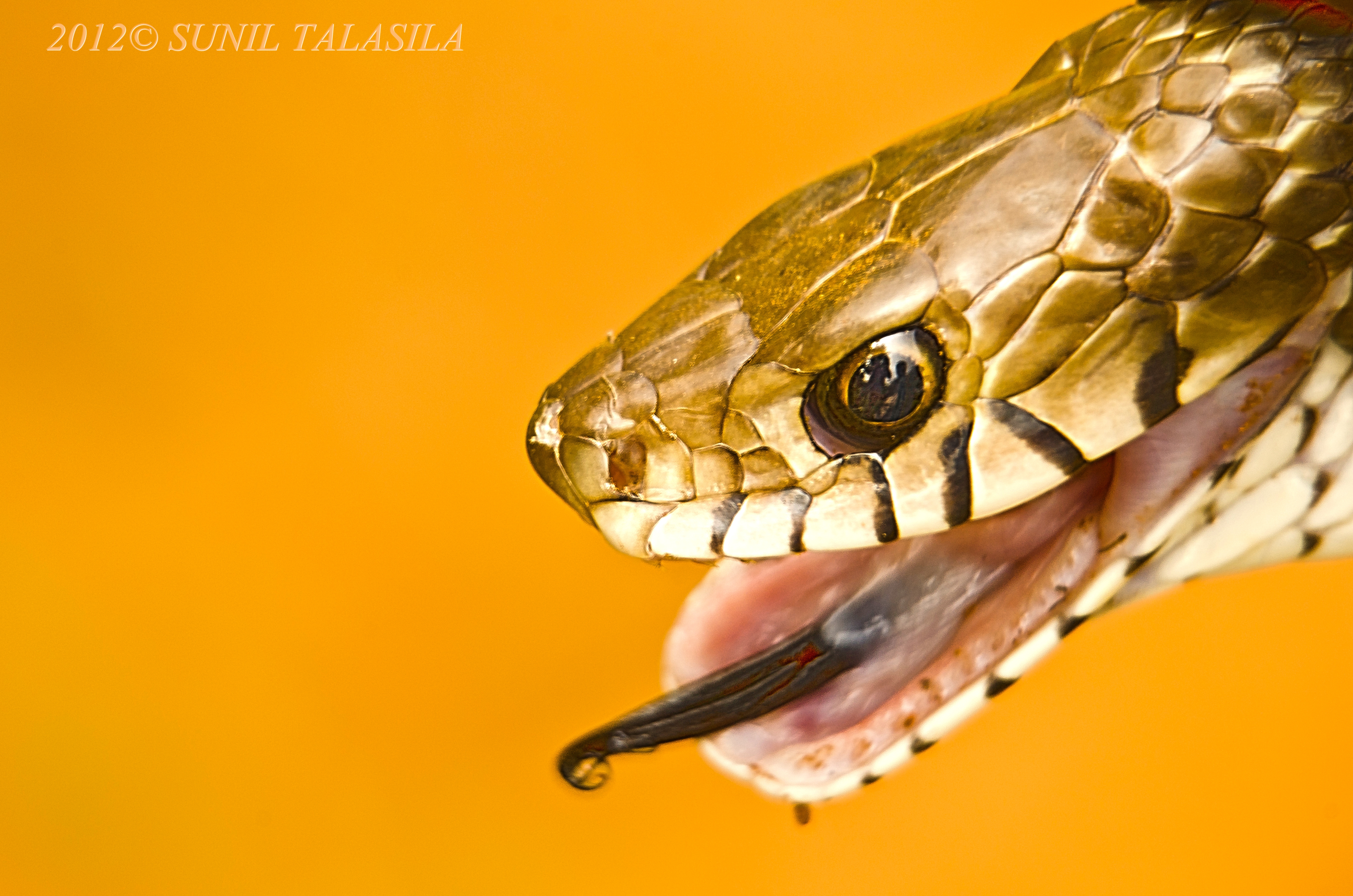
Volunteers of the Kalapara branch of Animal Lovers of Patuakhali rescued a six-foot rat snake and a one-and-a-half-foot kalnagini (ornate flying snake) from two homes in Kalapara upazila of Patuakhali on the morning of Tuesday, 5 May 2026. Both snakes were injured, and they were taken to the upazila livestock office for treatment, Jagonews24 reported that afternoon.
The rat snake, known in Bengali as darash, was found tangled in a net at the home of farmer Nilkanta in Pakhimara village of Nilganj union. On the same day the kalnagini was rescued from the house of Masud Molla in West Senatala village. The rescuers described the dark-brown rat snake as completely non-venomous and the kalnagini, red and black banded with a green and yellow sheen, as mildly venomous.
What the rescuers and the livestock office said
Bayzid Ahsan, team leader of the organisation's Kalapara branch, told Jagonews24 that the team went to the spot quickly after receiving word on its hotline and rescued the two snakes. Because they were injured, he said, they had been given first aid, and once they recovered they would be released into a protected forest.
Md Ali Ahsan, the sub-assistant livestock officer, told the paper that the two snakes were under observation and receiving the necessary treatment, and that they would be released into their natural habitat after they recovered. The report did not describe the snakes' injuries or say how they had been hurt, and it gave no date for the release.
The upazila livestock office belongs to the Department of Livestock Services (DLS), the government department responsible for veterinary coverage, development and extension services for livestock and poultry. Its work began in 1893 with a Civil Veterinary Department under the British government; after several reorganisations it was named the Directorate of Livestock Services in 1960, and its head office is at Pasusampad Bhaban in Farmgate, Dhaka, according to Banglapedia.
The rat snake, a common snake of villages and fields
The rat snake (Ptyas mucosa), called darash or dhaman in Bangladesh, is a common non-venomous snake of the family Colubridae, Banglapedia says. It occurs in two colour forms, light or yellowish brown and olive brown. It is usually under 2 metres long, though large ones can reach 3 metres. It climbs trees well, dives and swims, and moves fast. It will eat any animal it can manage, but prefers rats, mice, frogs and toads, and it begins swallowing its prey as soon as it seizes it. A female lays nearly a dozen sticky eggs, which hatch in about two months.
The species ranges across South and Southeast Asia, from Afghanistan and Iran through Pakistan, India, Nepal, Bangladesh and Myanmar to southern China, Taiwan and Indonesia. Typical adults measure 1.5 to 1.95 metres and some exceed 2 metres; the record is 3.7 metres. Its colour runs from pale brown in dry regions to nearly black in moist forest. It is active by day, partly tree-dwelling, and lives on forest floors, in wetlands, rice paddies, farmland and suburbs, where it hunts small reptiles, amphibians, birds and mammals. The International Union for Conservation of Nature (IUCN) lists it as Least Concern.
Two habits often put the rat snake in danger near people. When threatened, an adult growls and inflates its neck, which may be mimicry of the cobra, and the harmless snake is then mistaken for a venomous one and killed. Banglapedia makes the same point for Bangladesh: the rat snake is often taken for a cobra and killed, although its head is much narrower than a cobra's and it has no hood. The second habit is the 'combat dance' between rival males, in which two snakes twist around each other with their bodies partly raised. Banglapedia notes that many villagers wrongly believe this to be a cobra mating with a rat snake.
The snake's skin has long had commercial value. Banglapedia says rat snake skin has a high value in trade and its meat is eaten in Korea and China. Elsewhere in its range, the wildlife trade monitoring network TRAFFIC reported in April 2011 that large numbers of oriental rat snakes were being harvested and exported from Indonesia outside government rules, with quotas widely flouted.
The kalnagini, a snake that glides between trees
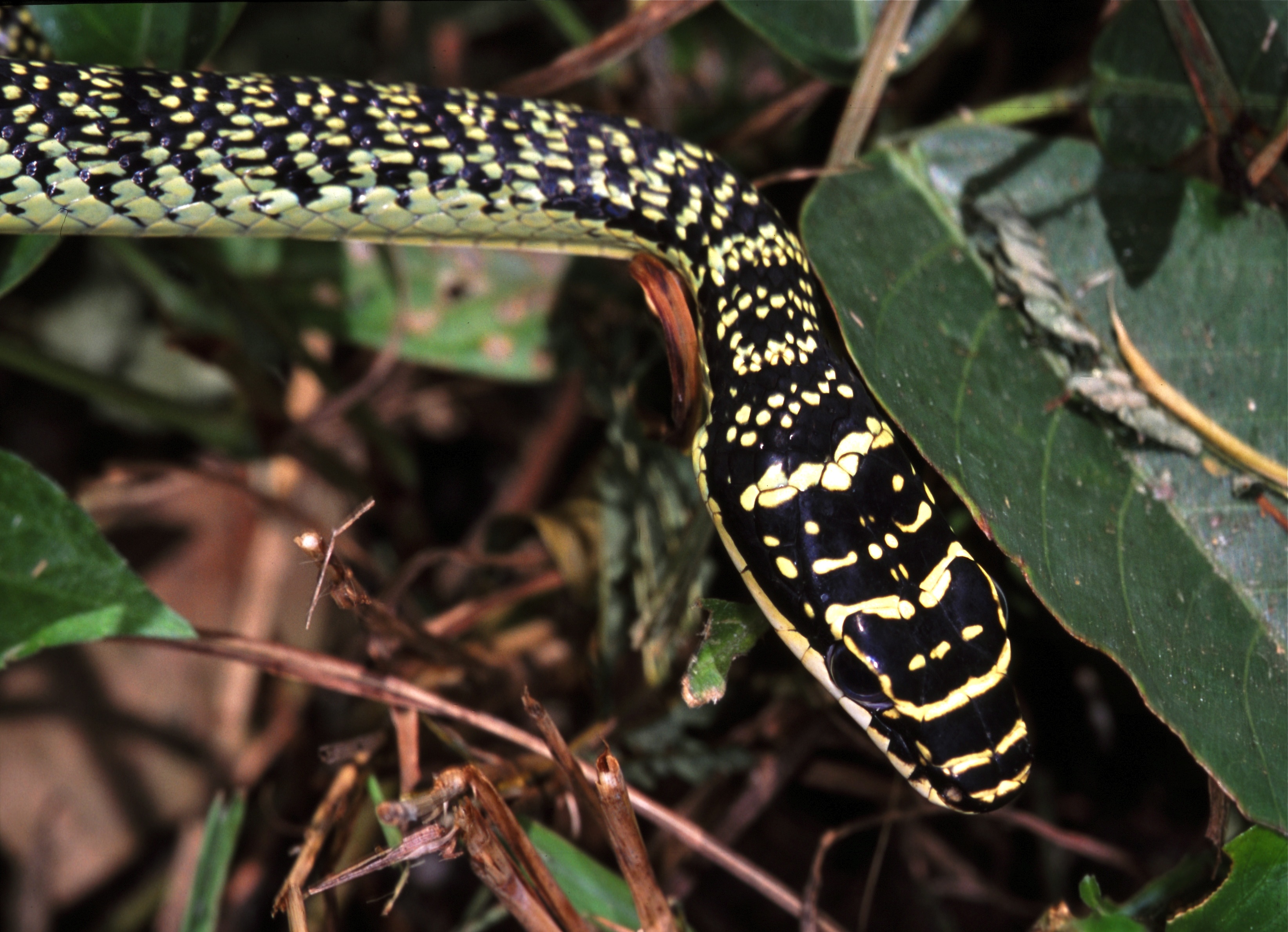
The kalnagini is the ornate flying snake or golden tree snake, Chrysopelea ornata. It is a slender tree snake found in South and Southeast Asia, from India, Sri Lanka, Nepal and Bangladesh to Myanmar, Thailand, Malaysia, Laos, Cambodia, Vietnam and southern China. The subspecies C. o. ornatissima lives in north and east India, Nepal, Bangladesh and Southeast Asia. Its Bengali names include kalnagini, uronto sap, sundari sap and kalsap. It is usually green with black cross-hatching and yellow or gold markings, has a flattened head, a blunt nose and large eyes, and measures from 11.5 to 130 centimetres; it matures at about one metre.
The snake does not truly fly. It climbs high, launches itself, pulls its belly inward to form a concave surface along its body and glides, undulating through the air, from one tree to another or down to the ground; glides of as much as 100 metres have been recorded. Banglapedia describes the kalnagini as able to glide from higher branches to lower ones. It is active by day, hunts lizards, bats and small rodents, and may also take bird eggs and insects. It lays six to twelve elongated eggs.
Whether the kalnagini should be called venomous has been described in different ways. The Kalapara rescuers called it mildly venomous. Banglapedia places it among the rear-fanged colubrid snakes of Bangladesh that are generally considered mildly poisonous, and says the bites of such snakes are usually not fatal to people. The reference literature on the species says its venom is meant to subdue fast-moving prey in trees and is not considered dangerous to humans, although the snake does not hesitate to bite if handled. In June 2025, Zohra Mila, a wildlife and biodiversity conservation official of the Bangladesh Forest Department, told RTV that the kalnagini is non-venomous and calm and seldom bites unless greatly disturbed. She said it breeds mainly from March to July and lays six to twelve eggs that hatch after about two months, and that dramas and films had portrayed it as a deadly snake, so people often kill it on sight.
Snakes, rats and the farmer's crop
For farming households the rat snake's diet matters. Banglapedia's entry on snakes says several non-venomous species that live close to people, among them the rat snake (dadash), the trinket snake (dudhraj), the python (golbahar), the balu boda and the wolf snake (gharginni), are useful for the biological control of rats and mice, and that snakes as a whole eat a huge number of live animals each year that are usually considered pests of crops.
Rats are among the costliest of those pests in Bangladesh. In October 2017, officials of the Department of Agricultural Extension (DAE) told The Financial Express that rats alone ate nearly 4 per cent of the country's annual food grains and vegetables, some 1.5 million tonnes, at a time when annual cereal production stood at 37.266 million tonnes and vegetable output at 3.06 million tonnes. DAE deputy director Deb Dulal Dhali called rats a threat to the country's food security system.
The damage was still being reported in the season before the Kalapara rescue. In March 2024, bdnews24.com reported that the DAE in Tungipara upazila of Gopalganj had begun a rat-killing drive to protect Boro rice, offering farmers 10 taka for every rat tail handed in at the upazila agriculture office. Farmers there said rats were cutting the base of the rice plants and that poisoned bait, traps and polythene barriers had not stopped them.
Kalapara: a coastal upazila of farms, rivers and forest
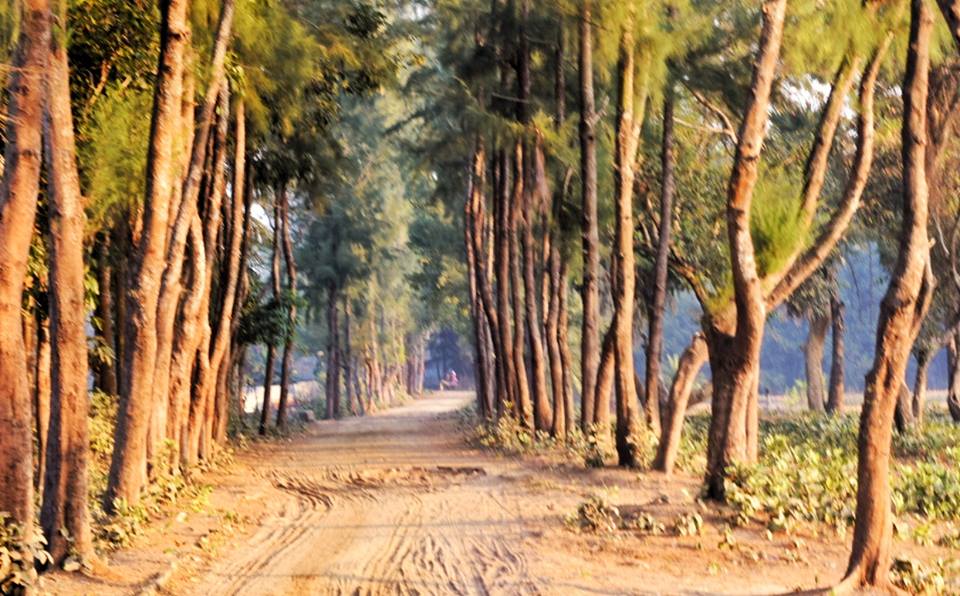
Kalapara is the southernmost upazila of Patuakhali district in Barishal division. Banglapedia gives its area as 491.89 square kilometres, bounded by Amtali upazila to the north, the Bay of Bengal to the south, and the Rabnabad Channel and Galachipa upazila to the east. Its main rivers are the Andharmanik, the Nilganj and the Dhankhali. Kalapara thana was formed in 1921 and became an upazila in 1983. The upazila sadar is known as Khepupara.
The 2022 census counted 286,993 people in Kalapara. The upazila has two municipalities, Kalapara and Kuakata, and twelve unions, one of them Nilganj, where the rat snake was found. Agriculture is the main source of income for 57.23 per cent of households, according to the census figures Banglapedia cites, and paddy, pulses, potato and vegetables are the main crops. Paddy, hilsa and dried sea fish are its main exports. The upazila also has shrimp farms, dairies, poultry farms and hatcheries, and its history includes devastating cyclones in 1822, 1960 and 1979.
At the southern tip of the upazila lies Kuakata, with an 18-kilometre beach from which both sunrise and sunset can be seen. Nearby is Kuakata National Park, declared by the government on 24 October 2010 to conserve plants, animals and nature and to develop tourism. It covers 1,613 hectares and is one of the areas declared safe zones for vultures. Banglapedia also lists a mangrove at Fatrar Char, tamarisk groves and the coconut-lined Narikel Bithi among Kalapara's sights.
Earlier rescues by the same volunteers
Animal Lovers of Patuakhali is an organisation that rescues wild animals in the district and returns them to the wild, in several of the reported cases together with the Forest Department. Reports published in the year before May 2026 show its Kalapara branch dealing with snakes found in homes:
- On 17 June 2025, members rescued two kalnagini snakes, each about two feet long, from the house of farmer Jabbar Munshi in Ditta village of Chakamaiya union in Kalapara. As the snakes were not hurt, they were released into the protected forest in Ditta village in the presence of the upazila's assistant commissioner (land), RTV reported. The branch's team leader told RTV that kalnagini are not harmful to people and that many non-venomous snakes are killed out of misunderstanding.
- On 21 August 2025, a monocled cobra (padma gokhra, Naja kaouthia) about four feet long was found caught in a net in the yard of a house in Hossainpara of Kuakata municipality. The organisation's rescue team, local environmental workers, municipal staff and the Forest Department rescued it and released it, Jugantor reported. K M Moniruzzaman, the Forest Department's Mohipur range officer, said that although the monocled cobra is one of the most dangerous venomous snakes of the country, it usually avoids people, and that killing snakes out of ignorance harms the environment.
- On 23 August 2025, the organisation's wildlife rescuers took a rare crab-eating water snake (painna) of about two feet from the eastern side of Kuakata beach and released it with the coastal environment group UPORA, municipal workers and the Forest Department, BSS reported. The head of its rescue and release wing, Asadullah Hasan Musa, said the species is mildly venomous but not a risk to people.
- In October 2025, the Kalapara branch rescued a wolf snake (ghorginni) of more than a foot and a half from a house near the fish market in Kalapara town at night and released it into the protected forest the next morning, Manobkantha reported. The branch's team leader said the snake was non-venomous and asked people who see a snake not to panic or kill it but to inform the organisation.
The cobra in Kuakata, like the rat snake in Pakhimara, had become caught in a net at a home, a situation the rescuers have met more than once in the coastal villages.
What the wildlife law said on the date
On 5 May 2026, wild animals in Bangladesh were protected by the Wildlife (Conservation and Security) Act, 2026, Act No. 86 of 2026, dated 10 April 2026 and deemed to have taken effect on 7 January 2026. Section 54 of the Act repealed the Wildlife (Conservation and Security) Act, 2012, while allowing cases already filed under the old law to be settled as if it had not been repealed. The preamble cites Article 18A of the Constitution, which makes the conservation of biodiversity, forests and wildlife a duty of the state.
Both rescued species appear in Schedule 2 of the Act, published in the Bangladesh Gazette of 10 April 2026: the Indian rat snake (Ptyas mucosa) and the ornate flying snake (Chrysopelea ornata) are listed among the colubrid snakes. The provisions that bear on a rescue like the one in Kalapara, as published on the government's Laws of Bangladesh website, are these:
- Section 2 defines hunting widely: killing, catching or poisoning a wild animal, chasing it for any of those purposes, injuring or harming it, or collecting or destroying the nests or eggs of wild birds or reptiles.
- Section 42(1) bars anyone from hunting an animal listed in Schedule 2 without a licence or permit. Under section 44 the penalty is up to one year in prison, a fine of up to 100,000 taka, or both, and for a repeat offence up to two years, a fine of up to 200,000 taka, or both.
- Section 10 bars anyone from keeping, rearing or holding a wild animal in captivity, or possessing, buying, selling or transporting one, without a licence, possession certificate or permit, and makes cruelty to a wild animal an offence. Cruelty includes beating, teasing, needless confinement, frightening an animal and publishing cruelty on social media.
- Section 14 says rescued, seized or captured wild animals must be released into a suitable natural environment, but allows them to be kept in confinement if there is a risk of spreading disease or if they need nursing.
- Section 34 allows the Forest Department to set up rescue centres to give wild animals treatment, food, shelter and security, and section 4(2) asks the government to arrange enough treatment centres and doctors for the welfare of wildlife.
The plan described by the rescuers and the livestock officer in Kalapara, first aid and observation while the snakes were injured and release into a forest after recovery, follows the course section 14 sets out.

Snakes and snakebite in Bangladesh
Banglapedia counts about 90 species of snakes in Bangladesh, more than three quarters of them non-venomous, and says fewer than half a dozen land snakes are highly venomous. A Dhaka Tribune report of July 2023 put the number at about 98 species, 31 of them venomous. Among the most common snakes Banglapedia lists the checkered keelback, the striped keelback, the wolf snake, the kukri snake, the trinket snake, the rat snake, the python, the cobra and sea snakes. The cobras and kraits (family Elapidae) and the vipers are the truly dangerous groups, and of these the cobra (gokhra) and the krait (keutey) live close to people.
Snakebite is a serious public health problem in the country. The Directorate General of Health Services (DGHS), in its National Survey on Annual Incidence and Epidemiology of Snakebite in Bangladesh, estimated that more than 400,000 people are bitten by snakes each year and that at least 7,511 die, four to five deaths a day, the Dhaka Tribune reported in July 2023. About 244 of every 100,000 people are bitten by venomous snakes each year, and 95 per cent of victims live in villages, the report said.
Photo: Suniltalasila / Wikimedia Commons (CC BY-SA 4.0)
Sources: Jagonews24, Banglapedia, Wikipedia, Bangladesh Laws (Wildlife (Conservation and Security) Act, 2026 and its schedules), RTV, Jugantor, BSS, Manobkantha, The Financial Express, bdnews24.com, Dhaka Tribune, TRAFFIC
Comments
(0)