
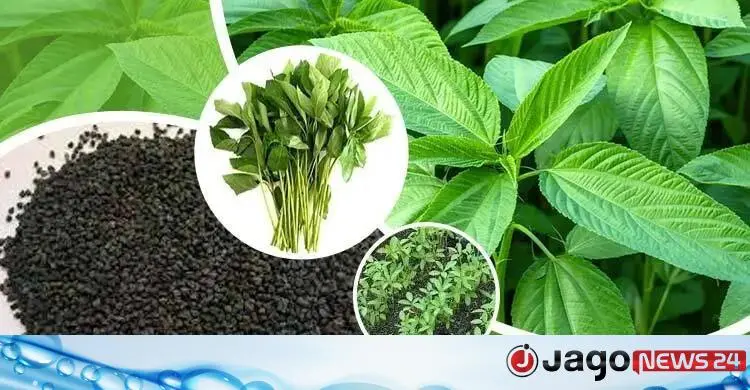
Shraban marks the end of the monsoon. New jute is not usually sown in Shraban; instead, mature jute plants in the field are cut, retted and stripped of fibre at this time. But deshi and tossa jute seed can be sown this month to produce good-quality seed.
Harvesting and retting
Jute should be cut when more than half the plants in the field have flowered. This gives better fibre quality and a good yield. For retting, tie the plants into bundles, let the leaves drop and then steep them. Once the jute has retted, arrange for the fibre to be stripped.
After stripping and washing the fibre well, dissolve one kilogram of tamarind in 40 litres of water and soak the fibre in it for 5 to 10 minutes; this gives bright-coloured jute. Where there is not enough water for steeping, jute can be retted by the ribbon retting method, which improves fibre quality and shortens retting time.
Sowing for seed
Floods often make it impossible to produce seed directly from jute plants. Instead, cut the tips or stems of jute plants and plant them on high ground, from which seed can be produced quite easily. Jute seed should be sown between the start of Shraban (mid-July) and the end of Bhadra (mid-September).
To get good jute seed, deshi jute seed should be sown this month. In line sowing, use 16 grams of tossa or 20 grams of deshi seed per decimal of land. In broadcast sowing, use 20 grams of tossa or 24 grams of deshi seed per decimal.
Seed from stem cuttings
In Shraban (mid-July), select the stems and tips of healthy, vigorous mother plants in the fibre crop that have not yet flowered but will flower soon. Cut them at a slant with a sharp knife or blade into pieces 20 to 25 centimetres (8 to 10 inches) long.
It is best to plant the cuttings on a cloudy day or in the late afternoon sun. Plant them in rows 30 centimetres (1 foot) apart, with 10 centimetres (4 inches) between cuttings. Bury about 5 centimetres (2 inches) of each cutting in the soil at a 45-degree angle, that is, at a slant.
Source: Jagonews24. First published in Bengali on The Agro News.

Comments
(0)