
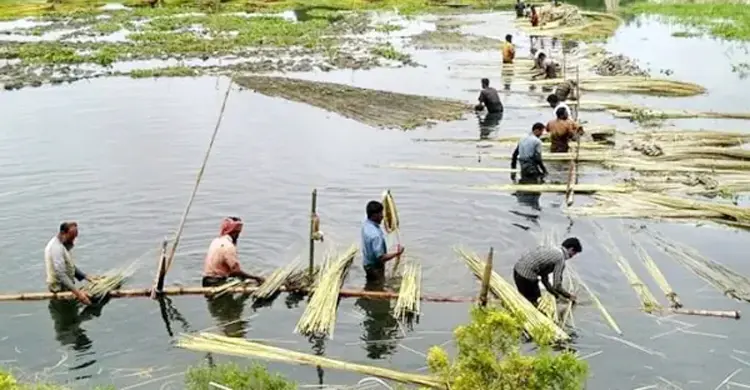
To get good jute fibre, the plants must be cut as soon as flower buds appear. After cutting, sort the thin and thick plants, tie them in bundles, strip the leaves and stand the bases in 1 foot of water for 3-4 days. Then ret them in clean water.
Very deep water is not needed for retting. It can be done in a field with 1 to 1.5 feet of water over grass. But if there are many plants, deeper water is needed so the bundles can be submerged.
If there is grass in the field, the jute plants do not touch the soil, so the fibre keeps a good colour. If there is no grass, some straw can be spread and the bundles retted on top. Covering the bundles with water hyacinth or straw is very good, but never weigh them down directly with soil.
Checking and washing
After retting starts, check the plants regularly so they do not over-rot. It is better to strip the fibre while floating in the water than on the ground, as this reduces the chance of soil and grit in the fibre. Then wash it in clean water.
If water is short or there is no place to ret, the bark can be retted instead of the whole plant, which also finishes rotting faster. Cut the top of a bamboo pole into the shape of the letter U, put the jute plant in the gap, and the bark can be stripped from the plant very easily.
The bark can then be retted in a tub or a square pit. If 5 grams of urea for roughly every 37 kg of bark is mixed into the water during retting, it rots even faster. Covering it with polythene or sacks for a week and then washing the base end again frees the fibre from the bark and improves its quality.
Drying and finishing
Washed fibre should never be spread on the ground to dry. It is better to dry it on bamboo racks, railings or roofs. Remember that high-quality fibre fetches the best price and always has buyers, while poor fibre that is over-retted, under-retted, faded, darkened, or has bark or sticks attached always sells for less.
Once the jute has rotted, arrange to strip the fibre. After stripping and washing it well, dissolve 1 kg of tamarind in 40 litres of water and soak the fibre in it for 5-10 minutes. This gives brightly coloured jute.
Where water for retting is scarce, jute can be retted by the ribbon retting method, which improves fibre quality and shortens retting time. Remember that the bark must be stripped as soon as the jute is cut, otherwise stripping will be difficult once the plants dry in the sun.
Source: Jagonews24. First published in Bengali on The Agro News.


Comments
(0)