
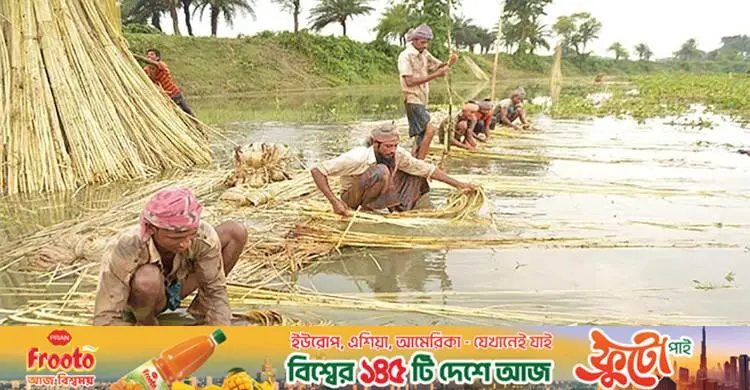
Land that grew other crops a few years ago is now largely under jute. Green jute plants cover the fields of Sharsha. In some places jute is being cut, in others bundled, and elsewhere farmers are getting ready to ret it. Favourable weather and the prospect of a good yield have raised farmers' interest in jute this year, but with production costs rising they fear they will not get a fair price.
Area up by 503 hectares
According to the Sharsha Upazila Agriculture Office, the area is well suited to jute: loamy soil, good quality and, in a favourable environment, little disease. With the agriculture department's encouragement and regular advice, free government-subsidised seed distributed through the department, and profits at low cost, jute has been grown on 503 more hectares this year than last. Last season the crop covered 5,000 hectares.
The upazila's loamy soil is well suited to jute, and the weather this year was also in its favour, so plants have grown well in many areas. Farmers hope for 10 to 16 maunds per bigha. The varieties grown include an Indian seed variety known as Krishi Sebain, and local and high-yielding varieties have been grown in different parts of the upazila. Many farmers took up jute because of the agriculture department's advice and free seed under government incentives, and they see it as profitable because there is demand for both jute and jute sticks.
Costs worry growers
Despite the good yield, production costs are a worry. Wages for cutting, bundling and retting have risen, as have fuel and transport costs. If the market does not give the expected price, farmers fear a loss instead of a profit.
Farmers say that higher acreage and output are not enough; a fair price for the jute they produce must also be ensured. If prices match production costs, they will be further encouraged to grow jute. The fields of Sharsha are now busy with harvest and the golden fibre is coming home, and farmers hope a fair price for their hard work will come with it. To sustain the rise in jute cultivation, a fair market price is now their biggest demand.
They say labour, wages, fertiliser and fuel are expensive: "We work ourselves to the bone to grow our crops and we do not get a fair price. If we do not, we will fall into debt. Our one demand of the government is that farmers get a fair price for their crops. The government should look to the farmers."
Abdul Halim, a jute farmer from Bagachra in Sharsha, said: "The jute yield is good this year. But cutting and retting jute costs a lot of money in labour, and fuel prices have risen too. All in all, production costs are much higher than before. If we do not get a good price in the market, the farmer will make no profit. Jute takes a lot of work, and there is one expense after another until the crop is home. If prices fall, all the farmer's toil will be in vain."
Jute farmer Rafiqul Islam said: "We grow jute with great hardship and spend a lot before the crop comes home. From sowing the seed to retting the jute, the cost of every job has gone up. If we do not get a fair price, farmers will fall into debt. Our demand of the government is that a fair price for jute and other farm produce be ensured, taking production costs into account."
Traders and jute sticks
Local trader Mozammel Hossain said that when supply rises at the start of the season, prices tend to fall. Farmers who have no way of storing jute are often forced to sell cheaply, so middlemen profit while the actual growers are denied a fair price.
Jute sticks bring extra income besides the fibre. They are used for fuel, house fencing, roofing and other purposes, so there is local demand, and they are also sent to other parts of the country. Even if jute prices are somewhat low, farmers try to make up losses by selling jute sticks, though they say it is hard to profit overall unless jute prices are stable.
Demand for jute sticks in local markets and other regions is also raising farmers' interest in the crop. They say jute would be more profitable if its market price held steady.
Sharsha Upazila Agriculture Officer Dipak Kumar Saha said: "This season jute seed has been distributed among farmers under government incentives. The Department of Jute is also giving farmers various kinds of support. If jute is retted properly after cutting, the fibre quality will be better and farmers will have the chance of a good price."
He said: "Farmers are being advised to use clean water for retting, to ret for the right length of time, and to wash and dry the fibre well after stripping. If they can produce quality fibre, demand and prices will stay good."
Source: Jagonews24. First published in Bengali on The Agro News.

Comments
(0)