
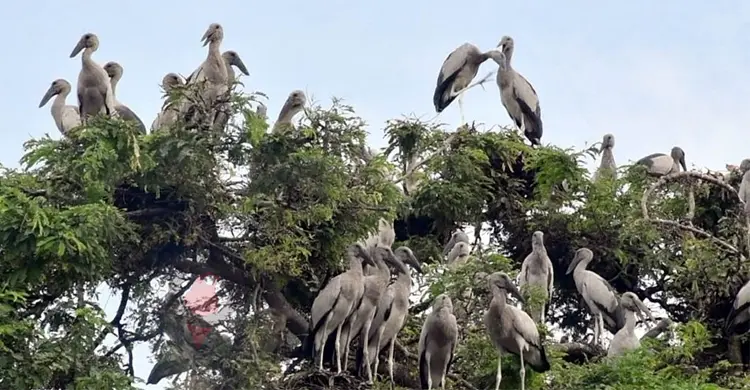
The rare Asian openbill (shamukkhol) has made its nests in Kanaipukur village of Khetlal upazila in Joypurhat, and the villagers guard the birds with deep affection. At a glance the trees seem to be covered in clusters of white flowers. The village's big trees have become their sanctuary, and the flapping of wings and the birds' chatter fill the village air. Their beauty stands out in the golden morning sun and the soft light of dusk.
The Asian openbill is found in Bangladesh, India and various countries of South and Southeast Asia. Its numbers have been falling steadily over the past few decades, and the report says the International Union for Conservation of Nature (IUCN) has therefore declared the species least concern. The species is protected under Bangladesh's wildlife law.
These birds form huge colonies where they live, flocking together in each large tree. If they have suitable habitat, weather, enough food and safety, they generally do not move. They nest on the high branches of large mango, shimul (silk cotton), banyan and peepal trees. They lay three to five eggs in July and August; the eggs take 25 days to hatch, and the chicks learn to fly at 30-35 days.
A colony of more than 10,000 birds
A visit found that more than a hundred trees around a pond owned by Abdus Samad Mondol and Sobhan Mondol in Kanaipukur village of Alampur union, 12 kilometres from Khetlal upazila town, have become a permanent sanctuary for thousands of birds of six species, including the openbill. Every afternoon thousands of openbills come to shelter in the trees, and the whole pond bank rings with their calls. Their wings flap all night. After a peaceful night they set out at dawn to search the nearby canals, beels and crop fields for insects, snails and mussels. With safe shelter and care, they go through everything here, from breeding to eggs, chicks and adulthood, so their numbers grow day by day.
The birds have lived in nests in the big trees around the pond for about 12 years. Thanks to safe shelter and people's affection, the number of birds in the village has now passed 10,000. The whole village protects the colony that has grown up on its land, and visitors come every day from far and near to see it.
Jahangir Mondol, Babu, Sohel Hossain, Rasel Ahmed and other locals said they wake each morning to birdsong and the sound of flapping wings. The rare openbill is seldom seen, so everyone works with the help of the local administration to care for the birds and look after all their needs.
The pond's owner Abdus Samad and his younger brother Sobhan said: "We have protected the birds. We no longer get fruit from the trees. Fish do not do well in the pond either, because the trees and undergrowth around it have become a jungle."
A bird that once lived everywhere
Joypurhat Mohila College lecturers Abdur Rahim and Emdadul Haque said the large openbill eats a lot and prefers very old, tall trees to live in, so it nests in ancient trees. Openbills were once seen all over Bangladesh, but are rarely seen now. Their favourite food is snails, which is why they are known as shamuk bhanga, shamuk khor, shamuk khol or sham khol.
Visitors Mubtasim Rahat, a student at Akkelpur Degree College, and Smaran Kumar and Azizul Islam, students at Joypurhat Government College, said they were enchanted to see thousands of openbills. Birds are a natural resource, and protecting them protects the environment, they said, urging the administration and everyone else to come forward to protect them.
Khetlal police station officer-in-charge (OC) Nirendranath Mondol said: "We have already asked conscious people in the area to make sure nobody kills the birds. The birds are our country's resource." He pledged that, alongside the police, the upazila and union parishads would look after not only the security but every aspect of the bird colony.
Source: Jagonews24. First published in Bengali on The Agro News.

Comments
(0)