
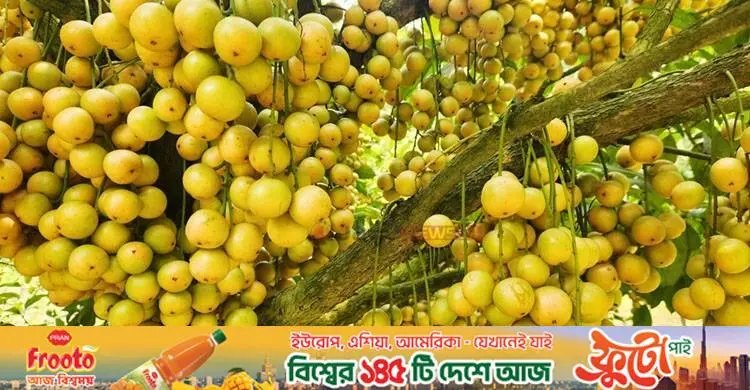
This season Jhenaigati in Sherpur, at the foot of the Garo hills, is a fair of yellow. In several orchards in the upazila, bunches of sweet-and-sour, juicy latkan fruit hang from the trees. The leaves can hardly be seen; from the branches down to the base of the trunk there is nothing but latkan.
From a few saplings to a commercial orchard
Md Hamidullah, member for ward 9 of Nalkura union in Jhenaigati upazila, fell in love with a latkan orchard in 2007 when he visited his uncle's home in Amlab village of Belabo upazila, Narsingdi, his birthplace. On the way back he brought a few latkan saplings with him as a hobby, and planted them on abandoned land next to his house in Bharua village of Nalkura union.
About seven years after planting, in 2014, the trees bore fruit for the first time. The yield met his expectations, and he realised latkan could be grown successfully in the area. He then gradually built up a commercial orchard. He now has more than 100 latkan trees, and this year he earned Tk 1 lakh 90 thousand by selling the fruit of 51 of them.
In the orchard, bunches of latkan hang on every tree from base to tip. Fruit traders have come from different areas to buy, going into the orchard themselves and picking as much as they want. Since photos of the orchard appeared on social media, many people have come to see it.
UP member Md Hamidullah said: "At first I planted a few saplings just as a hobby. Later, seeing the good yield, I decided to expand the orchard. Latkan does not need much care. It takes about 10 years after planting for a tree to mature, and from then on production keeps rising."
He said: "When I first planted the orchard, many people discouraged me. They said latkan would not do well here and I would make a loss. But I did not give up. Today it is proven that latkan can be grown in our area. Now I earn a significant income from latkan every year. I plan to plant more trees in future."
Others follow his lead
Md Zulhas Uddin, a worker in the orchard, said: "The wages I get for looking after the member's latkan orchard keep my family going. Following his example, several others have also started growing latkan, and many workers support their families by working in those orchards too."
Local farmer Md Abdus Salam said: "After seeing the member's orchard, I have already prepared land next to my house to plant latkan saplings. I hope to plant them soon."
Young agricultural entrepreneur Sifat Hossain said: "Latkan trees do well in the hill environment and have few diseases. Their care is also relatively easy, so many young people are now interested in growing it. Several small orchards have already been set up in this hilly area."
Schoolteacher Md Abul Kashem said: "The latkan from this orchard is large and very sweet. Latkan is a medicinal fruit rich in calories and nutrients. I was amazed to see the latkan in this orchard. I will plant latkan saplings myself."
Zahidul Haque Monir, president of Voice of Jhenaigati, said: "Expanding fruit-based farming in the hills is good for the environment too. If latkan farming grows, the hills will become greener and farmers' incomes will also rise. Latkan is not only a tasty fruit but also rich in nutrients. If its commercial cultivation can be expanded, it will open new possibilities for the hill economy."
District agriculture officer Md Sakhawat Hossain said: "Latkan is a high-value, profitable fruit. The soil and climate of the hill areas are very suitable for it. Farmers are being given training, advice and the technical support they need. If commercial latkan farming can be expanded, it can raise farmers' incomes and play an important role in the rural economy."
Source: Jagonews24. First published in Bengali on The Agro News.

Comments
(0)