
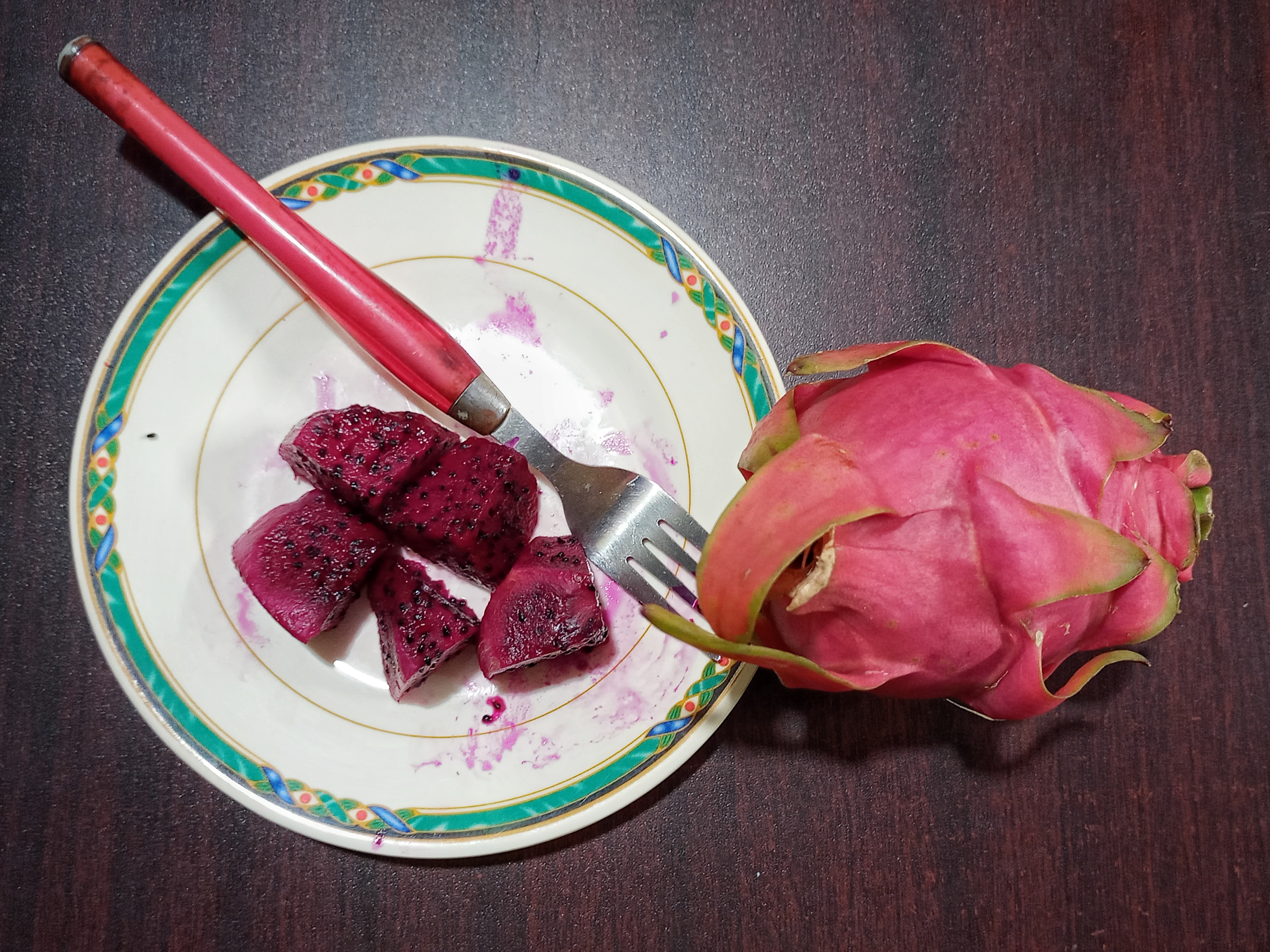
Gourinathpur bazar in Maheshpur upazila of Jhenaidah district had been no more than a small, marginal market five years earlier. By July 2026 it had become what Jagonews24 called the "capital" of dragon fruit. In a report published on 8 July 2026, the news site said more than a hundred wholesale depots, known locally as arats, had grown up around the trade in the fruit and were sending it to different parts of Bangladesh. On an average day, according to the market's traders, dragon fruit worth Tk 1 crore to Tk 1.5 crore was bought and sold there, and the depots had given work to several thousand people.
The report described a district where cultivation of the foreign fruit had spread widely and where demand for it was growing around the country year by year. Two other reports from the same week, one by the state news agency Bangladesh Sangbad Sangstha (BSS) on 7 July and one by Bangla Tribune on 6 July, described the same market and the same scale of trade, and BSS added the Department of Agricultural Extension's (DAE) figures for the district's dragon fruit fields.
A day at the Gourinathpur depots
Farmers brought their harvest to Gourinathpur every day from morning until evening, Jagonews24 found on a visit to the market. The buying and selling took place in the depots, where bright red dragon fruit was stacked under the sheds, and the market rang with bargaining all day long. The scene, the report said, was much the same every day.
Shariful Islam, a local farmer, told Jagonews24 that he grew dragon fruit on five bighas of land. "I can pick the fruit from the field and sell it easily at this market," he said. "That has cut transport costs and the risk of the fruit going bad. I bring it to the market in battery-run vans, on bicycles and in sacks."
Bangla Tribune, which published its account two days earlier, saw rows of depots heaped with red, pink and yellow dragon fruit. From dawn, it reported, farmers arrived with fruit by van, pickup and truck. In the depots the fruit was sorted, weighed and packed, then sent on by truck to districts around the country. Fruit from farms in the district and from neighbouring areas was sold there, and depending on size and quality a kilogram of dragon fruit was selling for Tk 80 to Tk 180. The paper described Gourinathpur as one of the largest wholesale markets for the fruit in the country, busy from morning to afternoon throughout the season, and said farmers were getting fair prices because a large market had grown up close to their fields.
Two growers told Bangla Tribune the same story from the field. One said that before the market existed he had to take his fruit to markets far away, and that with a big market at Gourinathpur his transport costs had fallen and he got a fair price. Another said that dragon fruit cost comparatively little to grow and paid well, that there was no shortage of buyers, and that he was enlarging his orchard every year.
Work for thousands, buyers from other districts
Zakir Hossain, an accountant at one of the depots, said the market had opened up work for many people. "I work at the depot alongside my studies and get a salary of Tk 15,000 to 18,000 a month," he told Jagonews24. "Apart from that, separate people work at the depots weighing and packing the fruit. Each of them can earn Tk 12,000 to 15,000 a month on average."
Abdus Samad, a wholesale fruit trader who had come from Natore, said many traders like him came to the market to buy. "The business environment and security are satisfactory," he said. "Dragon fruit can be found in many areas, but the quality of the fruit at Gourinathpur bazar is good, and the prices are within reach. I come to this market every week, buy fruit and go back to Natore by train."
Sayeed Sarkar, who runs a wholesale and retail depot, gave Jagonews24 the figure in the headline. "Traders from other districts can do business here easily," he said. "On an average day dragon fruit worth Tk 1 crore to Tk 1.5 crore is bought and sold in this market. The fruit is supplied to Dhaka, Chattogram, Sylhet and other big cities. Prices go up or down with the size and quality of the fruit."
The traders Bangla Tribune spoke to gave a similar account: about 100 depots, more than Tk 1 crore worth of dragon fruit changing hands every day, and fruit leaving for Dhaka, Chattogram, Khulna, Rajshahi, Sylhet, Barishal, Rangpur and other regions. A depot owner said huge quantities of fruit arrived every day in the season and that wholesale buyers from different districts came to buy directly, so that farmers got a good price and the depots could do business. A wholesale trader said the quality of Gourinathpur fruit kept demand high and that several truckloads went out to different districts each day. BSS, in its report of 7 July, gave the same daily figure of Tk 1 crore to Tk 1.5 crore, attributing it to a wholesale and retail depot owner, and said the depots had created work for several thousand local people.
How the wholesale market began
The market was young. In October 2023 The Daily Star's Jhenaidah correspondent reported that commercial dragon fruit farming had been gaining popularity in the district for a couple of years, and that some local youths, seeing the farmers' interest, had set up a wholesale dragon fruit market at Gourinathpur. The market had started in July that year, and farmers claimed it was the country's first wholesale dragon fruit market.
At that time the correspondent counted at least 30 vendors, among them many young people who had been out of work. Farmers and traders said dragon fruit was selling there for Tk 180 to Tk 200, depending on quality, and traders claimed that fruit worth nearly Tk 1 crore was being sold at the market every day. One vendor said farmers from all six upazilas of Jhenaidah and from the neighbouring parts of Jashore brought their produce there, and another said he bought about a hundred maunds of dragon fruit a day and sent it to districts across the country.
The same report quoted the Jhenaidah office of the DAE as saying that 842 hectares in the district's six upazilas had been brought under dragon fruit in 2023, against 203 hectares in 2022 and 151 hectares the year before. Some growers it spoke to had moved their land from seasonal crops to dragon fruit because it paid better.
Jhenaidah's dragon fruit fields in figures
By the 2024-25 season, according to the district office of the DAE as reported by BSS on 7 July 2026, dragon fruit was grown on about 1,129 hectares in Jhenaidah, and the district's six upazilas produced about 36,182 tonnes of the fruit. Kotchandpur had the largest area at 439 hectares, followed by Kaliganj with 328 hectares and Maheshpur with 316 hectares. Jhenaidah Sadar had 25 hectares, Shailkupa 15 hectares and Harinakunda 6 hectares.
The district stood at the top of the national table. Prothom Alo, citing DAE data in August 2025, reported that Jhenaidah was the leading dragon fruit district, with 32,768 tonnes in the previous fiscal year, followed by Jashore with 12,553 tonnes and Rajshahi with 4,477 tonnes. The Jhenaidah output figure in that report differs from the one the district office gave BSS for 2024-25; both are DAE figures as the two reports state them.
For the whole country, the same Prothom Alo report gave the DAE's figures: dragon fruit was grown on 1,115 hectares in 2021-22, producing 13,872 tonnes; in 2022-23 it was grown on 2,588 hectares and production reached 51,287 tonnes; and in 2023-24 production rose to 68,813 tonnes. The DAE's data, the paper said, showed production up by about 400 percent in three years. Agriculturists quoted by Bangla Tribune in December 2023 said the country's dragon fruit output had been only 66 tonnes in 2014.
Maheshpur and Jhenaidah
Maheshpur is one of the six upazilas of Jhenaidah district in Khulna division. Banglapedia, the national encyclopedia of Bangladesh, gives its area as 417.85 square kilometres. It is bounded by Jibannagar and Kotchandpur upazilas to the north, Chaugachha upazila to the south and east, and the Indian state of West Bengal to the west and south. Its main rivers are the Ichamati, Kodla, Betna and Bhairab. Maheshpur thana became an upazila in 1983. The 2011 population census counted 332,514 people there.
Farming is the backbone of the upazila. Banglapedia, drawing on the 2011 census, records agriculture as the main source of income for 74.79 percent of households, with commerce next at 12 percent. Its main crops were listed as paddy, jute, wheat, sugarcane, cotton, onion, garlic, tomato, potato and vegetables, its main fruits as mango, jackfruit, banana, blackberry, papaya, coconut, star apple, watermelon and date, and its main exports as banana, jackfruit, date molasses, potato and vegetables. The upazila had 12 hats and bazars; dragon fruit, a newer crop, does not appear in those lists.
Jhenaidah district covers 1,964.77 square kilometres, according to Banglapedia. It is bounded by Kushtia district to the north, Jashore district and West Bengal to the south, Rajbari and Magura to the east, and Chuadanga district and West Bengal to the west. Jhenaidah became a subdivision in 1862 and a district in 1984. Its six upazilas are Jhenaidah Sadar, the largest, Kotchandpur, the smallest at 165.66 square kilometres, Maheshpur, Kaliganj, Shailkupa and Harinakunda. The 2011 census counted 1,771,304 people in the district, and agriculture was the main source of income for 67 percent of households.
What dragon fruit is, and how it came to Bangladesh
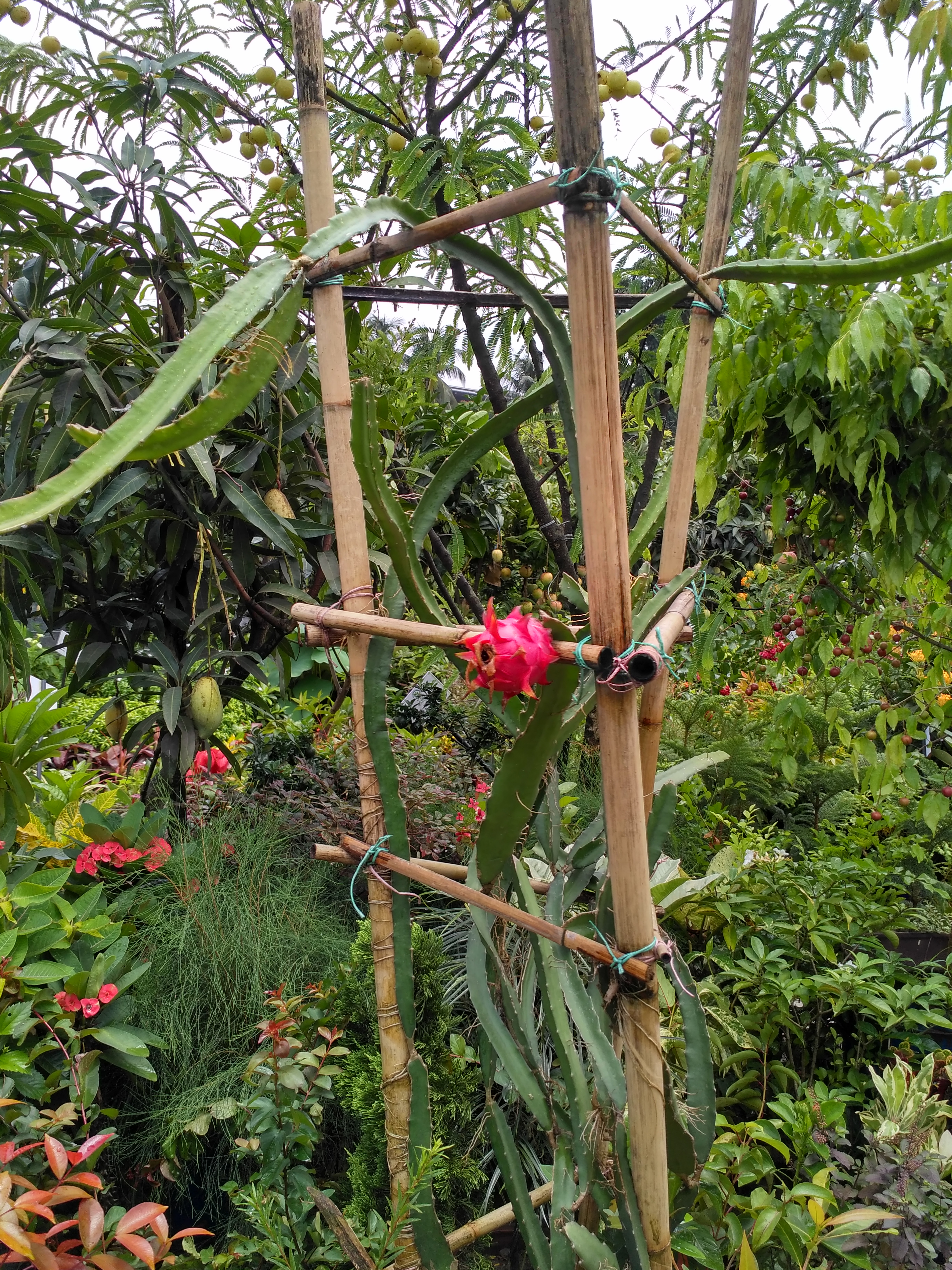
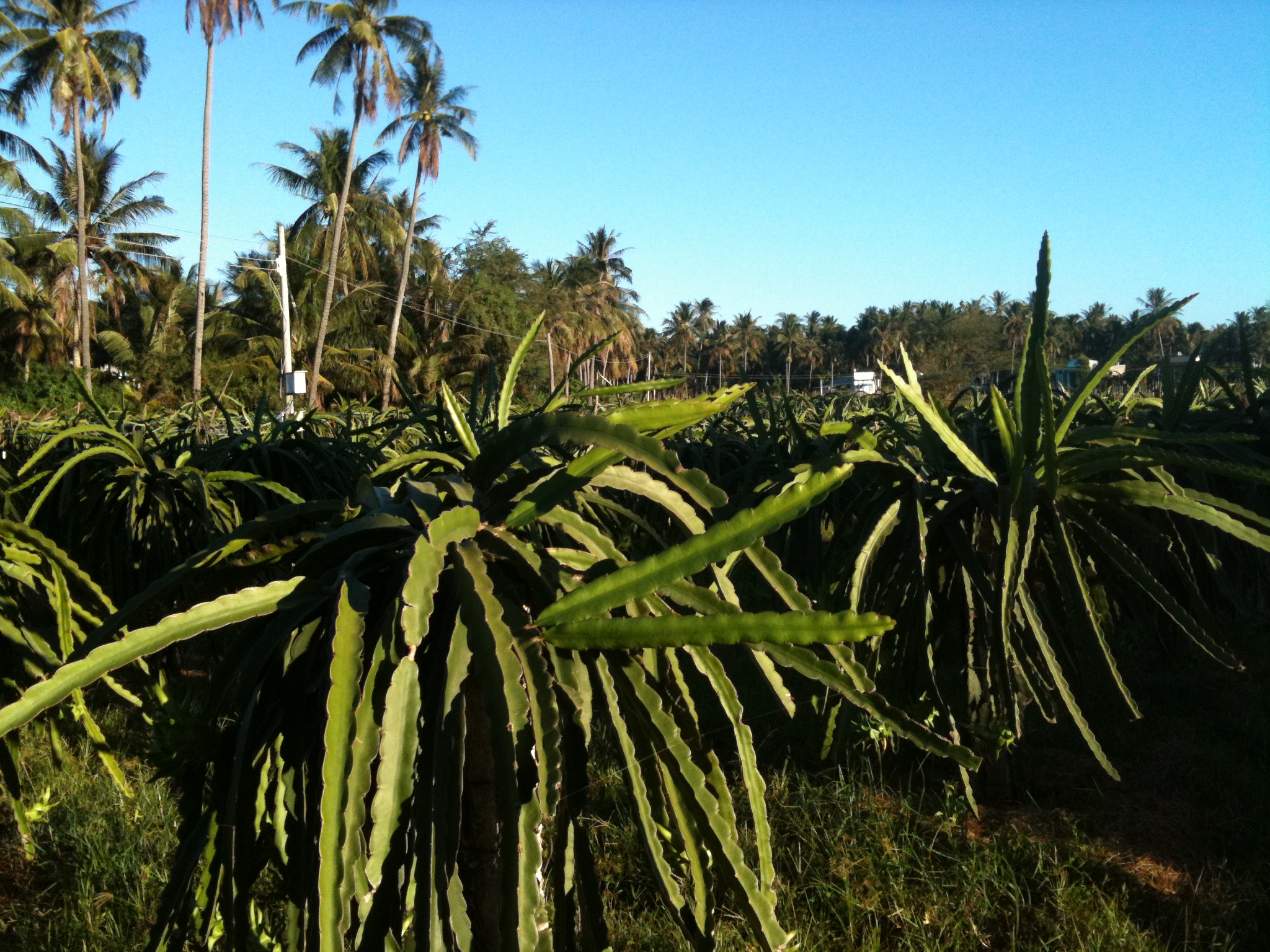
Dragon fruit, also called pitaya or pitahaya, is the fruit of several species of climbing cactus in the genus Selenicereus, formerly Hylocereus. The most widely cultivated species, Selenicereus undatus, is native to southern Mexico and Central America, and by the turn of the 21st century the crop had spread to China, Colombia and most of Southeast Asia, with Vietnam among the largest producers. The plant has long, three-ribbed stems and climbs with aerial roots. Its large, scented flowers open only at night and have usually wilted by the next day; they are pollinated by nocturnal visitors such as bats and moths, and in some varieties cross-pollination is needed for a good set of fruit. From pollination to harvest takes four to eight weeks, depending on temperature.
The fruit commonly comes in three types: pink-skinned with white flesh (S. undatus), red-skinned with red flesh (S. costaricensis, also known as Hylocereus polyrhizus) and yellow-skinned with white flesh (S. megalanthus). The red and purple colours come from pigments called betacyanins, the same family that colours beetroot. In commercial plantations, according to reference sources on the crop, plants are set out at 1,100 to 1,350 a hectare and can take up to five years to come into full production, when 20 to 30 tonnes a hectare can be expected.
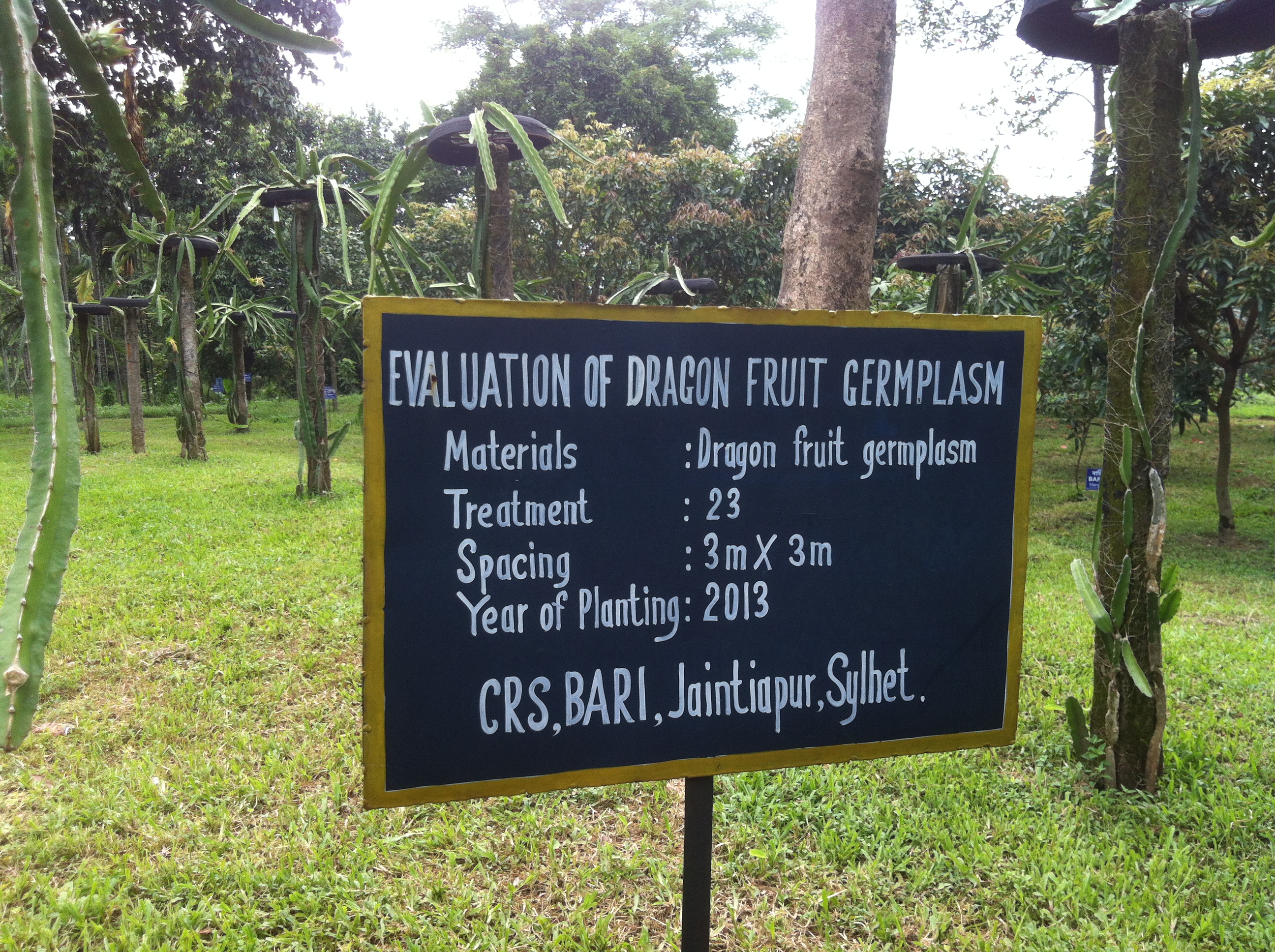
How the crop reached Bangladesh is told in more than one way. Krishi Batayon, the agriculture ministry's online publication, says cultivation began in 2007 with varieties brought from Thailand, the United States and Vietnam, Prothom Alo reported in August 2025. A chief scientific officer of the fruit division of the Bangladesh Agricultural Research Institute (BARI) told the paper that the institute had developed a dragon fruit variety in 2002-03 and that it was the variety most widely grown commercially, a medium-sized, sweet fruit that yields well. A former DAE director told the paper he had been sent to Vietnam in 2009 to learn the crop, spent nine days with growers there and brought back 60 cuttings of five varieties; around 2013, under a quality horticulture development project, 100,000 seedlings were planted in 1,000 demonstration plots across the country. He said the first government planting had been on a farmer's land in Natore in 2011.
BARI's released variety, BARI Dragon Fruit-1, is large, with a skin that turns red when ripe and juicy flesh, according to BARI information reported by Bangla Tribune in December 2023; the seeds are small, black and soft, and a single fruit weighs 150 to 600 grams. BARI considers the soil and climate of Bangladesh well suited to the crop, which can be grown in almost any flood-free soil, the report said.
How Jhenaidah's farmers took up the crop
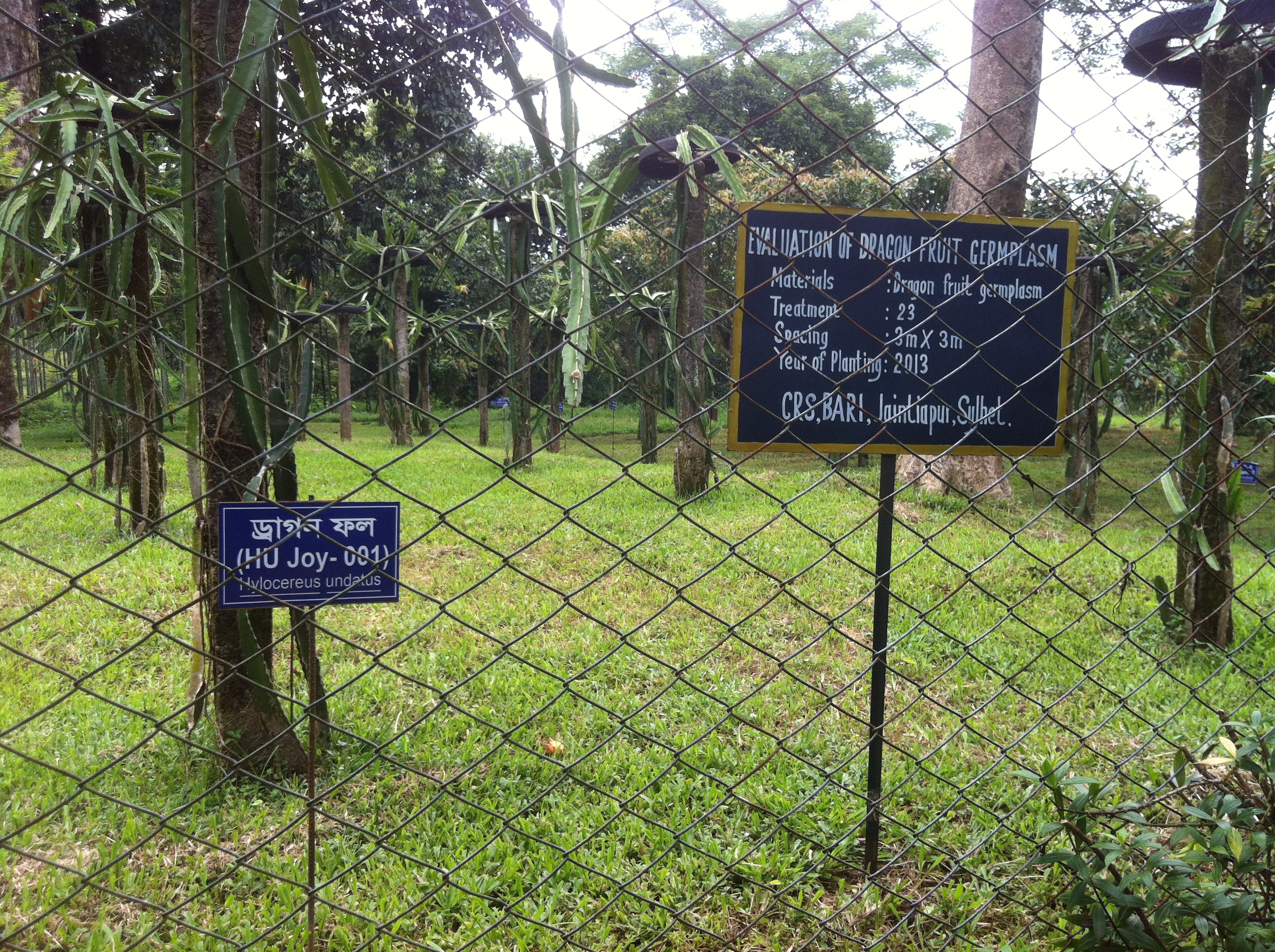
In Jhenaidah the crop started in Kaliganj upazila. Bangla Tribune reported in November 2019 that more than 15 farmers were growing dragon fruit on 25 acres in Kaliganj, and that the first had planted it on a bigha of leased land in 2014 despite doubts about whether it would yield. Another grower began the same year with seedlings from the agricultural university in Mymensingh, bought for Tk 120 each, and others followed with orchards of several bighas. The Kaliganj upazila agriculture officer told the paper that two farmers had started the crop there, that many others had followed them, and that the DAE was giving growers training and technical help.
The growers described their method to the paper. Concrete pillars are set in prepared land, four plants are put in around each pillar, and a tyre is fixed on top so that the branches can spread over it. One grower said seedlings were planted in October and fruit came about 18 months later; another planted 580 plants on a bigha and had well-formed fruit after 16 months. The first year cost about Tk 2 lakh a bigha for pillars, tyres, iron rods, irrigation, fertiliser and care, they said, and later years cost far less. A grower said the fruit ripened 40 to 45 days after flowering, that a ripe fruit weighed about 300 to 400 grams, that fruit could be picked for three to four months a year, and that a plant, once planted, bore fruit for at least 15 to 20 years. In 2019 the fruit was selling for Tk 200 to Tk 800 a kilogram.
The season matters. Prothom Alo reported in January 2024 that the normal dragon fruit season ran from May to November, and that some growers had started using a "lighting method", lamps in the orchards in the winter months of December to March when sunlight is weaker, to produce fruit out of season. Growers said main-season fruit matured in 25 to 28 days and weighed 200 to 500 grams depending on the variety, while off-season fruit took 38 to 42 days, came in smaller numbers and could weigh up to 800 grams because it stayed longer on the plant. A DAE horticulturist told Prothom Alo in August 2025 that two systems were used in the country, the conventional one and the "China method", and that the China method yielded 2,500 to 3,000 kg a bigha at a cost of Tk 1.5 lakh to Tk 2 lakh.
Falling prices and the 'tonic' question
The big market at Gourinathpur grew while prices were falling. Prothom Alo reported in August 2025 that only three years earlier dragon fruit had been seen as a fruit for the well-off, selling at around Tk 500 a kilogram on average, but that prices had begun to fall in 2023 and the fruit was then selling for Tk 80 in some places and Tk 100 to Tk 120 in others. A vendor at Karwan Bazar in Dhaka told the paper that most of the dragon fruit there came from Jhenaidah and Rajshahi. A Kaliganj grower who had farmed the fruit since 2017 said a bigha's harvest that once sold for about Tk 10 lakh now fetched Tk 3 lakh to Tk 3.5 lakh, which he put down to rising output.
Part of the fall has been blamed on claims about growth chemicals, which the sources describe in different ways. In December 2023 Bangla Tribune reported a heated social media debate over videos claiming that a "tonic" was being used to make dragon fruit grow larger. The director of a DAE project on year-round fruit production told the paper the campaign against the fruit was wrong, saying plant growth regulators such as gibberellic acid were used to enlarge fruit in many countries. The paper also reported that a BARI laboratory had tested dragon fruit for pesticide residues in July 2023 and had found no harmful pesticide.
In January 2024 Prothom Alo reported from Rajshahi that growers there said they used no hormone, even with the lighting method, and that off-season fruit was larger because it stayed on the plant longer; the DAE's deputy director in Rajshahi blamed what he called propaganda by some YouTubers for the fall in prices. In August 2025, however, a DAE horticulturist told Prothom Alo that growth hormone had come into wide use around 2023, mainly on large orchards, that it entered Bangladesh illegally from India, and that its use was higher in border districts. The BARI chief scientific officer told the paper that reports of tonic use had done more than rising output to bring prices down, and advised buyers to choose medium-sized fruit with fully red skin. An official of the Bangladesh Food Safety Authority, speaking anonymously, told Prothom Alo that the authority had taken an initiative to test how safe the dragon fruit on the market was, and meanwhile advised buyers to avoid oversized fruit.
Jagonews24's report on Gourinathpur did not raise the question. In its report of 6 July 2026, Bangla Tribune quoted the Maheshpur upazila agriculture officer as saying that farmers were being given regular training and technical advice to ensure the safe production of dragon fruit, that the department was keeping constant watch so that harmful chemicals were not misused, and that the DAE was working for orderly marketing at Gourinathpur bazar and fair prices for farmers.
Photo: Ruhan / Wikimedia Commons (CC BY-SA 4.0). The top picture shows a Bangladeshi dragon fruit, as background.
Sources: Jagonews24 (8 July 2026), Bangladesh Sangbad Sangstha (7 July 2026), Bangla Tribune (6 July 2026, 6 December 2023 and 9 November 2019), The Daily Star (11 October 2023), Prothom Alo (20 January 2024 and 11 August 2025), Banglapedia, Wikipedia
Comments
(0)