
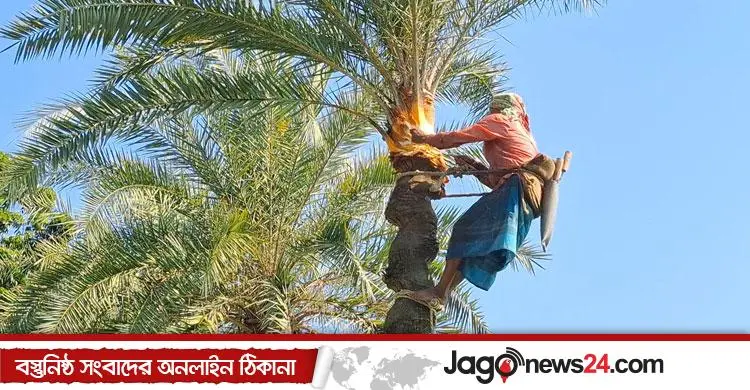
Winter is knocking at the door, and signs of its arrival have been in the countryside since the start of late autumn. In Jhenaidah, gachhis (date palm tappers) have begun preparing to collect date palm sap and make gur for the coming winter, tending trees village by village. The tappers say that although the number of trees has fallen, they have not given up collecting sap.
Across the district, tappers are busy clearing the heads of date palms growing along roadsides and field ridges. At dawn they set out with thungi, bailadhara, rope and gachhi-da (the tapper's knife), skilfully cleaning the tops of the trees with sharp blades. After the heads are cleaned, the trees are given two weeks' rest. The great winter effort of collecting sap and making gur fills the farmers with hope.
Tappers fear for a tradition
Anisur Rahman, a tapper from Ramchandrapur village in Sadar upazila, told Jagonews: "We start preparing the date palms for tapping from the beginning of the month of Kartik. Sap will be available a week from now."
Mojibar Rahman said: "I have been cutting date palms for about 45 years. Selling sap and gur brings a good income in winter. Now no new tappers can be found; nobody wants to do this work. Date palms are declining and tappers are disappearing. If this continues, Jhenaidah's heritage of date palm sap, gur and tappers will all be lost."
According to the Department of Agricultural Extension (DAE), Jhenaidah is one of the main holders of the date palm gur and sap tradition. Because of its natural features and climate, date palms grow well in the region, and the district produces at least 800-850 tonnes of date palm gur every year.
The village tappers make this gur by natural and safe methods, and raw sap is also very popular. There is strong demand across the country for date palm gur, sap and patali, which are supplied from Jhenaidah to the rest of the country.
Trees and output
Updated figures from the district DAE show the district currently has 142,235 date palms, of which 112,760 can be tapped. Some of the rest are saplings, and tappers do not collect sap from some trees. In winter the district produces 4,814,241 litres of date palm sap and 872 tonnes of date palm gur, which meets local demand and is also supplied to other districts. Kotchandpur upazila has the most date palms in the district, 47,853.
Anjer Biswas of Sabdarpur village in Kotchandpur union said: "Date palm gur tastes the sweetest. When winter comes, people from towns and villages come to us for sap and gur. This is the heritage of our villages and of the country, and it must be kept alive somehow. Sap collection has not started yet this year; the trees are still being prepared. It will begin within one or two weeks."
Achhia Begum, a housewife of Barkodalia village in Sadar upazila, said: "There used to be a lot of sap. Now there are fewer trees and less sap. The bain (large clay oven) for boiling the sap has been repaired. We are village people and have to run our households this way. Selling sap, gur and patali gives us a little extra income at this time of year."
Md Kamruzzaman, deputy director of the DAE in Jhenaidah, told Jagonews: "We plan to train tappers in collecting sap, producing gur and marketing it safely. We have contacted the Sugarcane Research and Training Centre. Last year we trained many tappers in the district through them, and we are trying again this year. The date palm gur production target this year is about 900 tonnes. Tappers in all parts of the district have already prepared their trees, and sap collection may begin from next week."
Source: Jagonews24. First published in Bengali on The Agro News.
Comments
(0)