
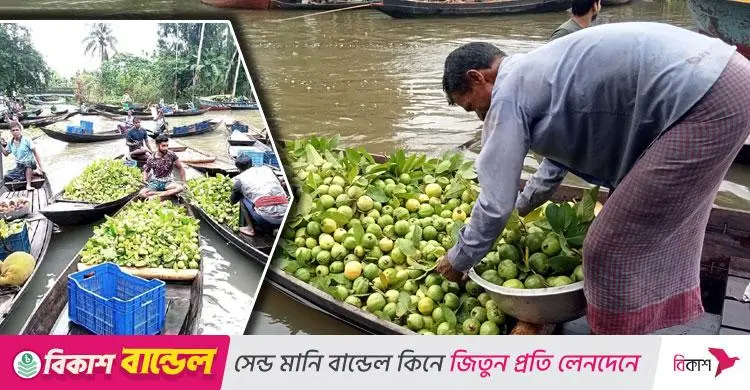
Guava output in 36 villages of Jhalokati is lower than last year. Farmers are getting good prices despite the smaller crop, but they are still not happy. They say a bigha of land should produce 10 maunds of guava a day, but it is producing two and a half to three maunds, so even with higher prices they cannot earn what they hoped. The Bengali months of Asharh, Shrabon and Bhadra are the season for ripe guava.
Bhimruli village lies to the north of the district's Sadar upazila. Its market, the largest, trades guavas worth several lakh taka every day. Guava is grown commercially on 350 hectares in 13 villages of Sadar upazila, and there is guava cultivation in 23 surrounding villages as well. It has changed the fortunes of several thousand families in these villages.
A floating market on the canal
Most of the land in these areas is under commercial guava. Produce is bought and sold from small dinghies floating on the water. Wholesalers from various areas come with trawlers, trucks, mini-trucks and pickups, finish buying between 9am and noon, load the guavas and head for their destinations. Guava is the main product of Bhimruli's floating market: row upon row of boats piled with raw and ripe, green and yellow guavas, sitting two-thirds under water with the weight. The whole area rings with the calls of traders; in a word, it is an astonishing market on a canal.
Local people say it is the "largest" floating market in the region. Boats laden with guava move back and forth on the water at Bhimruli as farmers look for a good price. Traders' depots line both banks of the canal, and they are the buyers. Farmers from the region that grows the lion's share of Bangladesh's guava do their trading sitting in their dinghies, and the scent of ripe guava spreads across the markets and orchards of the south. Guava is fondly called "the apple of Bengal" or "the poor man's apple".
A huge quantity of guava is produced here every year, but farmers suffer losses for lack of storage. The fruit ripens quickly, and if it cannot be sold fast, farmers lose out. With government or private initiatives for storage and processing, farmers could profit while meeting consumer demand all year. Because no cold storage or processing industry has developed for lack of entrepreneurs, and production costs have risen, many are losing interest in growing guava.
Drought cut the crop
This year the trees flowered in Falgun, but excessive drought caused a water shortage, so flowers dropped and many trees died. Because of economic hardship, farmers could not give the trees enough fertiliser and soil. Overall, output was lower but prices were good, yet farmers remain disappointed. Where 10 maunds a day should be coming down, 3–5 maunds are. Depending on size and quality, a maund sells for Tk 1,000 to Tk 1,200.
Phoni Bhushan Das, a guava farmer in Bhimruli, said: "Drought and the heat of the sun burned the guava buds and young fruit, so output is low this year. Prices are better than in other years, but with low output I cannot earn what I need."
Zahid Mia, a guava farmer in Kanchabalia village, said: "We are lucky. We feared a poor yield because of the drought, but by the grace of the One above, what we did get this year is quite good. At the start of the season a maund of guava sold for Tk 800, at Tk 25–30 a kg. The price has now come down, and I can sell at Tk 1,000 to Tk 1,200 a maund."
Bimal Mistri, a guava farmer in Jagadishpur village, said guavas worth several crore taka rot in these areas every year for lack of cold storage. Guava is perishable and ripens quickly, and there is no way to store it.
Trade and the call for processing
Wholesaler Liton Haldar said: "In season, about 10,000 maunds of guava are sold every day. Thousands of maunds go from the market by road and water to Khulna, Feni, Dhaka, Sylhet, Patuakhali, Bhola, Madaripur, Natore and Barishal. About 7,000–8,000 working people in the area earn their living directly or indirectly from it."
Guava farmer Biswajit Chowdhury said large guavas could be processed and exported through government or private initiatives, earning a lot of foreign currency. He said guava produced at 5–6 metric tonnes per hectare brings in about Tk 2.5 to 3 crore a year.
Jhalokati Deputy Commissioner Ashrafur Rahman said farmers would benefit financially if agro-based industries, including storage, were set up. Although guava has been grown here for generations, the lack of entrepreneurs has meant no cold storage or processing industry has developed, and farmers are losing interest in cultivation day by day.
Source: Jagonews24. First published in Bengali on The Agro News.
Comments
(0)