
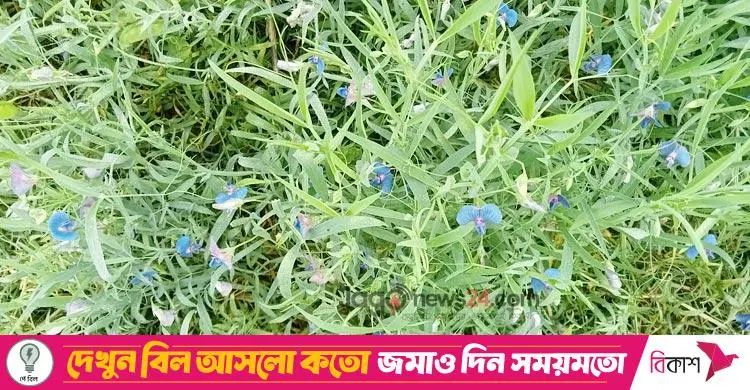
Jhalakathi, in the Barishal region known as a granary, grows many kinds of vegetables and is also well ahead in pulses and oilseeds. Among pulses, farmers are increasingly interested in growing khesari (grass pea). Across the fertile fields, the bluish flowers of green khesari stretch to the horizon, and with demand for khesari dal rising day by day, farmers have begun to dream.
Many kinds of food are made from this pulse, and demand rises sharply during Ramadan. The agriculture department expects farmers to harvest their khesari just after Ramadan this year. There is a prospect of a bumper khesari crop on the aman land of the district's four upazilas.
The district agriculture department says khesari has been grown on 7,495 hectares in 32 unions of the four upazilas. Once the plants grow, khesari vines are also valued as a leafy vegetable, popular in villages, towns and cities alike. The pulse is grown on large areas of aman land.
Relay cropping
Farmers say five to six kg of khesari seed per bigha has to be broadcast on muddy land in November while the aman paddy is still standing. This is called relay cropping. It lets farmers sow khesari at the right time, and because the seed is scattered on muddy land in November, it germinates well. With this method farmers are spared the cost of preparing the land.
Sown in November, the plants are now moving from flower to pod, and khesari can be harvested in March. Most farmers apply no fertiliser to relay khesari, but broadcasting 6 kg of urea, 10 kg of TSP and 5 kg of potash per bigha at sowing ensures a good yield. When scattering fertiliser and seed, the paddy plants should be standing; relay khesari technology cannot be used in fields where the paddy has lodged. Fertiliser should not be scattered while the plants are wet, and drainage is a precondition for growing pulses.
Farmers must leave at least 6 to 8 inches of stubble when harvesting the paddy. Tall stubble lets the khesari plants climb, so they get plenty of light and air from all sides, and each plant bears plenty of flowers and pods, giving a much higher yield.
Low cost, good returns
Farmers estimate they will get more than 200 kg of khesari per bigha, worth an estimated Tk 10,000 or more. A kilogram of khesari dal now sells for Tk 70-80, while growing it by relay in paddy fields costs only about Tk 1,000 a bigha, including seed and fertiliser. Khesari roots also form nodules that make the soil fertile, so growing the pulse raises soil fertility. Mixing the paddy stubble into the soil after the khesari harvest also raises fertility and somewhat reduces salinity, so later crops do better.
Farmers said khesari sold for Tk 2,000 to 2,500 a maund last year, and they expect prices to rise further this year. Growing khesari costs little, and its demand as a leafy vegetable brings extra profit. Dried khesari vines are also unmatched as cattle feed.
Monirul Islam, deputy director of the Department of Agricultural Extension (DAE) in Jhalakathi, said: "With favourable weather this year, khesari has been grown on 7,495 hectares in the district: 1,626 hectares in Sadar upazila, 876 in Nalchity, 2,043 in Rajapur and 2,950 in Kathalia. The plants are moving from flower to pod, and you can see at a glance that the yield will be very good. The agriculture department is giving farmers every kind of support."
Source: Jagonews24. First published in Bengali on The Agro News.
Comments
(0)