
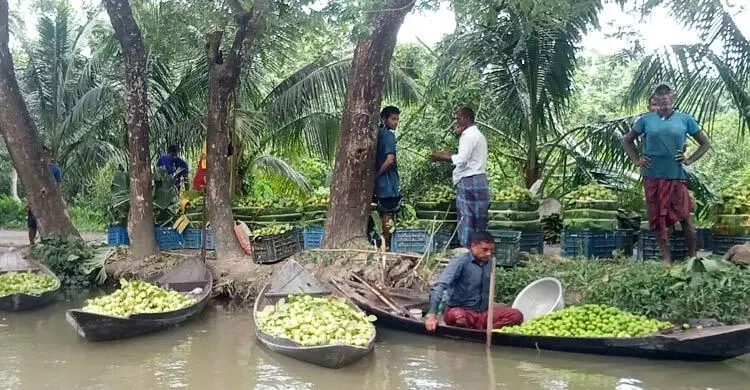
Guava growers in Jhalakathi have suffered heavy losses in the situation that arose across the country around the quota reform movement. Yields were already lower this year, yet instead of despairing they had pinned their hopes on getting a fair price. Those hopes have come to nothing, and they say they are disheartened by a shortage of wholesalers, buyers and tourists.
Enquiries show that although guava is grown here and there everywhere, commercial cultivation is centred on Banaripara in Barishal, Jhalakathi Sadar and Swarupkathi in Pirojpur. Guava is grown on 937 hectares in 16 villages of Banaripara, 350 hectares in 13 villages of Jhalakathi and 645 hectares in 26 villages of Swarupkathi. For thousands of people in these areas, guava is the only means of livelihood.
Late flowering and no rain
Guava has been grown commercially for generations on large areas of Kirtipasha, Bhimruli, Shatadashkathi, Khajuria, Dumuria, Kapurkathi, Jagdishpur, Mirkathi, Shakhagachhi, Himanandakathi, Adakathi, Rampur and Shimuleshwar villages in Jhalakathi. This year, however, the trees flowered late, and much of the blossom dropped because there was no rain. On top of that, the situation in the country has worried guava growers and seasonal traders. Farmers fear heavy losses if things do not return to normal.
Local farmers said that although guava was grown sporadically more than 200 years ago, commercial cultivation began in 1940 and has been growing steadily. This year guava is being grown commercially on at least 1,932 hectares.
"We can't even sell at a token price"
Guava grower Pankaj Baral said: "Since the Padma Bridge opened, more tourists and wholesalers have been coming. But because the country's situation turned bad right at the start of the season, wholesalers, buyers and tourists are not coming, so demand for guava is much lower. Forget a fair price, we cannot even sell at a token price. Forget profit, I'm worried whether I'll even recover my costs."
Farmer Debabrata Haldar Bitu said: "Guava is our only source of seasonal income. When the crop is good, we are comfortable. But this time there are no wholesalers and no tourists. With the market as it is, I don't even feel like picking the guavas from the trees."
Another grower, Bipul Chakraborty, said: "Three men in our household work in the guava orchard, doing all the tending and everything else. What we earn this season keeps the family going all year. The yield is lower this year, and then there is the quota movement. If we don't get a fair price, it will be hard to run the household even for the three months of the season. Only the Creator knows how we will manage the rest of the year."
Sujan Haldar Shanu, who runs a tourism business, said thousands of tourists from home and abroad come for the guava season. They used to come only by water; now that the roads are better, the trip takes much less time, so tourist numbers have been rising. But with the situation in the country this year, he does not expect many tourists or visitors.
Guava grower and former union parishad chairman Bhaben Haldar said the ripe guava season starts at the beginning of Shraban, and it is right now that destruction has broken out in the country in the name of the quota movement. As a result, hardly any wholesalers, buyers or tourists are coming, and covering costs has become very difficult.
Monirul Islam, deputy director of the Department of Agricultural Extension (DAE) in Jhalakathi, said guava is a source of economic comfort and livelihood for thousands of people in the area. With little rain this year some of the blossom dropped, but if growers had got a fair price for what remains, they might have made up the loss. Now, because the current situation in the name of quota reform is keeping wholesalers, buyers and tourists away, growers and traders will face heavy losses, he said.
Source: Jagonews24. First published in Bengali on The Agro News.
Comments
(0)