
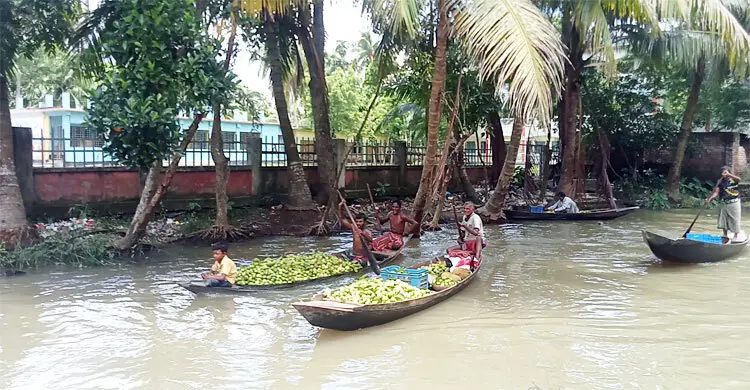
There are no tourists, wholesalers or visitors at Bhimruli in Jhalakathi, the traditional floating guava market of southern Bengal. The Bengali months of Asharh, Shraban and Bhadra are the peak guava season. Every year at this time, crowds of travellers, tourists, wholesalers and visitors pour in, and shops and restaurants are busy. This year the market area is quiet. With no wholesalers, farmers are selling guava at Tk 400 to 450 a maund.
Even the guavas brought in small baskets to sell to tourists are not fetching the hoped-for price, and seasonal shopkeepers are not selling as much as they expected. Guava farmers and local people fear losses of several crore taka in all. Farmers stumbled at the very start of the season. Yields were already low this year, and they had been counting on fair prices. With demand weak because of a shortage of wholesalers, buyers and tourists, they are frustrated at not getting the price they wanted.
Where guava is grown
Guava is grown here and there almost everywhere, but commercial cultivation is centred mainly on Banaripara in Barishal, Jhalakathi Sadar and Swarupkathi in Pirojpur. Guava is grown on 937 hectares in 16 villages of Banaripara, 350 hectares in 13 villages of Jhalakathi district and 645 hectares in 26 villages of Swarupkathi. For thousands of people in these areas, guava is their only livelihood. In the heavy rains of Asharh and Shraban, the rivers and canals here are full of guava.
In Jhalakathi, guava has been grown commercially for generations across large parts of Kirtipasha, Bhimruli, Shatadashkathi, Khajuria, Dumuria, Kapurkathi, Jagadishpur, Mirkathi, Shakha Gachhir, Himanandakathi, Adakathi, Rampur and Shimuleshwar villages. This year the trees flowered late, and because there was no rain, many of the flowers dropped. This has cost guava farmers and seasonal traders several crore taka.
Local farmers say guava was grown sporadically more than 200 years ago, but commercial cultivation began in 1940 and has been growing steadily. In 2024, guava was grown commercially on 562 hectares, producing 6,042 tonnes.
Farmers' worries
Farmer Pankaj Baral said: "Much of the blossom that came on the guava trees this year dropped because there was no rain. After the Padma Bridge opened, more tourists and wholesalers started coming. But because the anti-discrimination movement took place at the start of the season, wholesalers, buyers and tourists have not come, and demand for guava is much lower. Forget a fair price, we cannot even sell at a nominal price. Forget profit, we are worried whether we will even recover our costs."
Farmer Debabrata Haldar Bitu said: "Guava is our only source of seasonal income. When the harvest is good, we are well off. The floating market on the water sees transactions worth several crore taka a year. Some temporary shops set up to serve wholesalers, tourists and visitors, and the sellers make money. But because of the violent situation in the country, everything, including the arrival of wholesalers, has been affected. The market is in such a state that I do not even feel like picking the guavas."
Farmer Bipul Chakraborty said: "Three men in our family work in the guava orchard doing all kinds of jobs. Our income in this season keeps the family going all year. This year yields are lower, and on top of that the country is in a bad state. If we do not get a fair price, it will be hard to run the household even for the three months of the season. Only the Creator knows how we will manage the rest of the year."
Tourism slump
Tourism businessman Sujan Haldar Shanu said: "Thousands of tourists from home and abroad come for the guava season. Earlier they came only by water; now that the roads are better, the journey takes little time. But because of the situation in the country, there are no tourists. Because tourists were damaging farmers' orchards, we arranged scenic tours of the guava gardens. But with the guava market in this state, few tourists or visitors are coming. People here will face losses on every front this year."
Former union parishad chairman Bhaben Haldar said: "Asharh, Shraban and Bhadra are the peak season. Because of the situation in the country, tourists and wholesalers are not coming, and it has become very hard for farmers even to recover their costs."
Md Monirul Islam, deputy director of the DAE in Jhalakathi, said: "Guava has been grown commercially on 562 hectares in 13 villages of Jhalakathi Sadar upazila, producing 6,042 tonnes. In the guava season, guava is a source of economic well-being and livelihood for thousands of people in the area. Some of the flowers dropped because there was no rain. Even so, if farmers had got a fair price for what they have, they could have made up the loss. But because wholesalers, buyers and tourists are not coming due to the present situation in the country, they face heavy losses."
Source: Jagonews24. First published in Bengali on The Agro News.
Comments
(0)