
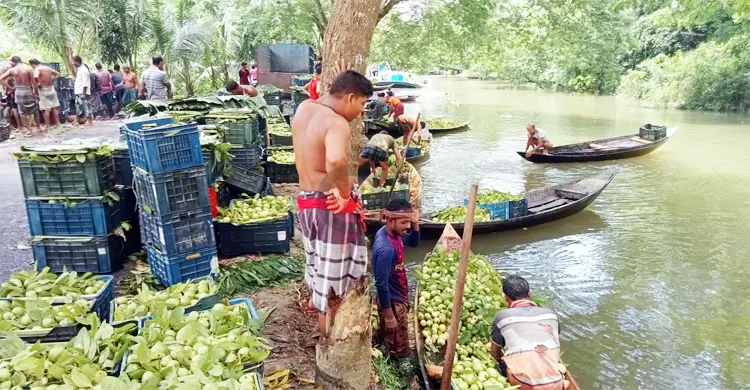
Guava from the south, known as "the apple of Bengal", comes to market in the Bengali months of Asar, Srabon and Bhadra. During these three months the face of 55 villages in Jhalakathi, Barishal and Pirojpur changes. Canals, beels, rivers and ditches brim with water, and floating guava markets sit on that water, giving the rural economy a boost. This year, however, growers say the guava yield has been low.
The fame of the floating guava markets is spreading at home and abroad day by day, and tourists crowd to them. Thanks to the Padma Bridge, the number of tourists has grown, and the fortunes of guava growers, wholesalers and related traders have turned too.
Although guava is grown in scattered patches elsewhere in Barishal division, commercial cultivation centres mainly on Banaripara in Barishal district, Jhalakathi Sadar and Swarupkathi in Pirojpur. Guava is grown on 937 hectares in 16 villages of Banaripara, 350 hectares in 13 villages of Jhalakathi and 645 hectares in 26 villages of Swarupkathi. In Jhalakathi, guava is grown commercially across large parts of Kirtipasha, Bhimruli, Shatadashkathi, Khajuria, Dumuria, Kapurakathi, Jagadishpur, Mirkathi, Shakha Gachhir, Himanandakathi, Adakathi, Rampur and Shimuleshwar villages.
Several thousand working families in these villages have been growing guava for nearly 200 years. Several thousand seasonal traders and labourers are also involved in growing, trading and marketing guava. During the season, seasonal guava markets spring up in at least 20 places, among them Bhimruli, Atakathi, Dumuria, Ganapatikathi, Shatadashkathi, Rajapur, Madra, Adamkathi, Jindakathi, Barnapatikathi, Atghar, Kuriana, Andakul, Rayerhat, Brahmankathi, Dhalhar and Baukathi. In each season, 5,000 to 7,000 maunds of guava are traded a day at these markets.
Early history of guava growing
Asked when guava growing began in the south, local people say they have been growing guava for generations, for more than 200 years. According to them, about 200 years ago a local man, Kalicharan Majumder, brought seeds of this guava variety from Gaya in India and sowed them in the area, and guava farming has spread from there.
However, veteran guava grower Bhabendranath Haldar said that while it was grown in scattered patches earlier, commercial guava cultivation began in 1940 and has been growing steadily. In 2010, guava was grown commercially on 1,932 hectares, producing about 20,000 tonnes. Current guava production has reached 30,000 tonnes.
Grower Pankaj Baral said guava trees do not need much fertiliser or any special inputs; care alone is enough, and little needs to be done through the year. The trees start flowering in Boishakh and Joishtho, but the fruit does not ripen unless the rains begin. On good land, 12 to 14 tonnes of guava are produced per hectare.
'Green apple' goes abroad too
After meeting domestic demand, guava from here goes to Brazil, Portugal, Colombia, Mexico, Malaysia and other countries. The largest market is the Bhimruli floating guava market in Sadar upazila. Harun Khan, a wholesaler at the market, said that in season he sends three to four maunds of guava a day to large traders in Sylhet, from where it goes abroad.
Not only Bhimruli but every market sends guava abroad, and demand for this juicy guava is high in foreign markets. During the season, traders from Chandpur, Cumilla, Noakhali, Dhaka, Sylhet and Chattogram take consignments of guava away every day on hundreds of trawlers, boats and trucks.
Lower yield, growers at a loss
The agricultural extension department said the guava yield was lower this year. Because of the lack of rain, many blossoms dropped, and that cut the yield.
Seeing photographs being taken, Jindakathi guava grower Ranjit Kumar said angrily in the local dialect: "What good will pictures do? Take a picture and even the guava feels ashamed. If there's a way to survive, arrange that."
Sunil Mondal of Kapurkathi village has a large guava orchard, from which at least 30 maunds reach the market every day. Selling at Tk 400 a maund brings in about Tk 12,000. Out of that he must pay Tk 6,000 a day to 10 guava pickers, plus transport costs. All told, Sunil Mondal is counting losses every day.
People involved in the trade said guava was grown in 36 villages at the time of the Liberation War and has now spread to 55. Although official records put production at 30,000 tonnes, growers say several thousand more tonnes are produced outside the count.
Local guava grower Mukunda Gharami told Jago News: "We have to take loans from NGOs at high interest. The Krishi Bank gave a small amount of credit, but it was little compared with what was needed. Although electricity supply and communications have improved, investors are showing no interest here."
Tourism businessmen Nishith Haldar Shanu and Gautam Mistri said thousands of local and foreign tourists come here during the guava season. They used to come only by water, but tourist numbers have been growing since the Padma Bridge opened.
Guava grower and former UP chairman Bhaben Haldar said cultivation needs normal rainfall. "This year, although the trees were cared for properly, most of the flowers dropped because there was no rain. With the fruit now on the trees we are getting good prices, but this money does not cover our costs. We are making a loss."
Monirul Islam, deputy director of the Department of Agricultural Extension in Jhalakathi, said guava is the source of economic comfort and livelihood for thousands of people in the district. Because of the Padma Bridge, guava is reaching different parts of the country by road within the day. He said that although the yield is lower this time, growers are getting good prices.
Source: Jagonews24. First published in Bengali on The Agro News.
Comments
(0)