
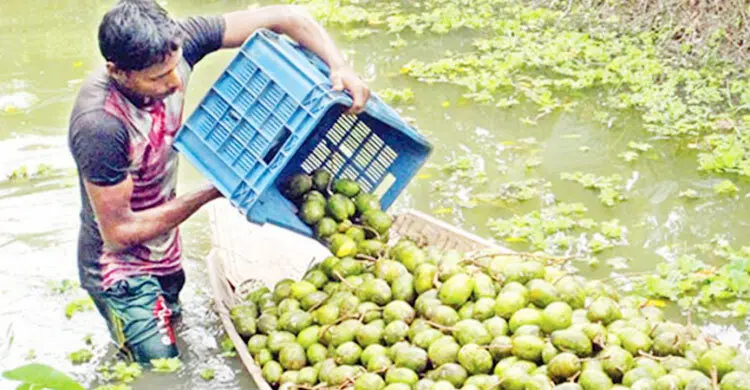
Jhalakathi was already well known for its guavas; now amra has been added to its name. Farmers in more than 200 villages of the district have planted amra trees and dream of financial security, and they say Jhalakathi's amra is going abroad as well as meeting demand at home.
Every day around 50 sacks of amra are loaded into the luggage holds of two passenger buses at Kirtipasha crossing on the edge of Jhalakathi town and sent abroad by sea via Chattogram. The fruit is now grown commercially in about 50 villages, including Bhimruli, Shatadashkathi, Khejura and Atakathi. Because it is sweeter than amra from other districts, demand for it is growing.
Agriculturist Md Monirul Islam, deputy director of the Department of Agricultural Extension (DAE) in Jhalakathi, said: "This year amra has been grown on 600 hectares. The yield has been around 12 tonnes a hectare. Because it is a cash crop, farmers are becoming interested in it, and the yield is rising every year."
Growers and prices
Ripon Chowdhury, a farmer from Bhimruli in Kirtipasha union, leased 10 kathas of land in 2017 and planted amra trees. He said he had sold more than 50 maunds this season. "Shraban, Bhadra and Ashwin are the peak months for amra, so prices are good then. Some trees bear fruit all year round," he said.
He added with regret: "Huge quantities of amra grow in Kuriana, Atghar, Bhimruli, Dumuria and Betra, but there are not enough traders and wholesalers to collect it. At the grassroots, amra collected from the orchards sold at first for Tk 300-350 a maund. Now it is between Tk 550 and nearly Tk 1,000. Amra does not rot as quickly as guava, so it is more profitable."
Farmer Moloy Halder was taking amra by boat to the Bhimruli floating market. "Jhalakathi's amra goes from Bhimruli to Dhaka and other cities, and even beyond the country's borders," he said. "It is in demand across the country because of its quality. Everyone who buys amra wants amra from this area." He called for more support from the administration and the agriculture department.
Pests and the floating markets
Amra growing has its problems too. In the monsoon a kind of caterpillar eats the leaves and strips the trees bare, damaging the crop. Although farmers want to grow amra without pesticides, they need help from the local agriculture office to control these pests, and they say they often get no response.
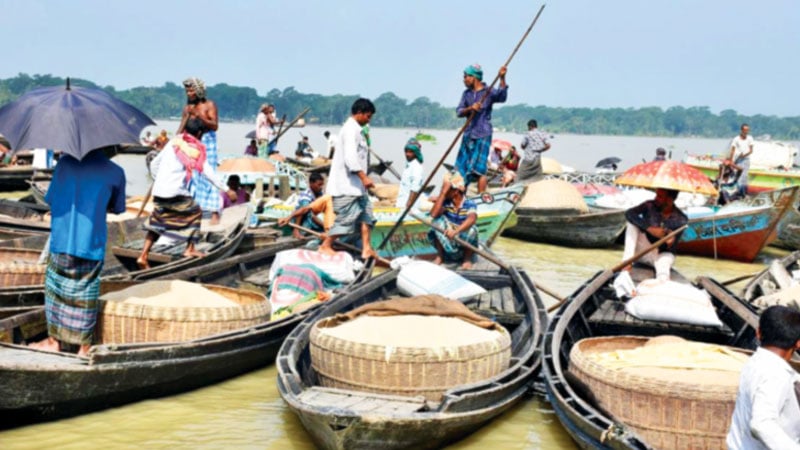
There are about a dozen large and small wholesale depots at Bhimruli. They mainly buy guava, but the peak amra season begins as guava ends, so the wholesalers stay on and the trading in amra carries on. Amra is currently sold at the floating markets of Atghar, Kuriana in Pirojpur and Bhimruli in Jhalakathi. Bhimruli is the largest and liveliest. The market opens by 8am and trade continues until noon. Farmers and orchard owners arrive in small dinghies and boats, and wholesalers buy the fruit and take it away by truck or trawler. These markets will stay busy through Ashwin and Kartik, though not as bustling as the guava markets.
Liton, a wholesaler at Bhimruli, said: "The peak amra season starts as soon as Shraban ends. Every day 50-60 maunds of amra go in sacks to Dhaka, Chattogram and Chandpur. The price is between Tk 600 and Tk 800 a maund." Wholesalers said raw and processed amra go by ship from Chattogram to India and neighbouring countries, and that since last year amra from the area has also been exported to London.
Dr TM Mehedi Hasan Sunny, resident medical officer (RMO) of Jhalakathi Sadar Hospital, said: "Amra contains plenty of vitamin C, vitamin A, calcium, phosphorus and many other nutrients. Its fibre helps digestion, so eating amra regularly in season relieves constipation. Besides eating it raw, it can be eaten mixed with mustard, cooked or made into a preserve."
Farmers hope that if the government bought amra directly, and large traders came to collect it straight from the area, the amra trade and exports would both grow.
Source: Jagonews24. First published in Bengali on The Agro News.
Comments
(0)