
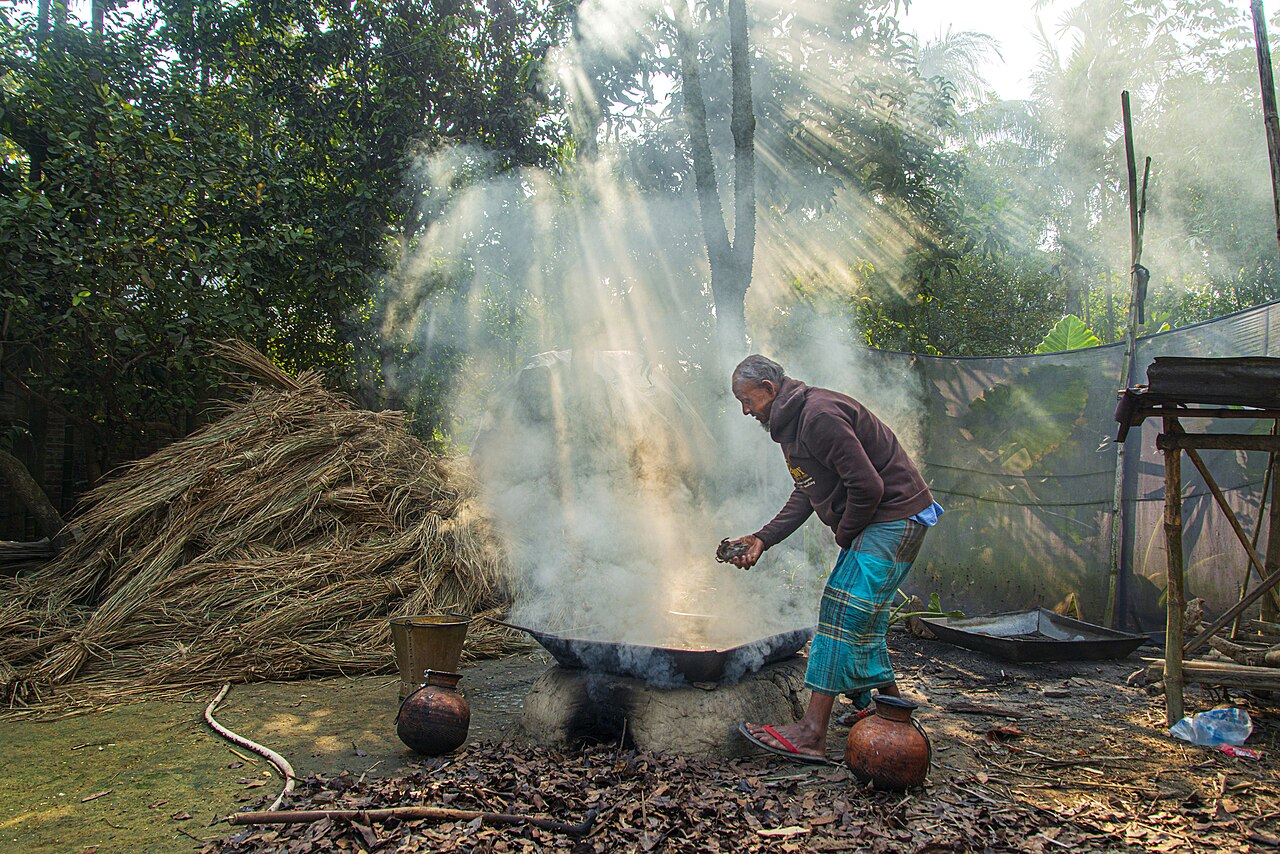
In Jashore's villages the palms are being cleaned and readied for tapping as the cool mornings return. The sap season runs from Kartik to Falgun, roughly mid-October to mid-March. Farmers, tappers and traders hope sap and molasses will bring about Tk 100 crore of economic activity this season.
The Department of Agricultural Extension counts about 22,59,711 date palms in the district's eight upazilas. Sap is drawn from 3,29,196 of them by 6,250 tappers and 15,144 farmers. Output is put at 5,28,88,695 litres of sap and 7,090 tonnes of molasses worth about Tk 111.17 crore.
On last season's figures Bagherpara made the most molasses at 611 tonnes, ahead of Manirampur at 582 and Jashore Sadar at 521. Jashore date molasses received geographical indication (GI) status on 15 February 2024.
Behind the promise lies a long-running crisis. Ali Reza, a tapper from Masna Khanpur in Manirampur, says young people no longer want the work and that palms are vanishing, burned as fuel in illegal brick kilns. A tapper spends Tk 2,000-3,000 on tools before the season, while daily wages are Tk 400-500.
Atiar Rahman of Arabpur leases about 600 palms a year. He says costs are up, tappers are hard to find and molasses prices are low, and he fears tapping could stop altogether.
Sultana Afroz, additional deputy director (horticulture), says farmers are being advised to plant palms around homes, on fallow land and along roads, and trained in better tapping methods.
Deputy Commissioner Mohammad Ashek Hasan says a gathering of tappers is planned for the first week of November. A database of more than 1,000 tappers has been built in Chaugachha, and incentives will be arranged as needed. Several entrepreneurs have learned maple syrup making in Canada, and a date sap syrup is planned, to be tested by BSTI. The report is by district correspondent Sarowar Hossain.
Photo: NIslamPhoto / Wikimedia Commons (CC BY-SA 4.0)
Source: Banglanews24

Comments
(0)