
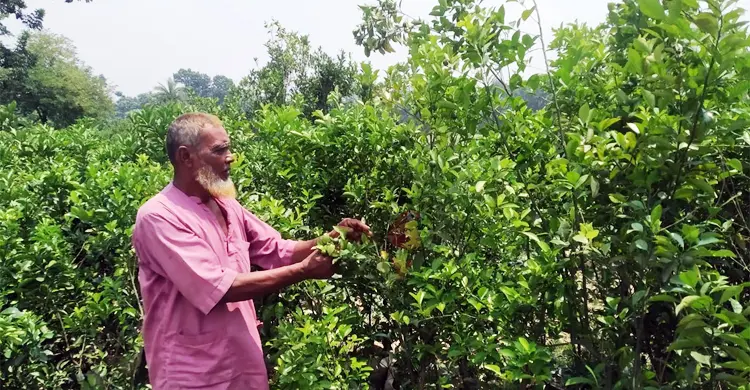
Mohammad Ali, 72, of Basudebpur village in Rohita union, Manirampur upazila, Jashore, has been in the nursery trade for 55 years. He says he has produced more than 20 lakh seedlings and spread them across the country, and that there is no sapling that can be grown in Bangladesh that he has not produced. Following his lead, countless nurseries have sprung up in Basudebpur and nearby villages, and Basudebpur has become the "nursery village". That is now the name everyone knows it by.
About 500 families live in Basudebpur, some 13km south of Jashore town. Four hundred of the homes have nurseries, though a little over 100 are formal businesses. Basudebpur bazar also has more than 100 small and large seedling shops. Three-quarters of the villagers are now involved in the nursery trade.
Wherever you look in the village there are nurseries and seedlings. There is hardly a sapling that cannot be found: from mango, jackfruit, guava and every local fruit to apple, orange, grape, malta, foreign persimmon, durian, rambutan, "pinak butter", kiwi, white sandalwood and red sandalwood, among other fruit and herbal trees.
Locals say nursery owners supply seedlings by the truckload all over the country throughout the year. About one crore seedlings a year go out from Basudebpur. The whole village has become self-reliant, and by producing seedlings in such numbers the villagers are also helping to protect the environment.
The 'nursery guru'
Mohammad Ali laid the foundation of the nurseries in Basudebpur. In Manirampur and nearby areas he is known as the "nursery guru". His business, Puraton Nursery, beside the bazar, is now run by his sons.
Recalling how it began, he goes back nearly 60 years, before independence. He used to go to Jhikargachha bazar with his father, Oliullah Munshi, carrying litchi graft seedlings, selling them for one or two annas each. Traders from Barishal and elsewhere came to Jhikargachha by boat then with seedlings of amra, bay leaf, guava and other trees. By watching their seedlings and talking to them he slowly learned how to raise other plants. After litchi he grew betel nut seedlings, then jamrul, bay leaf, sapodilla, mango, kul and guava seedlings and grafts. He never looked back. For 55 years he has been producing seedlings and sending them across the country; in some years he produced one or two lakh.
He said his father started the nursery trade but he gave it a formal shape. The village now produces very good quality seedlings at lower prices than other areas, so wholesalers and agri-entrepreneurs from Rangpur, Dinajpur, Rajshahi, Khulna, Barishal, Sylhet and elsewhere buy from here. From the seedling business Mohammad Ali has bought 25 bighas of land and built a brick house.
A village of nurseries
His son Anarul Islam, who runs part of Puraton Nursery, said he came into the business through his father. Several lakh seedlings a year go out from their nursery alone, and others followed their example until almost every home had one. Seedlings supplied through the year from the village's more than 400 nurseries would reach one crore, he said.
He added that this year's orders for litchi seedlings from the northern region alone are worth Tk 1.5 crore to Tk 2 crore, to be supplied in the coming season.
Shahjahan Kabir, owner of Akash Nursery, said he joined the trade through his father 18 years ago. Ten workers now work at his nursery, where he raises seedlings of mango, amra, guava, orange, malta, sweet tamarind, olive and other fruit, timber and medicinal trees. Wholesalers and retailers from different areas buy them by the vehicle-load. He produces and sells about 50,000 seedlings a year.
Nursery worker Bholanath Sarkar said that since nurseries spread to every home there has been no shortage of work. Most labourers in the village work in nurseries, and the wages keep their households going.
Inspired by the spread of nurseries, Jamal Hossain set up a nursery in his yard and on his roof three years ago. He has 60 kinds of seedlings there, and last year earned more than Tk 3 lakh from selling them.
Manirampur upazila agriculture officer Rituraj Sarkar said almost every home in Basudebpur has a nursery. They produce many kinds of seedlings and supply them nationwide all year, particularly to orchard owners and traders on demand. The nurseries have made the whole village self-reliant and changed its socio-economic condition, and by producing lakhs of seedlings the villagers are also playing an important part in protecting the environment.
Source: Jagonews24. First published in Bengali on The Agro News.


Comments
(0)