
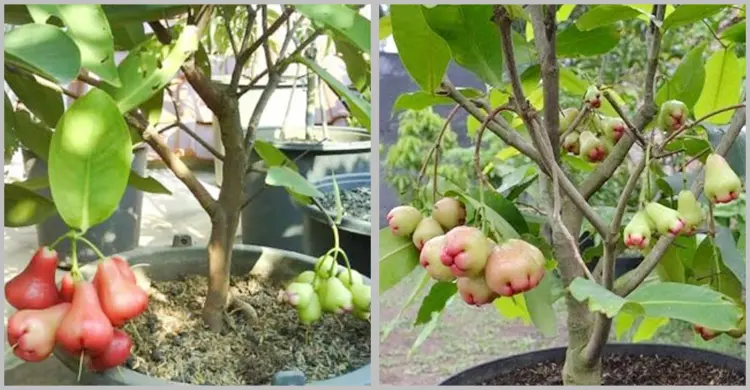
Rooftop gardens are becoming popular in both villages and cities, as people turn to them for fruit and vegetables free of poisonous chemicals. Fruit and vegetables are a better choice for the roof than flowers and ornamental plants, and jamrul is a popular fruit in Bangladesh that is easy to grow on a rooftop.
Jamrul can be eaten both raw and ripe, and a tree bears fruit in several flushes in a season. The fruit is shaped much like a pear and is waxy white, but red, green and other coloured varieties have now been developed. Alongside the small, bland local type, sweeter and larger varieties have arrived in the country. Some of the new varieties are big and sweet and came from Thailand, which is why everyone calls them Thai jamrul.
Planting in a half-drum
Trees of the modern varieties are bushy and short, so they can be planted in half-drums on the roof. If there is space in the yard, however, planting in the ground is better than a tub or drum. Fill the half-drum by May with a mix of half loam soil and half cow dung or organic fertiliser.
Mix into each half-drum 1 kg of wood ash, 500 g of bone meal, 250 g of TSP, 150 g of MoP and 50 g of boron fertiliser. Leave at least two inches empty below the top rim of the drum when filling it with soil and fertiliser.
Planting in the ground
Trees planted in the ground grow larger. If you plant several grafts, keep them 3-4 metres apart, and for an orchard keep the same distance on all sides. June-July is the best time to plant grafts, though jamrul can be planted at any time of year. Dig a pit half a metre in each direction at the chosen spot.
Mix 15 kg of cow dung, 1 kg of wood ash and 500 g of bone meal into the soil of each pit. Plant the graft in the middle of the pit, press the soil down around the base and support it with a stake. Water lightly after planting and whenever the soil dries. Applying chemical fertiliser to young and fruiting trees before each monsoon is beneficial.
Each fruiting tree needs, every year, 10 kg of cow dung together with 500 g of mustard oil cake, 1 kg of urea, 500 g of MoP and 500 g of TSP, mixed into the soil around the tree after loosening it a little away from the base. If this seems like too much trouble, 4-8 fertiliser tablets pushed into the soil at the base of each drum tree in a rooftop garden will serve the whole year.
After planting jamrul on the roof, look after it regularly and water it in the right amounts. That way you will get the harvest you hope for.
Source: Jagonews24. First published in Bengali on The Agro News.

Comments
(0)