
Jamalpur district has chars, or river islands, spread over a wide area. They grow maize, green chillies and a range of other cash crops. But poor communication is the main obstacle: farmers often miss out on fair prices for what they grow because their produce is so hard to move. The wealth of char crops could lift the national economy, yet the difficulty of road travel has made life on Jamalpur's chars miserable.
According to the Department of Agricultural Extension (DAE), the chars in Jamalpur's seven upazilas cover 47,893 hectares: 8,051 hectares in Jamalpur Sadar, 8,330 in Sarishabari, 6,150 in Melandah, 8,250 in Islampur, 7,350 in Dewanganj, 5,100 in Madarganj and 4,262 in Bakshiganj.
A long way from the upazila towns
To reach the chars, people travel a long way from the upazila towns and then cross the Jamuna or one of its branch rivers. Some chars still have no proper roads. On the sand the only ways to travel are on foot, by motorcycle or by horse cart. Where roads exist, many are so broken they are barely usable.
Char people cannot easily reach hospital if they fall ill suddenly, and the poor links also get in the way of marketing their crops. Residents have urged the government to improve communication so that they get fair prices and a better quality of life.
From Sarishabari town it is about an hour by car to a branch of the Jamuna, then around half an hour by trawler across the river. The settlements lie further on from where the trawler drops passengers, across open sand, reachable by motorcycle, horse cart or on foot. About 20 minutes by motorcycle brings you to Nalsandhya village in Pingna union of Sarishabari, home to around 7,000 people. The char grows large amounts of chillies, maize and vegetables, but as on other chars, poor communication makes life hard.
The Mondoler Bazar to Kholabari road
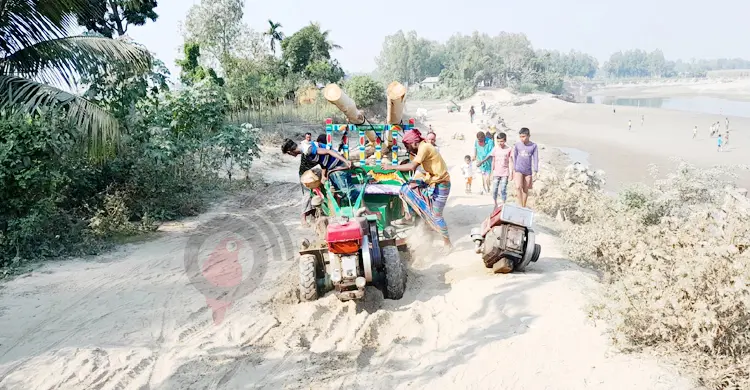
Kholabari, a char area in Dewanganj, lies about three kilometres from Mondoler Bazar, and locals describe that three-kilometre road as a nightmare. In the monsoon, when the current of the Jamuna meets a branch of the Brahmaputra running alongside, much of the road has been washed away. Just past Mondoler Bazar is a broken section no vehicle can cross. In the dry season people walk across it, knee-deep in dust, and goods vehicles have to be pushed and manoeuvred for a long time to get through.
In the monsoon this stretch has to be crossed by boat, at some risk, and often no boat is available. The rest of the road to the Jamuna at Kholabari is also badly broken; in places there is no trace of the bitumen, only some scattered gravel.
At the broken section near Mondoler Bazar, two engine-driven vans were seen carrying eucalyptus logs cut on the char. They could not get across for a long time, and one van, loaded with logs, was seen stuck in the dust.
Md Ali, met on the road near Mondoler Bazar, said: "In the monsoon there is no end to our suffering on this road. You cannot cross this stretch without a boat, and often there is no boat. If someone falls ill suddenly, there is nothing left but death."
Anwar Hossain, who drives an auto-rickshaw on the road, said: "Since the break near Mondoler Bazar we cannot go through. Even the road that is left is broken everywhere. It has been like this for a long time and nobody looks into it."
Farmers say prices would double
Shafiqul Islam of Char Mugri, next to Kholabari in Chikajani union, said: "A lot of maize grows on this char, and chillies too. Yields of both have risen a great deal. There is demand for both crops, so we get a price and they sell straight from the field. But if the road (Mondoler Bazar to Kholabari) were good, we would get double the price."
Md Sona Mia, coordinator of the char crop marketing centre at Kholabari Bazar, said: "We suffer most in the monsoon. The broken part of the road has to be crossed by boat. Often an emergency patient has to be taken to hospital but there is no boat. The boats stop after dusk, and then nothing can be done in an emergency. Train passengers often get stuck there."
He said auto-rickshaws now run only as far as the broken section: people wade through knee-deep dust and take another auto-rickshaw on the other side. "Big vehicles used to come on this road. Now no goods vehicle can get in. The road has been like this for three years. Maize, chillies and groundnuts grow on thousands of acres here; it is a farming area. It costs as much to get across this break to Mondoler Bazar as it does to go to Dhaka. If the road were good, farmers would get better prices for their crops." He urged the government to repair the road, used by thousands of people, quickly.
Officials and researchers
Md Ashraful Islam Akkas, chairman of Chikajani union parishad, said: "We are talking to the LGED (Local Government Engineering Department) about repairing the road from Mondoler Bazar to Kholabari. Work on the Mondoler Bazar road has already started."
Md Manjurul Kadir, chief scientific officer at the Jamalpur regional office of the Bangladesh Agricultural Research Institute (BARI), told Jagonews: "Crops grow well on the chars, but marketing is a big problem because of poor communication. From some chars, getting to market means two or three hours by boat and then a broken road. That stands in the way of farmers getting a fair price." He added that government help does not reach the extreme chars, and that Dewanganj, Islampur and Sarishabari have many remote chars.
Md Shamsul Alam, Jamalpur intervention specialist of the Making Markets Work for the Chars (M4C) project, jointly funded by Switzerland and the Bangladesh government, said: "Poor communication on Jamalpur's chars is a challenge. For trainings our staff often have to stay overnight on a char to run the next day's session. In places we take senior officials by special boat. Communication on the chars of Sarishabari and Islampur is very bad."
Source: Jagonews24. First published in Bengali on The Agro News.
Comments
(0)