
Jamuna river erosion has left thousands of people destitute. In nature's game of breaking and building, they find shelter again on the Jamuna's chars, and with effort, nature makes them prosperous once more. This is the story of how the destitute people of the chars are bouncing back.
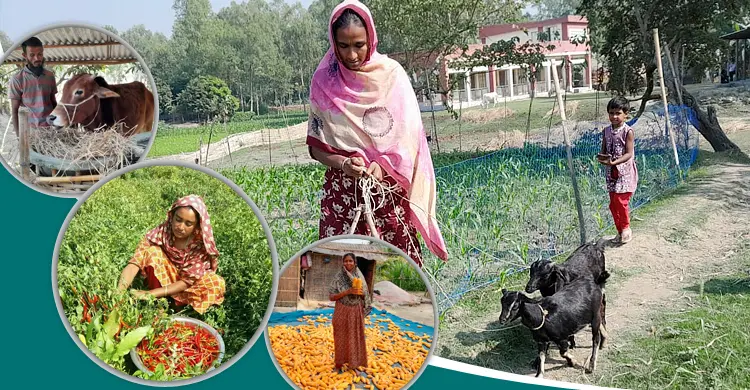
People on the chars of Jamalpur are turning their lives around through livestock rearing and farming. Having learned to use improved seed and modern techniques, they are getting several times the yields of before, and fair prices too. With modern livestock management they fatten animals in a short time and make a profit. Women are leading the way.
According to the Department of Agricultural Extension (DAE), the chars in Jamalpur's seven upazilas cover 47,893 hectares: 8,051 hectares in Jamalpur Sadar, 8,330 in Sarishabari, 6,150 in Melandah, 8,250 in Islampur, 7,350 in Dewanganj, 5,100 in Madarganj and 4,262 in Bakshiganj.
Dewanganj is 42 km from Jamalpur Sadar. A road runs north from Mondoler Bazar in Dewanganj. Along the broken road, the trees thin out and the soil becomes sandier, with only fast-growing eucalyptus on either side. This is Chikajani union. About three km on, the road ends at Kholabari Bazar. Beyond it lies the Jamuna char, with Char Mugri nearby.
Women fattening cattle
Asiya Khatun lives in Char Mugri. She has two children, a nine-year-old son and a five-year-old daughter. Her home was in Kholabari until the Jamuna washed it away; now she lives on rented land at Char Mugri haat. Her husband, Ruhul Amin, is unemployed. Asiya passed the HSC and sat the primary school teacher recruitment exam, passing the written test but failing the viva. She now keeps the household going by rearing cattle.
Having learned improved livestock management, she is making a profit in a short time. "The last one I bought for Tk 69,000 and sold for Tk 1 lakh 12 thousand after rearing it for three or four months," she said.
"I have learned the rules of rearing animals. I feed them from two containers, one for water and one for grass. Before, I gave water and grass together in one container. I grow improved grass on empty land beside the house to feed the cattle. Every three months I give deworming medicine at a set dose for every 75 kg of the animal's weight," she said.
She said she fattens any cow within four or five months of buying it, and they can also work out a cow's weight, so there is no risk of being cheated when selling.
Like Asiya, Momota Begum and Shirina Begum of the village have become self-reliant by rearing cattle. "We buy cattle, rear them for three or four months and sell them. The profit is good. We feed them grass and grow the grass ourselves. We vaccinate on time. In a short while we fatten them and sell them on," said Shirina Begum.
"About three months ago I sold one. I bought it for 50,000 and after three months sold it for Tk 80,000," she said.
Momota Begum said: "I bought two cows for Tk 1 lakh 16 thousand. I'll keep them for a while, not long, three or four months. Right after buying I gave them deworming tablets. I'm feeding them grass, oil cake and bran on schedule. I hope to get a good price."
Maize and chilli
Salma Begum's family has four members. Her husband is a day labourer, and they have two daughters, aged 13 and 7. She grows maize.
"We are profiting from maize. A bigha used to yield 20 to 25 maunds; with improved seed and methods it now yields 40 to 45 maunds. There is demand for maize too, at Tk 1,200 to Tk 1,300 a maund," Salma Begum said.
"We apply fertiliser and spray the maize field. My husband and I farm together," she said.
Farmer Md Shafikul Islam has also turned his life around growing maize and chilli. "River erosion took everything, house and land. Now I am doing well farming, and I have a place to live," he said.
Yields are good and fair prices are available, he said. A bigha yields 10 to 12 maunds of chilli. Last year dried chilli fetched up to Tk 20,000 a maund, and he sold 10 maunds.
"I spray pesticide on time, use zinc and boron and apply fertiliser at the right time. That is why the yields are good," he added.
Ramisa Begum and Nargis Begum of the village said they too are profiting from maize and chilli.
In Char Mugri and other villages of Chikajani union, the fields are now covered with young maize plants, and almost every house keeps cattle and goats.
Seed, markets and credit
Md Manjurul Kadir, chief scientific officer at the Jamalpur regional office of the Bangladesh Agricultural Research Institute (BARI), told Jago News: "Getting improved seed to remote char areas is a challenge. Marketing is also a big problem, which we are gradually overcoming. River erosion victims are left completely destitute. They face a financial crisis, and banks do not lend to them."
"Jamalpur grows a lot of maize, groundnut, chilli and various vegetables. Maize is the main crop of the Dewanganj chars, followed by chilli. Groundnut and foxtail millet are also grown, and onion too. There is intercropping as well, with groundnut and onion grown together," he said.
He said linkages set up by various private organisations for marketing are more or less ensuring farmers a fair price.
"But it would be good if poultry feed could be made locally from the maize here, and entrepreneurs could come forward for that. A factory could be set up here to pack dried chilli."
Manjurul Kadir added: "The groundnut grown on the Dewanganj and Rajibpur chars will be harvested in the first week of February. Panchagarh produces the most groundnut and uses it as seed there, so a linkage should be made. Then these farmers can sell groundnut at a high price, and Panchagarh can use their good seed."
He said production in Jamalpur is rising mainly because of improved seed and modern techniques: where a bigha used to yield about 20 maunds of maize, it now yields up to 45 maunds.
The M4C project
According to those involved, the Making Markets Work for the Chars (M4C) project is chiefly behind the change in living standards through modern livestock and farming methods in Jamalpur's remote chars. It is jointly funded by Switzerland and the Government of Bangladesh and implemented by the Rural Development Academy, Bogura, and Swisscontact Bangladesh.
Md Shamsul Alam, intervention specialist for the M4C project in Jamalpur, told Jago News: "On the chars we are working mainly to improve marketing. We are also working on contract farming of crops, cattle and goat rearing, and building traders' capacity, and to help farmers and traders get the credit they need."
"We are working with large companies to market farmers' produce so that farmers get a fair price. Through this work, production on the chars will rise and they will get fair prices, which will improve their living standards," he said.
"Through M4C we form groups of farmers and traders. They get training in growing crops and rearing livestock, and in marketing. This builds farmers' links with the different parts of the marketing process."
He said M4C is being implemented in Sarishabari, Melandah, Islampur, Dewanganj and Bakshiganj upazilas of Jamalpur. "There are 3,000 families in 118 farming groups, 2,500 families in 100 cattle-rearing groups and 2,000 families in 80 goat-rearing groups. In Jamalpur, 17,000 people have been trained in the three categories over the past year."
Dewanganj's harvest
Dewanganj upazila agriculture extension officer Abul Hasan Raju told Jago News: "Dewanganj has 18,838 hectares of cultivable land. Maize is now one of our main crops. The target this year was 5,300 hectares, but maize has been grown on 5,500 hectares, more than the target. Groundnut was grown on 220 hectares against a target of 100 hectares, and chilli on 350 hectares."
Assuming 35 to 40 maunds of maize per bigha, Dewanganj could produce 60,000 to 65,000 tonnes of maize this year. At 25 to 30 maunds per bigha, 2,500 to 3,000 tonnes of green chilli could be produced, and at one and a half tonnes per bigha, 330 tonnes of groundnut, Abul Hasan Raju estimates.
He said yields have risen sharply because farmers use improved seed and modern methods, but char farmers are not getting as much government support as they should. Improving communications cannot happen overnight, but he can build market linkages, and that is being done.
Abul Hasan Raju added: "This year 1,200 hectares of new char have emerged in Dewanganj and are being farmed with groundnut, wheat and chilli. We expect farmers to profit from various crops this year."
Source: Jagonews24. First published in Bengali on The Agro News.

Comments
(0)