
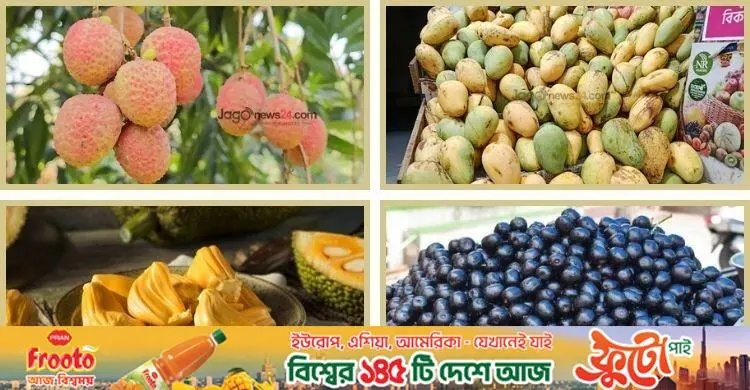
Jaishtha is the last month of summer, when fruit ripens and swells with juice. The main juicy fruits of this month are mango, jam (black plum), jackfruit and litchi. Bangladesh's markets overflow with fruit and the air is full of its fragrance. Fruit from the villages fills city lanes and markets; no other month of the year sees so much fruit. That is why many people call Jaishtha 'Madhumas', the honey month.
In the dictionary, though, Chaitra is Madhumas. One may wonder why a month of blazing sun should be called the honey month. In fact this is the spring season. With spring comes a big change in nature: trees fill with colourful flowers, the cuckoo calls, and people too feel a different emotion. That is why the month of this season is called 'Madhumas'.
A season of fruit and festivals
Back to Jaishtha. Besides mango, jam, jackfruit and litchi, this month brings pineapple, watermelon, dewa, latkan, kalo jam, golap jam, cane fruit, gab, jamrul, custard apple, kau, water palm, wood apple (bel), papaya, karamcha, chalta, star fruit, olive, ashphal, local dragon fruit, sharifa and many other fruits to market. In the villages, relatives invite one another around the fruit, and people visit relatives carrying fruit from their own trees. Fruit festivals are also held in the towns, and new traders appear.
Fruit is sold even from temporary tents, and online trade picks up too. Temporary businesses spring up in areas famous for mangoes and litchis. People from other professions are seen trading seasonal fruit, because ripe fruit cannot be kept at home for long. Many farmers grow local fruit alongside other crops and earn extra income from it. Since the fruit season is short, many profit by taking up fruit trading as part-time work.
People of various professions sell fruit on social media, and many vegetable sellers switch to fruit this season. Various organisations hold fruit festivals at their offices, buying assorted fruit to celebrate with colleagues. Social and cultural organisations and university campuses also hold fruit festivals.
Schools and colleges declare a 'summer holiday' in this season, so students rush to their village homes to enjoy the fruit. Schools and colleges in rural areas also organise fruit festivals. Although foreign fruit dominates all year, in Jaishtha the whole market is controlled by local fruit and foreign fruit is seen less, because Bengalis are strongly drawn to local fruit at this time, in a way not found the rest of the year.
The king of fruits
The mango is not only the king of fruits; the mango tree is Bangladesh's national tree. The mango has been prized for a long time. The Persian poet Amir Khusrau called the mango "the best fruit of Hindustan" in the 14th century, and in modern times the famous horticulturist Popenoe called it "the king of fruits of the East". In Sanskrit it is amra; in Bengali, aam. Sanskrit has another name, rasal, which refers to both the fruit and the tree. 'Aam' also means common: the mango is the fruit of the common people. Although its origin is debated, scientists agree that this region is the original home of the mango.
History tells us that in 327 BC Alexander was delighted to see and taste mangoes in the Indus Valley. Around this time the mango spread to the Malay peninsula, Indonesia, the Philippine islands and Madagascar. Mangoes have been grown in Africa since 1331 AD. In the 16th century the mango reached the Persian Gulf region. In 1690 there were reports of mangoes grown in glasshouses in England. The mango reached Yemen in the second half of the 17th century and the Canary Islands in the 19th century. Mango growing in Italy was reported in 1865. In the early 18th century the Portuguese carried mangoes by ship to America and Brazil. In 1774 Spanish traders took the mango to Mexico. In 1865 the first mango tree grew from a seed in the soil of the Hawaiian islands. Bangladesh has nearly a thousand varieties of mango with colourful names.
Other local varieties include Suryapuri, Kua Pahari (late), Bombai (late), Mohanbhog (mid-season) and Lata-Bombai (a small tree with small fruit, mid-season). The varieties released by BARI are the early BARI Aam-1 (Mahananda), mid-season BARI Aam-2 (Amrapali), which is somewhat late, BARI Aam-3, and the late BARI Aam-4.
Jackfruit, jam and litchi
The jackfruit is the world's largest fruit and a delightful one. It is not only the national fruit but is also known as the poor man's fruit. People here happily eat unripe jackfruit as a vegetable. Ripe mango is delicious with milk, and jackfruit can be eaten with or without milk and rice. The dried seeds are roasted, boiled or cooked as a vegetable in curries.
Jam brings to mind the rural poet Jasimuddin's line, "staining our faces with the sweet juice of ripe jam". There are broadly two kinds: kalo jam, which is large, and wild jam, which is small. Jam is most plentiful in Cumilla, Noakhali, Sylhet, Dinajpur and Pabna.
Another juicy fruit of the month is the litchi. Masumpur in Dinajpur is famous for litchis, and Madrazi and Bombai litchis are found almost all over the country. Inside the juicy white flesh is a small brown seed. The fruit is sold by the piece, 50 or 100 to a bunch, and priced by the hundred. Each variety has its own price and taste.
A blessing, and a warning
Jaishtha's many fruits also include watermelon, melon (bangi), jamrul and more. Fruit is a wonderful blessing of Almighty Allah. People usually cook their food, but fruit is a blessing that needs no cooking, and there is no need to drink water after eating it, because most fruit contains a measured amount of water. A proverb says, "Drink water after fruit and death calls you to come", meaning it is better not to drink water right after eating fruit.
We will eat plenty of fruit this season. But beware: some dishonest traders mix toxic chemicals into fruit to ripen it quickly and make it look shiny. We must stay away from such traders and warn those doing this wrong. If they do not heed the warning, it is the sacred duty of every conscious citizen to help the relevant government department bring them to justice.
Source: Jagonews24. First published in Bengali on The Agro News.

Comments
(0)