
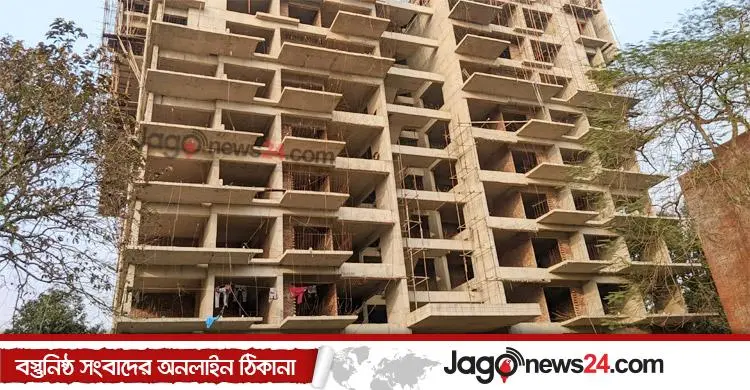
Twenty-six structures are being built under a further development project at Jahangirnagar University (JU), one of the country's richest reservoirs of wildlife and biodiversity. About a thousand trees have been felled, countless birds and animals have lost their habitat, and many birds are dying after striking the tall buildings. The Implementation Monitoring and Evaluation Division (IMED) says the "unplanned" tree felling is harming the university's natural environment.
Jahangirnagar University and the University Grants Commission of Bangladesh sent a proposal to the planning ministry to raise the project's cost and extend its deadline again. In response, the ministry had IMED prepare an on-site report. IMED director Sonia Binte Tabib inspected the site on 8 December last year and prepared the report, which found various irregularities in implementation.
Trees, birds and wildlife
After the inspection, IMED said that although many trees need to be planted to keep the environment in balance, no money was set aside in the project for tree planting. Many birds are dying after hitting the multi-storey buildings, and the number of birds on campus has fallen significantly. The trees were cut without considering the campus's monitor lizards, mongooses, foxes, squirrels and migratory birds.
Under the project, 2,000 extra students will be admitted to 15 additional departments; the fourth and fifth floors of one male students' hall will be extended; and new halls will be built, three for male and three for female students, described as 10-storey halls with a capacity of 1,000 each. This will house another 6,152 students. A modern 10-storey administrative building and five residential towers for teachers, officers and staff are also meant to solve much of the university's residential and administrative problems.
The project, begun in 2018, was not finished even after one extension, and a new extension has been sought. About 207 trees of various species, including 178 jackfruit trees, were felled for the three female students' halls; 200 for the extension of the Social Sciences faculty building; over 150 for the library; over 100 south of the central playing field for the sports complex; and over 100 for the guest house, with more than a thousand trees felled across the campus in all.
Fears of empty buildings
Five 11-storey buildings are being built to house teachers, officers and staff. IMED said quarters built earlier on campus are lying unused and most teachers and officers live off campus, so the new buildings are feared to stand unused too.
The project was approved at a cost of Tk 1,445 crore 36 lakh, to run from October 2018 to March 2022. It was later extended to 31 December 2024. By November 2024, financial progress stood at Tk 944 crore 52 lakh 48 thousand, 65.35 per cent of the total cost, with physical progress at 70 per cent. The work will not be completed in this term either, and a further extension of two and a half years, to 30 June 2027, has been proposed. It was while examining the case for this extension that IMED's report uncovered the environmental damage.
The project has 26 construction and civil works components, of which seven are complete. Of the remaining 19, work is under way on extending power lines and installing transformers, extending water lines and installing deep tube wells, preparing a playing field for female students, and improving the Al-Beruni Hall playing field.
Work is also continuing on the administrative building (10 storeys), a residence for house tutors (10 storeys), a residential complex for provosts (10 storeys), residential towers for teachers, officers, third-class employees, fourth-class employees and cleaners (11 storeys each), and a guest house cum postgraduate researchers' house (10 storeys).
Horizontal extensions of the Biological Sciences, Social Sciences, Arts and Humanities, and Mathematical and Physical Sciences faculty buildings (6 storeys each), a lecture theatre and examination hall building (6 storeys), a new library building (6 storeys) and a sports complex (3 storeys) are also under construction.
The work order for the 10-storey administrative building, on a 10-storey foundation, was issued on 19 April 2022. After work began, the contractor faced internal opposition at the university over the site and stopped construction. The education ministry then ordered in August 2022 that work be suspended until further instructions. Later, to maintain environmental balance, it was decided to build the administrative building at a new site, but the ministry has not yet approved the procurement proposal for it. IMED found the extension of two and a half years to June 2027 justified in order to complete tendering, construction and all other project activities.
IMED said the project started more than a year late. The first meeting directed that clearance be obtained from the Department of Environment, with work on other structures to begin after that. From March 2020, regular work was severely disrupted by the global coronavirus pandemic.
IMED's recommendations
IMED recommended ensuring that the university takes the necessary steps to repair the environmental damage caused by the project, and that construction follows the project plan, with action under the rules against contractors found negligent. The university authorities should take proper steps so that buildings for provosts, teachers, officers and staff do not stand unused, and the sports complex should be used for its purpose of fostering sport and producing new players. In future projects, the ministry concerned should check the reality and build only the number of buildings needed, avoiding waste of time and public money. IMED opposes any further extension after this one.
Asked about the report, Sonia Binte Tabib told Jago News: "The project work is ongoing. We visited and saw the progress, and looked at how much time it will take to finish."
Asked what kind of environmental damage is being done, she said: "A committee has been formed at Jahangirnagar University. If you ask the committee, they will be able to tell you better."
What the university says
Asked why new buildings are being built when many older quarters are lying empty, project director and member of the university's committee, engineer Md Nasir Uddin, told Jago News: "Everyone knows why the quarters are empty. There is not really a liveable environment there. The new buildings are being built to a proper standard. I hope they will always be full."
On what steps would be taken for the environment after so many trees were cut, he said: "Trees are being planted at all the construction sites. A university is not a forest. In the beginning trees were planted everywhere because the land was empty. Now some trees have had to be cut to construct buildings. We are planting trees again."
He added: "We have asked for an extra two and a half years. We hope the project will be 100 per cent complete in that time."
Asked about the campus's wildlife and biodiversity, Professor Md Kamrul Hasan of JU's zoology department told Jago News: "Under the project, buildings have been built by destroying the habitat of birds and animals, and tree cover has shrunk. We were not involved in how the sites were selected."
On the IMED report, he said: "The IMED report has not reached us yet. It is true that bird habitat has been destroyed, but I do not know whether birds are dying."
Source: Jagonews24. First published in Bengali on The Agro News.

Comments
(0)