
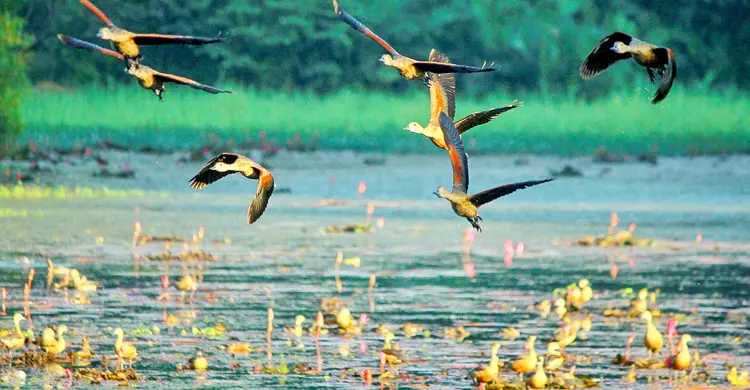
As every year, flocks of migratory birds have flown thousands of miles to Jahangirnagar University (JU), known for its natural beauty, heralding the arrival of winter.
Amid the dryness of winter, the visiting birds have brought the university's water bodies back to life, and their calls fill the green campus from morning to evening. On foggy mornings the birds flit and squabble over lakes full of red water lilies, flying from lake to lake, hunting for food or rising in flocks into the blue sky beside the red-brick buildings.
The university has 12 water bodies large and small. Birds have come to the one next to the transport yard, the one in front of the new administrative building, the one inside the Wildlife Rescue Centre and the one beside the swimming pool.
Visitors put birds at risk
On holidays, bird-loving visitors from Dhaka and nearby areas crowd onto the campus, and the pressure of visitors and extra vehicles is threatening the birds' habitat.
Tamanna, a third-year student of Biochemistry and Molecular Biology, said: "Guest birds come to Jahangirnagar from far away and we spend our days enchanted by them. Just watching them fly in flocks and move together across the water shows how beautiful it is."
Bird expert Kamrul Hasan, a professor of zoology at the university, said the first migratory birds of the season arrived at the university's lakes on 17 September. So far lesser whistling ducks and some large whistling ducks have come. Most birds usually arrive in December, when the most species are seen. Because admission tests ran at the university for a long stretch of November and drew crowds, bird numbers are comparatively low so far, but he hopes they will rise towards the end of December.
He said large crowds gather on the lake banks on holidays, so the birds do not feel safe. Everyone must make sure visitors do not linger on the banks, throw stones or drop plastic waste.
University takes steps
Acting proctor A S M Firoz-ul-Hassan said Jahangirnagar is naturally different from other universities in Bangladesh, and many migratory birds come to its lakes in winter. The lakes have been cleaned for the birds and, as every year, awareness banners and festoons have been put up. He urged visitors to keep the birds safe.
To escape severe cold and food shortages, migratory birds usually start arriving in the haor regions and other parts of the country from the last week of September to early October, from Siberia, China and Mongolia north of the Himalayas.
According to the zoology department, guest birds have been coming to the university's lakes since 1986. In the past 195 species of local and foreign birds were seen in the water bodies, including pintail, comb duck, pochard, chita tupi, lesser whistling duck, nakta, manikjor, garganey, small and large sorali, bamunia, ducks, moorhen, wagtail, foreign egrets and jacana.
Source: Jagonews24. First published in Bengali on The Agro News.

Comments
(0)