
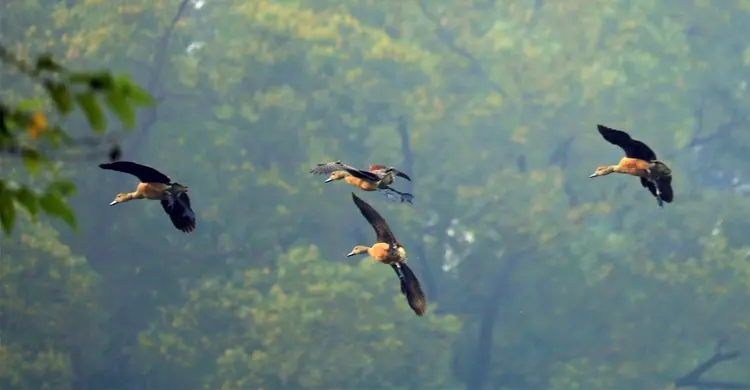
Dew-soaked grass at dawn, a line of fog close by fading in the sunlight, then a sudden gust of chilly north wind: this is how nature announces that winter is coming. At this time of year Jahangirnagar University becomes another name for natural beauty, as birds from abroad arrive on its lakes, red with water lilies.
The university has been closed since 17 March to stop the spread of the coronavirus, and the campus, empty of students, is silent. But the arrival of migratory birds seems to be bringing it back to life.
On this campus of rolling and flat land on the outskirts of the capital, bird numbers rise as the cold deepens. The sight of birds floating and playing on the lakes is a delight, and all day long they fill the university's water, land and sky with their play.
They have already settled on the lake in front of the new administrative building, the lake inside the Wildlife Rescue Centre, the lake by the transport section and Joypara lake by the swimming pool.
Along with native species, these foreign ducks come from the snowy Himalayas and faraway Siberia. They spend some time in different parts of Bangladesh and then return home, which is why they are called guest birds. They fly each year to temperate countries such as Bangladesh mainly to escape the severe cold of their own regions.
They include sarali, garganey, pochard, manikjor, murgyadhi, jolpipi, nakta, kalai, flycatcher, patari, chita tupi, lal gurguti and many other species.
According to the university's zoology department, migratory birds first began coming here in 1986. The campus has 195 species of birds in all, 126 native and 69 foreign. The migrants start settling around the university's waterbodies in early October, and numbers peak around December.
More birds, more species
Birds usually start arriving in early November, but this year they came earlier, from September, and both the number of birds and the number of species have risen.
The bird census last December recorded a little over 5,000 birds on campus. This year a preliminary census found about 5,000 birds at the very start of the season.
Last year five species came; this year seven species have come to the university's four lakes.
The species are the nakta duck, khunte duck, jiria duck, bhuti duck, lenja duck, African comb duck, lesser whistling duck and greater whistling duck. The lesser whistling duck comes from the country's haor region, while the greater whistling duck comes from Siberia, Nepal, China and Assam and Arunachal in India.
Bird expert Dr Md Kamrul Hasan, professor of zoology, said the preliminary census was carried out on 8 and 9 November.
He said more birds were expected this year than in other years. The most birds usually come in December, but this year the number seen in December in past years had already been seen in November.
Birds keep away from crowds
The university's main road runs beside the two lakes by the transport section and the administrative building, and birds are easily seen from the roadside, so visitors crowd these two lakes most. On the other two lakes birds are seen all over the water, but on these two they stay on one side only, opposite the road and the crowds.
Bird experts say human disturbance, traffic noise and rubbish keep the birds away. Birds are afraid of people, so a set distance should be kept from them. People sometimes carelessly cross the fence to get closer to the birds, which disrupts their free movement.
Because the lakes are beside the road, many people also throw plastic bottles, polythene and other rubbish into them, polluting the environment.
No entry for visitors
With the campus closed to curb the spread of the coronavirus, the authorities have banned outsiders from entering, so bird-watching enthusiasts cannot visit the campus to see the birds as in other years.
Many, however, are defying the ban and entering the campus, increasing the coronavirus risk for campus residents and the likelihood of more disturbance to the birds.
The university's acting registrar, Rahima Kaniz, told Jagonews24 the administration was working hard to stop outsiders entering the campus, but it was not entirely possible because of people's lack of awareness and cooperation, and security staff were facing obstruction in various ways. As every year, the necessary steps had been taken to protect the birds, she said.
Bird fair unlikely
The university's zoology department organises a bird fair to promote bird conservation and public awareness, and has held one every year since 2001. This year, with the campus closed because of the coronavirus, a bird fair is unlikely.
Professor Dr Md Kamrul Hasan, convener of last year's bird fair, said there was no chance of a bird fair this year if the campus stayed closed, though one might be held if the campus reopened while the birds were still there.
Source: Jagonews24. First published in Bengali on The Agro News.

Comments
(0)