
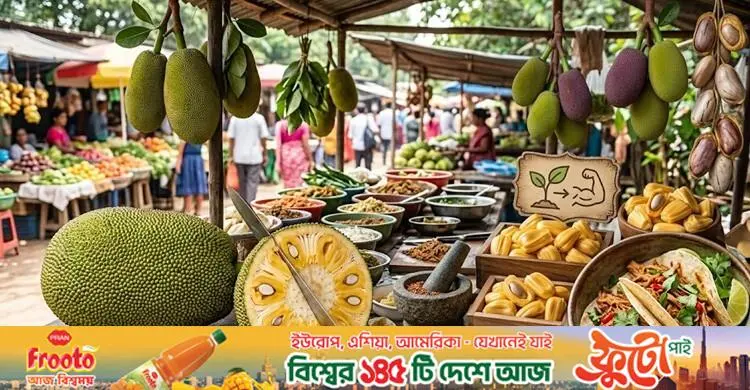
In Bangladesh the jackfruit is a familiar summer fruit. For some it is a childhood memory, for others a sweet afternoon snack, and for many a curry or bhuna of unripe jackfruit. But the fruit we have long seen only as a seasonal or village food has a new identity in many countries: "vegetarian meat", a plant-based alternative to meat.
Many supermarkets in the United States, the United Kingdom, Australia and Europe now sell unripe jackfruit canned, frozen or vacuum-packed, and many restaurants use it to make burgers, tacos, sandwiches, pizzas and barbecue. So what is it about the jackfruit that has made it popular worldwide as a meat substitute?
Texture and taste
The biggest feature of unripe jackfruit is its fibrous texture. Although it is hard and dense before cooking, long boiling or slow cooking separates the fibres, which look and feel much like pulled chicken or slow-cooked beef.
Of course, jackfruit never tastes like meat. The main reason for its popularity is its ability to create a meat-like texture, so with various spices, sauces and cooking techniques it can easily be used in all sorts of meat dishes.
Another big advantage of unripe jackfruit is its very mild flavour, so it readily absorbs the taste of the spices, sauces or herbs it is cooked with. That is why the same jackfruit can be made into barbecue one time and Mexican tacos or Indian curry another. According to food experts, this versatility has given the jackfruit a special place in kitchens around the world.
Health and the environment
People around the world are changing their diets. Considering the environment, health and animal welfare, many are cutting down on red meat and turning towards plant-based food, and unripe jackfruit is an attractive option. It contains dietary fibre, vitamin C, potassium, vitamin B6 and other nutrients, is comparatively low in fat and has no cholesterol.
But it is important to remember that although jackfruit is a meat substitute, it is not nutritionally equal to meat. It does not contain the amount of protein that meat does, so people on a fully vegetarian diet also need lentils, soya beans, chickpeas, nuts or other protein-rich foods.
As concern about climate change has grown, so has the importance of sustainable food systems. Various studies have found that producing plant-based food generally needs less land and water and produces fewer greenhouse gas emissions than raising livestock. Many environmentally conscious consumers are therefore interested in alternatives such as jackfruit. Jackfruit alone is not the solution to the environmental crisis, but it is seen as an important part of a plant-based diet.
From immigrant shops to restaurant menus
Abroad, jackfruit was once found mainly in Asian immigrants' shops. That has changed. Many international restaurants now serve jackfruit barbecue burgers, jackfruit tacos, jackfruit sandwiches, vegan pizza toppings, jackfruit curry, salads and wraps.
As the jackfruit has grown in international popularity, its processed market has also grown fast. Many countries now sell canned unripe jackfruit, frozen jackfruit, vacuum-packed jackfruit, ready-to-cook cut jackfruit and ready meals with spices added, making jackfruit easier to use in busy lives.
An opportunity for Bangladesh
Bangladesh is one of the world's leading jackfruit producers, but a large amount of jackfruit is still wasted for lack of proper storage and processing.
Experts say that if jackfruit can be processed to international standards, it could open new opportunities for the country's agricultural exports. Value can be added not only to fresh fruit but to frozen bulbs, pieces of unripe jackfruit, canned products, dried jackfruit and even jackfruit seeds.
The name "vegetarian meat" should not be misread: jackfruit is not an exact substitute for the taste or nutrition of meat; it has earned the name because of its texture in cooking and its practical qualities.
The jackfruit that many once thought of as just a village fruit has found a new identity in international food culture. It shows that a local fruit can take an important place in global food trends if its potential is used properly.
Bangladesh's national fruit is not only part of our heritage; it is also a promising resource for a sustainable future food system, the farm economy and export trade. Now is the time to look at the jackfruit with fresh eyes.
The article draws on POWO and the Food and Agriculture Organization.
Source: Jagonews24. First published in Bengali on The Agro News.

Comments
(0)