
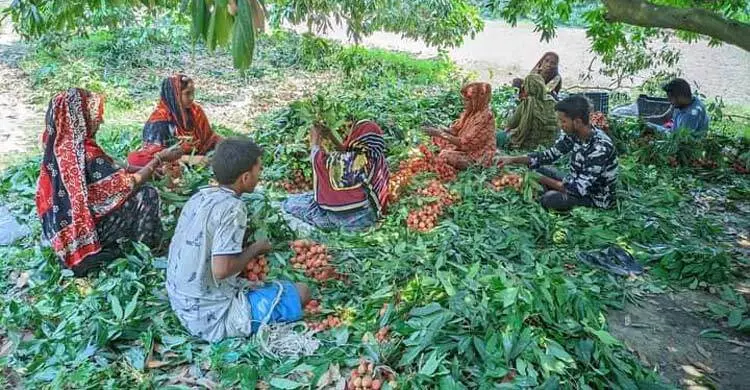
Ishwardi's juicy litchis are prized across the country, and when the season of sweet fruit comes, fruit lovers look for its pulpy, fibre-free litchis. Many may not know that 25,000-30,000 women workers in the upazila are involved in growing, caring for and marketing litchis. Locally they are known as "litchi kanya" (litchi daughters).
Last year these women were paid Tk 300-350 a day; this year it has risen to Tk 400-500. Despite an average rise of Tk 100, they are not happy. They complain that they are paid less even though they do as much work as men. Those involved say women lag behind in pay because they cannot climb trees.
How wages are set
Litchi growers say women play a part in every task from tending the orchards to marketing, working alongside men in harvesting and marketing. Men's daily wages vary: those who pick and sort litchis get Tk 600, those who count get Tk 800, and those who pack them for market get Tk 1,200. Women's wages also vary: sorters get Tk 400 and counters Tk 500.
Abdul Jalil Kitab Mondal, a farmer who won a national gold medal for litchi farming, told Jago News that 25,000-30,000 women in the upazila are directly involved in litchi production, sorting, counting and marketing during the season, among them housewives and school and college students.
He said women's wages were Tk 300-350 last year and have been raised to Tk 400-500 this year. Men climb trees to collect litchis and pack them for market, which women cannot do, so men are paid more.
Johurul Islam, a litchi grower from Maniknagar village, said: "Over the last seven days 33 workers collected, sorted and counted litchis in my orchard. Twenty-five of them were women. Women are good at sorting and counting and can keep pace with men. Their pay is also a little lower, which saves us some money."
Women's view
Asia Begum, a housewife from Mirkamari village, told Jago News: "The litchi season gives us extra income. With what we earn sorting and counting in growers' orchards near home we can buy pots, pans and household goods. With 20-25 days' pay we can buy a kid goat, raise it and sell it at a profit."
On wages she said: "We do no less work than the men - in some cases we do more. Yet our daily wage is Tk 400-500, while men are given Tk 600-700."
Nusrat Jahan, a college student from Maniknagar village, said: "I have been sorting and counting litchis since I was in class eight. What I earn in 15-20 days covers my study costs for the whole year. Hundreds of school and college girls like me do this work. We get Tk 400-450 a day."
Ishwardi Upazila Agriculture Officer Mita Sarkar told Jago News that most of the women workers are housewives who support their families financially with the extra income of the litchi season. If they could be given training, they would become more skilled at the work.
Source: Jagonews24. First published in Bengali on The Agro News.


Comments
(0)