
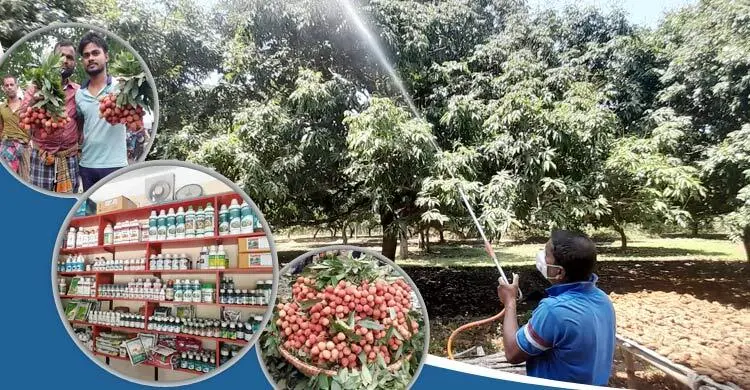
Litchi has been grown commercially in Ishwardi upazila of Pabna for about 42 years. When the season comes, 123 villages in seven unions of the upazila turn the colour of litchi. It is the main cash crop for farmers here. About 25,000 tonnes of litchi are produced every year, with a market value of about Tk 500-550 crore.
Litchi is grown most in the villages of Mirkamari, Char Mirkamari, Maniknagar, Joynagar, Awtapara, Jagannathpur, Kadimpara, Mahadebpur and Sahapur. Once the season starts, growers get busy, and fertiliser and pesticide dealers enjoy about three months of brisk sales.
According to growers and fertiliser and pesticide dealers, Tk 72-80 crore of fertiliser and pesticide is used in the upazila in the litchi season. The soil here is losing its fertility from years of heavy use, yet use keeps rising every year, harming the environment and human health.
Tk 2,000 a tree
The upazila agriculture office said litchi is grown on 3,100 hectares in the upazila, which has 3,60,000 litchi trees large and small. Every year Tk 500-550 crore worth of litchi is produced.
Farmers said 15-20 kinds of fertiliser, insecticide and fungicide are applied to each tree from flowering to harvest, with quantities set by the tree's age and size. A tree 30-35 years old gets Tk 2,200-2,500 worth, a 15-year-old tree Tk 1,800-2,000 and a tree under 10 years Tk 1,500-1,800.
They said the exact amount cannot be calculated because use depends on the weather. In bad weather more insecticide and fungicide are needed, and costs rise. But a medium-sized tree (15 years old) takes about Tk 2,000 of fertiliser and pesticide, so the upazila's 3,60,000 trees take Tk 72-80 crore a year.
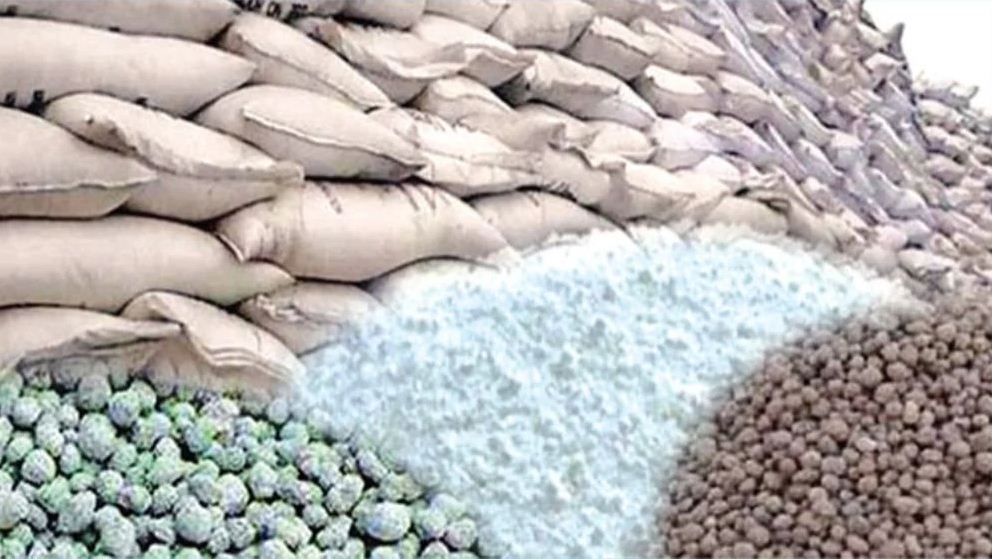
Fertilisers and pesticides are used to protect against insects, prevent blossom drop, keep trees healthy, enlarge the fruit, keep the litchi's colour and guard against fungus, among other things. After flowering, sprays of cypermethrin and nitrobenzene-group insecticides are used most. Then, depending on the tree's age, organic fertiliser and cow dung, MPO, TSP, carbofuran, boric acid, sulphur 80 WP, zinc sulphate, 'dep mixer' fertiliser, imidacloprid and fipronil, lambda, carbendazim and vitamins (PGR) are applied in turn. When insect or fungal attacks suddenly rise, various other pesticides are used as needed on the advice of agriculture officials and pesticide dealers.
Heavy metals in the soil
Soil researchers and environmentalists say the steady loss of essential organic matter from farmland leaves the soil lifeless, and one of the main causes is excessive use of chemical fertiliser and pesticide. Heavy metals in the soil of Ishwardi's litchi and vegetable fields are three times the normal level. Through this contamination, crops grown here enter the food chain and endanger people, increasing various diseases. The soil here is safe neither for the environment nor for public health.
Litchi grower Aminul Islam Chandan of Char Kadimpara village told Jagonews24 he has about 500 litchi trees and tends the orchard himself. "I have calculated that a 15-year-old tree needs about Tk 2,000 of fertiliser and pesticide. So crores of taka of fertiliser and pesticide are used in the upazila in the litchi season. Although pesticides harm the environment, they have to be used in litchi farming."
Gold medal-winning litchi grower Abdul Jalil, alias Kitab Mondol, told Jagonews24 that farmers here use excess fertiliser and pesticide for lack of proper experience, badly damaging the soil. By his account, litchi is grown on 3,100 hectares in the upazila, using Tk 75 crore to Tk 100 crore of fertiliser and pesticide almost every season. Without proper training and experience, farmers apply them as they please. Although many do not fully realise the serious health risk, some do, but find no remedy. If farmers could produce and use plenty of organic fertiliser and bio-pesticides, the environment would gradually recover, he said.
Dealers' view
Fertiliser and pesticide dealer Mostafa Zaman Noyon Biswas of Maniknagar village in Salimpur said a great deal is sold in the litchi season, and there are more than a hundred dealers in the area. His own shop sold Tk 25-30 lakh worth this season. He said the upazila agriculture officers and company sales representatives advise farmers on use.
Pesticide dealer Jahangir Hossain Pappu of Pathshala Mor told Jagonews24 that large amounts are used in the area's hundreds of litchi orchards, when business is good. Along with selling, he advises growers on use.
Officials and researchers
Ishwardi upazila agriculture officer Mita Sarkar said litchi is grown on 3,100 hectares in the upazila and Tk 500-550 crore worth is sold each season. Getting the desired yield requires the right amounts of fertiliser and pesticide, and farmers are being advised on this. To produce safe litchi, farmers are also being encouraged to bag the fruit and use bio-pesticides instead of excessive chemical fertiliser and pesticide.
Faruk Hossain, principal scientific officer at the Soil Resource Development Institute in Pabna, told Jagonews24 they had surveyed Ishwardi's farmland and collected soil. The soil health is very poor, with a lot of sodium, and it has been severely damaged by unbalanced use of fertiliser and pesticide.
Professor Dr Md Redwanur Rahman of the Institute of Environmental Science at Rajshahi University told Jagonews24 that his research on soil and water samples from Ishwardi's litchi land found very high levels of heavy metals, three times those in normal soil, which is extremely harmful to the human body. Crops grown on this land enter the food chain through soil and water, and people are falling ill with various diseases. Along with complex illnesses of the kidney and liver, miscarriage and diabetes, future generations face a serious threat, he said.
Source: Jagonews24. First published in Bengali on The Agro News.
Comments
(0)