
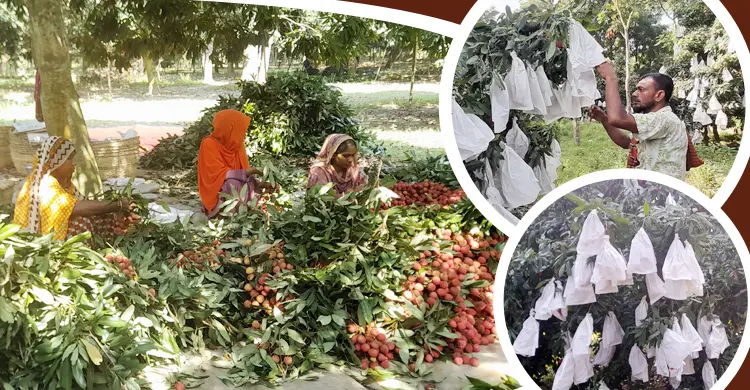
Pesticide-free litchis grown with the fruit-bagging method in Ishwardi, Pabna, are being exported to the United Arab Emirates (Dubai). Shamim Pramanik, a grower in Charkadimpara village of the upazila's Salimpur union, has succeeded in growing litchis under bags. His fruit grew large and turned a deep red, with no chemicals or pesticides used. Thanks to the bags, no litchis fell from the trees in storms and none lost colour in the drought. Protected inside the bags, the fruit could not be attacked by squirrels, bats, small bats or insects.
Like Shamim Pramanik, 21 litchi growers in Pabna district, 16 of them in Ishwardi upazila, have grown litchis with fruit bagging. Most used the method on a small, trial scale this year. With good yields, the growers say they want to use it on more trees in future.
The safe litchi project
With support from the Sustainable Enterprise Project (SEP) of Palli Karma-Sahayak Foundation (PKSF), the non-government development organisation Osaka began a sub-project in Pabna district on 30 June 2021 to introduce the production of safe litchis in an environment-friendly way. Its aims are for small entrepreneurs to adopt sustainable litchi farming, to ensure the production and distribution of safe litchis, and to link backward local litchi markets with advanced ones.
Expanding the market is very important for environment-friendly litchi production. This country's litchis are tastier than those of other countries and are in strong demand abroad, but large-scale exports are impossible without producing safe, pesticide-free fruit. Through training and encouragement of the project's small entrepreneurs, bagging was used on a trial basis at farmer level for the first time in Bangladesh in the 2022 season, with success. This time litchis grown commercially with bagging are being exported to the UAE for the first time, opening the door to sending litchis abroad. It is hoped that bagging will one day turn Ishwardi's litchis into a brand.
Growers' experience
Litchi grower Shamim Pramanik said: "I took four days of training in fruit bagging through the NGO Osaka. In 2022 I succeeded after using bags on a small number of trees as a trial. This time I produced about 50,000 litchis with bagging. I have already sent 15,000 litchis from my orchard to an exporting company, which checked and sorted them and sent them to Dubai. Because they are exported, I am getting a better price for the bagged litchis than for the other fruit in my orchard."
He said: "Each fruit bag costs Tk 5 and holds 10 to 16 litchis. Bagging starts 25 days before the fruit ripens, when the litchis take the shape of small beads. I didn't have to use chemicals or pesticides. I used vermicompost at the base of the trees. With bagging there were no insects or spots on the fruit, and the litchis grew larger. Next year I will use this technology on more trees."
Abdul Jalil, known as Lichu Kitab, a farmer from Mirkamari village in the upazila who has won the Bangabandhu National Agriculture Award for litchi farming, grew litchis in 100 bags on a trial basis this year. He told Jagonews: "Bagging seems a very good method for farmers. There is no fear of attacks by squirrels, bats or insects, and no risk of damage from heavy rain or drought. Being pesticide-free, the fruit is tasty and quite large. From next year I will grow litchis commercially with bagging."
Kajal Sardar, a litchi grower in Bharoimari village, said: "I bagged 200 bunches of litchis for my own family, which gave 2,500 to 3,000 litchis. With this method the litchis are pesticide-free and very safe, as birds and insects cannot attack them. In this year's severe drought, the litchis on most trees lost colour and stayed small, but the bagged ones were normal in size and colour. So many commercial growers nearby came to learn about bagging and have shown interest in using it in future."
Officials and scientists
Rafiqul Haque, project manager of the sub-project, told Jagonews: "The sub-project started work on 30 June 2021 and will end in September this year. Through it, growers have been trained to produce litchis with bagging, and they have succeeded. This year pesticide-free bagged litchis have been exported. Many farmers have shown interest in using bagging commercially, and if they all do, more litchis can be exported next year."
He said: "Under the sub-project, fruit bags were supplied to litchi growers at half price. The bag costs Tk 5, and growers were charged Tk 2.50 per bag. Farmers were also supplied with vermicompost, so they did not have to use chemical fertiliser."
Upazila Agriculture Officer Mita Sarkar told Jagonews: "Growing litchis with fruit bagging is undoubtedly a good initiative. No pesticide is used, so the fruit is very safe and healthy. I have spoken with many of the growers who tried bagging this year, and they say they will use it commercially in future. I have informed senior officials of the agriculture department, and the upazila agriculture office will give farmers full support with this method."
Dr Sharaf Uddin, senior scientific officer at the fruit division of the Horticulture Research Centre of the Bangladesh Agricultural Research Institute (BARI) in Gazipur, told Jagonews: "Bangladesh's litchis are tasty and nutritious and in great demand abroad. If safe litchis free of chemicals and pesticides are produced with fruit bagging, a lot of foreign currency can be earned by exporting them."
He said: "I went to Ishwardi to train growers in fruit bagging. Talking with them, I learned they are very interested in the method, and they will profit from it. Safe bagged litchis are valued at home and abroad. So that growers can easily send them abroad, I put them in touch with an exporting company called Zaman Traders, and it was through them that the farmers sent their litchis to Dubai."
Source: Jagonews24. First published in Bengali on The Agro News.
Comments
(0)