
India is stacking trade-remedy measures on Bangladesh's jute and jute goods. On 24 September India's finance ministry imposed an anti-dumping duty of up to $445 a tonne on Bangladeshi jute products. Four days later, on 28 September, India's Directorate General of Trade Remedies (DGTR) recommended a five-year countervailing duty (CVD) on the same goods, and the next day recommended an anti-dumping duty of up to $218 on the PET film used to package them, Amar Desh reports.
Traders say that if both the anti-dumping duty and the CVD apply at their highest rates, the extra duty on the products concerned would reach $585 a tonne, making Bangladeshi jute yarn, hessian and sacks dearer in India. The DGTR proposes separate rates for 24 mills that cooperated with the investigation: $101.54 a tonne for Sagar Jute Spinning Mills and Oriental Jute Mills, $101.54 to $132.36 for six sampled mills, $116.48 for the other 18, and $140.04 for exporters that did not cooperate.
The investigation covers jute yarn and twine, sacks and fabric, hessian cloth and bags, and diversified goods with at least 50% jute. Opened on petitions from the Indian Jute Mills Association and the AP Mesta Twine Mills Association, it examined data from April 2024 to March 2025. Bangladesh sees a CVD on top of an anti-dumping duty as a "double remedy"; citing the WTO subsidies agreement and Section 9B of India's Customs Tariff Act, it has lodged a written objection with the DGTR and asked for the investigation to be closed.
The market matters. Export Promotion Bureau data show 24.3% of Bangladesh's jute goods exports go to India, followed by Turkey at 21.4% and China at 17.5%. Jute yarn and twine make up about 62% of jute exports and grew 58.02% in 2025-26; jute exports in July-August this year rose 37.09% to $162.5 million. India first imposed anti-dumping duties on jute goods in 2017, extended them in 2022, and in 2025 withdrew transshipment facilities and restricted imports of jute goods through land ports.
Tapas Pramanik, president of the Bangladesh Jute Spinners Association, said a CVD cannot be imposed on goods already under another duty and the government should raise the matter internationally. Chattogram Chamber president Amirul Haque said the CVD is still only a recommendation, so negotiation could still turn it. Zakir Hossain Khan, marketing manager of the Bangladesh Jute Mills Corporation, urged building markets beyond India. Commerce Secretary Ataur Rahman Khan said Bangladesh will raise the issue at the next bilateral meeting in Delhi.
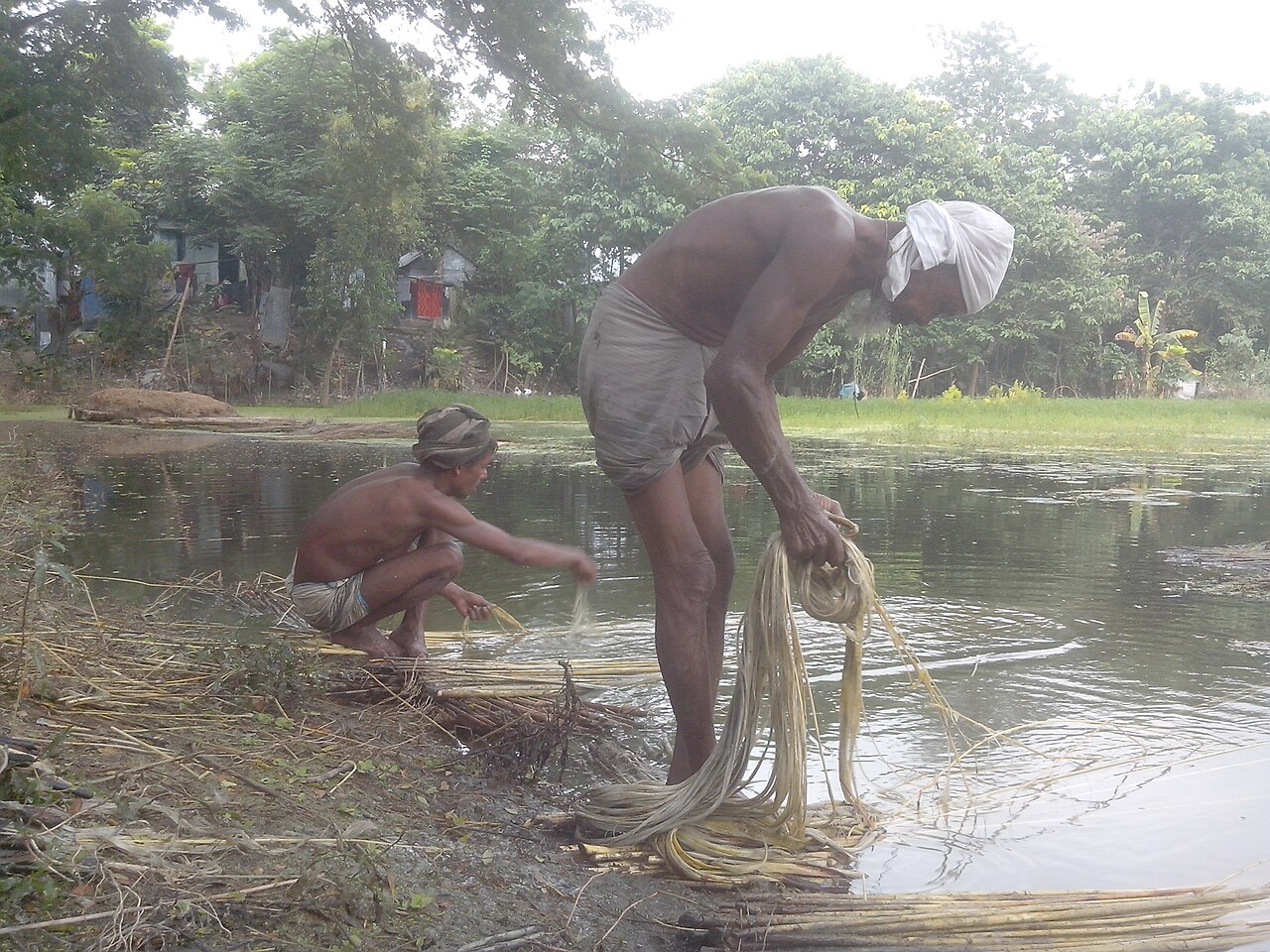
Photo: jute fibre in Mymensingh. Photo: Rupon Das / Wikimedia Commons (CC BY-SA 4.0)
Source: Amar Desh


Comments
(0)