
He once had a secure job, a fixed salary and an assured future: teaching in the BCS education cadre, then a job at a bank. A comfortable life lay open before him. But one day he left that safe path, returned to his village and took up farming.
On land in a remote village he began an integrated enterprise producing fish, cattle, chickens and organic fertiliser. The aim was not only to employ himself but to make farming modern and profitable and open a new path for local young people.
He is Ikhteyar Uddin Ahmed Munna, a young entrepreneur from Charteki village in Jangalia union of Pakundia upazila, Kishoreganj. His MM Agro is now more than a farm; it is becoming a model of what is possible in the rural economy.
From uncertainty to four linked enterprises
The venture began two years ago amid much uncertainty and trial and error. Today fish farming, Fayoumi chicken rearing, bull fattening and vermicompost production run side by side.
Leaving a secure job to farm in a remote village was not an easy decision. He had to give up a long career, an established profession and a regular income for a completely new road. In the end it was the wish to do something in his own area that drew him to agriculture. Rather than simply securing his own future, he wanted to do something connected to his village, its people and its soil.
From the start he realised that bringing several sectors under one management in an integrated system, rather than running separate farms in the conventional way, could cut costs and make the fullest use of resources. To put the idea into practice he travelled to different parts of the country, especially farms in the north, and talked to farmers and entrepreneurs. Then he set up MM Agro in Charteki.
Inside MM Agro
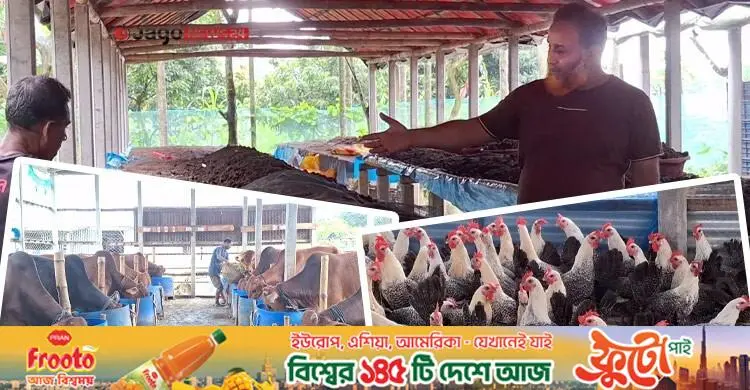
A visit to MM Agro shows a farm laid out with planning in the middle of a remote rural setting. There are four modern fishery ponds farming various species of fish. There is also a poultry unit, currently rearing about 2,000 Fayoumi chickens.
Another important part of the farm is bull fattening. Grass is grown on the farm to meet part of the cattle's feed needs. But one of MM Agro's most striking features is vermicompost production.
The key strength of integrated farming is using the by-product of one sector in another, and MM Agro follows that method. Cattle dung and other organic material are turned into vermicompost. Waste that could be a management problem on other farms becomes valuable organic fertiliser here.
The farm is now being brought up to a capacity of about 30 tonnes of vermicompost a month. The entrepreneur hopes it will become one of the farm's main sources of income once fully commercial production begins.
Overall management is in the hands of Badiul Alam, a retired army member who joined the project after leaving the army in 2015. "I am responsible for the overall management of the farm. I oversee who is doing what and what needs to be done where," he said. "If farmers use the organic fertiliser we produce, good and safe crops can be grown."
Seen separately, fish, chickens, cattle and fertiliser are four different businesses. Joined on one farm, the by-product of one becomes a resource for another. Dung becomes vermicompost, home-grown grass feeds the cattle, and the other parts of production are linked alongside fish farming. Each part connects with the others in a cycle, creating scope to cut production costs and waste.
Jobs for local people
Employment is another important side of MM Agro. Several unemployed young men from the area work on the farm, and students get work on holidays. Some tend the fish, some look after the cattle, some work in the poultry unit and others in vermicompost production.
Farm worker Robi said: "There are various projects here including cattle, fish, chickens and vermicompost. About eight of us work here, permanent and local together. We cut grass, collect dung, give feed and water to the animals and birds, and do other work. If needed we can also take an advance on our wages."
Another worker, Ripon, said: "I have worked here for about a year. With this income I can support my family of four. If the project grows, many more people like us will get jobs."
Niloy, a student at Pakundia Degree College, works on the farm alongside his studies. "I am a second-year higher secondary student. I work here between college hours, and this lets me pay for my studies. Several other students like me work here," he said.
Family support and official view
Ikhteyar's elder brother Elias Uddin Chunnu said: "My younger brother taught in the BCS education cadre and later served as a senior bank officer. He left these secure professions to work for the development of the area. Everyone in the family has encouraged and supported him."
"Ikhteyar believes you do not have to retreat just because you fail the first time," he said. "Various initiatives have been taken, including vermicompost, vegetables, fish, trees and a betel nut garden. It has not yet turned a profit, but he does not want to step back. His aim is to expand the project and create jobs for unemployed young men and working-age women in the area."
Pakundia Upazila Agriculture Officer Nur-e-Alam said Ikhteyar came to him for advice about two years ago and was advised to visit integrated farms in different parts of the country. Ikhteyar followed that advice, toured farms in various regions and tried to apply the experience on his own farm.
"The greatest advantage of integrated farming is that inputs produced in one sector can be used as a resource in another. This reduces production costs and waste and builds an environmentally friendly farming system. MM Agro can be considered a promising integrated farming model," the officer said.
Explaining his goals, Ikhteyar Uddin Ahmed said: "Our aim is to build organic-based farming by reducing dependence on chemical fertilisers. We are also trying to cut production costs, especially the cost of fish and livestock feed. For this we have brought in a feed machine and are testing feed made in different ways. We are growing various grasses, including Napier grass."
Finding ways to cut costs by using the by-product of one kind of production in another is the main goal, he said. Through vermicompost and organic fertiliser, he wants to create an alternative to chemical fertiliser, with sustainable, environmentally friendly production at low cost.
Source: Jagonews24. First published in Bengali on The Agro News.
Comments
(0)