
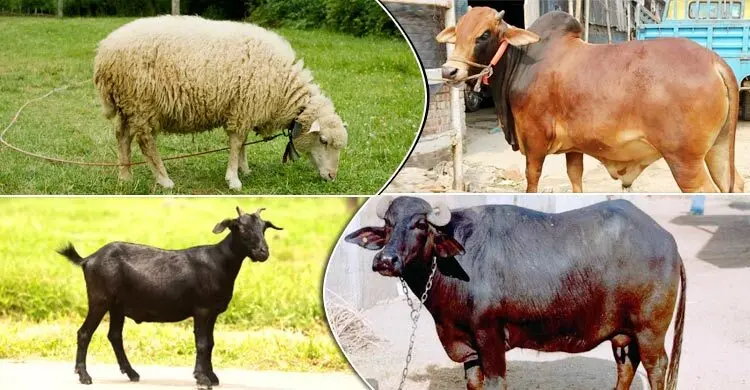
Qurbani must be made with a properly chosen animal. So the question may arise: how do you recognise an animal fit for sacrifice, and what are the guidelines for choosing one? Animals fattened by artificial means may turn out to be unfit for Qurbani after purchase, so it is important to know which animal is suitable.
Age and teeth
- Experts always advise buying local (deshi) cattle, because local cattle cannot be fattened much even if someone tries.
- A cow or buffalo is fit for Qurbani if it is at least two years old. The animal's age can be checked by looking at its teeth.
- A camel must be five years old. Goats, sheep and dumba (fat-tailed sheep) must be a full year old.
- If a cow's lower jaw has at least two spade-like permanent front teeth alongside its milk teeth, it can be taken as fit for Qurbani.
Health and condition
- The sacrificial animal must be completely healthy physically.
- Check whether the animal has a broken horn or a cut tail, or any wound on its mouth, tongue, body, legs, hooves or heels.
- Even where an animal can be sacrificed, you must make sure it is not pregnant.
- A pregnant animal cannot be sacrificed under any circumstances. A pregnant animal usually has a swollen belly and udder.
- Qurbani can be made with six kinds of animals in all: camels, cows, buffaloes, goats, sheep and dumba. The animals must be free of defects.
Source: Jagonews24. First published in Bengali on The Agro News.
Comments
(0)