
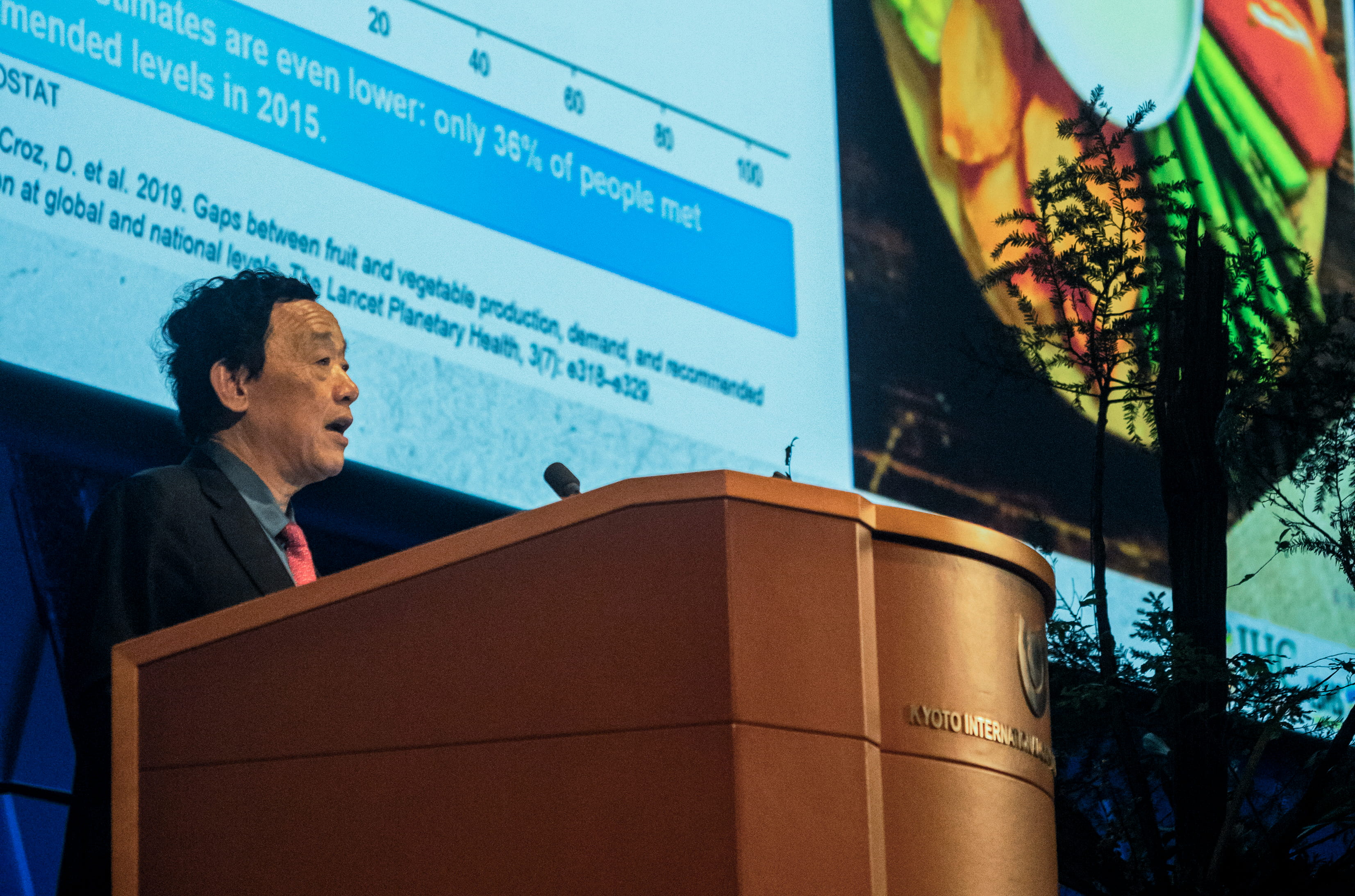
Agriculture has to stop measuring itself mainly by the quantity of food it produces and start counting whether it supplies the diverse, nutritious food a healthy diet needs, FAO Director-General QU Dongyu told the International Horticultural Congress 2026 in Kyoto.
"Success can no longer be measured simply by how much food we produce," he said. "It must also be measured by whether agriculture provides the foods that healthy societies require, and whether those foods are available, accessible and affordable for everyone."
By commercial measures horticulture has done well. Between 2010 and 2024 fruit and vegetable production grew faster than cereals, and horticulture now accounts for almost a quarter of global agricultural production value — about $1.4 trillion. Exports grew roughly 2.6 percent a year over the period, reaching 175 million tonnes worth $240 billion by 2024. That success, the Director-General told an audience of scientists, policymakers, business representatives and producers, has not translated into healthier diets.
He identified three connected problems. On productivity, horticultural yields have grown by less than one percent a year, behind cereals, after years of underinvestment in research, genetics and infrastructure. On availability, FAO's latest analysis shows that in 2023 only about half of countries produced enough fruit and vegetables to meet the FAO/WHO target of 400 grams per person a day, while actual average consumption is far lower — an estimated 80 grams of fruit and 190 grams of vegetables a day globally. On affordability, producer prices rose between 2016 and 2025 in 89 percent of countries for fruit and 93 percent for vegetables, with median annual increases of about 4.2 and 4.7 percent.
The trend line is worse than the current picture. By 2050, projections suggest fewer than one third of countries in sub-Saharan Africa will have enough fruit and vegetables to meet the joint FAO/WHO recommendation. With land and water increasingly constrained and rising temperatures, water scarcity, extreme weather, pests and diseases adding pressure, Qu called for investment in better seed and planting material, healthier soils, efficient irrigation, mechanisation and digital tools, extension services, post-harvest systems and stronger links between growers and markets. "Future growth must increasingly come from producing more with fewer resources," he said.
Whatever the technology, it has to reach the people who grow the crop. "No innovation, no policy and no investment will succeed without their knowledge, their confidence and their participation. Scientists and researchers' works must be recognized by farmers," the Director-General said. Farms of 20 hectares or less account for over half of global fruit and vegetable output, rising above 80 percent in Asia and sub-Saharan Africa — which is why he pressed for innovation that is accessible, affordable and adoptable by small-scale producers.
He pointed to AI, genome editing and digital tools accelerating breeding and cutting post-harvest losses, citing the Joint FAO/IAEA Centre's work on mutation breeding, which has contributed to more than 3,450 officially released crop varieties across over 70 plant species. He also drew on traditional knowledge: nearly half of the 104 systems recognised under FAO's Globally Important Agricultural Heritage Systems involve horticulture, from jujube orchards in China's Jia County to date palms and olive groves in Egypt's Siwa Oasis and terraced farming in Peru's Andes.
FAO's forthcoming report, Unlocking the Full Potential of Fruits and Vegetables Globally, expected in 2027, will examine production, trade and consumption trends alongside livelihoods, health, productivity, plant health, seed supply and markets. Preliminary findings presented at a Congress side event point to an urgent need for action.
Source: FAO Newsroom
Comments
(0)