
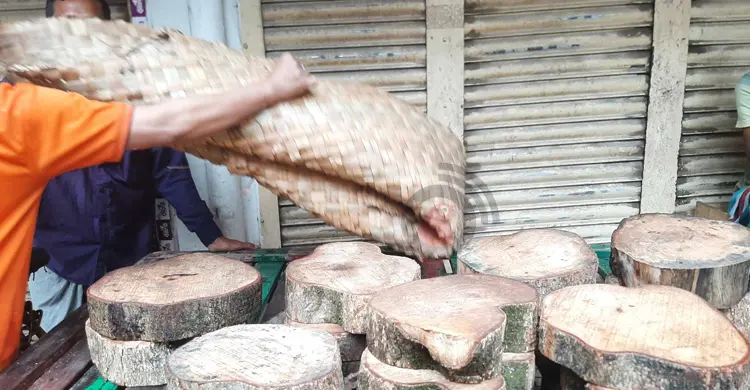
Eid-ul-Azha, the second-largest religious festival of Muslims, is tomorrow. Sacrificial cattle and goats are being bought and sold at markets in the capital and across the country, and demand has risen for hogla pati, mats woven from hogla leaves, and khaitta, wooden chopping blocks, as equipment for the sacrifice. Traders from different parts of the country have brought these goods to the capital.
But sellers said heavy rain in the capital from Wednesday morning, the day before Eid, had cut sales of hogla mats and khaitta, and prices have fallen for want of buyers. Buyers complain, however, that hogla mats and khaitta cost much more this year than last year.
Along with knives and cleavers, the equipment needed for the sacrifice and cutting meat includes the khaitta, made from a sawn section of a hard tree trunk. Hogla mats are used to hold the cut meat. In various places in the capital, each khaitta is selling for Tk 250 to 300, and in some places for Tk 400 or more. Each hogla mat costs Tk 150 to 200.
Seasonal sellers
Across the capital, people who will sacrifice animals are rushing to buy khaitta and hogla mats along with cattle feed. Around the cattle markets, in front of shops and even in neighbourhoods, they are being sold from temporary stalls.
Many seasonal traders are selling khaitta alongside other business before Eid-ul-Azha, arranging them in shops and by the roadside. They will be used on Eid day for cutting beef and mutton. But sellers said the downpour since Wednesday morning had cut sales.
A woman seller had laid out khaitta at the entrance to the market beside the main road at Shanir Akhra. She told Jago News she was selling each for Tk 250 to 300. They are made by cutting tamarind trunks into short pieces. But even standing soaked in the rain, she was not selling as she had hoped. She sold three on Tuesday; because of the rain there were few buyers from the morning, and by the afternoon she had sold only one.
Another trader, Abul Hossain, said a khaitta needs a thick trunk of tamarind or bael (wood apple). Since bael trees are hard to find, tamarind khaitta are more common in the market now. Cutting bones and meat needs strong blows with a cleaver, and blocks made from other trees cannot withstand them and crack or break. Sometimes splinters from the block stick to the meat. So there is no alternative to bael or tamarind wood for a khaitta, he said.
Robin Kasai, a meat seller at Merajnagar bazar in Rayerbagh, told Jago News he uses a khaitta all year. Professional butchers' blocks are larger and sturdier, and a good one costs more than Tk 1,000.
Mat prices up
Demand for hogla mats also rises at Eid-ul-Azha. From Wednesday morning to afternoon, traders were seen sitting with hogla mats and khaitta at important road junctions and in front of markets across the capital. This has been the scene for several days, and at the last minute buyers are bargaining and buying.
Buyers said hogla mats cost more than last year. Sellers explain that there is no demand for the mats during the rest of the year, so orders have to be placed four or five months before Eid-ul-Azha. Each mat costs Tk 100 to 150 to buy, so they have to sell at a higher price. A mat four haat (cubits) wide and five haat long costs Tk 180 to 200.
Traders are also selling blocks from vans in the lanes of various neighbourhoods. One of them, Shafiq, told Jago News: "I sell fruit from a van all year, but khaitta sell well at Eid-ul-Azha. There are khaitta from different trees in the market, but tamarind is the most suitable, because it gives off no powder, meat doesn't stick to it, and it is very hard and cheap." He is selling each for Tk 200 to 400 depending on size.
Md Alamgir, a resident of Muhammadbagh, told Jago News while buying a khaitta and hogla mat: "A few years ago I bought a hogla mat for Tk 80-90. Now they're asking Tk 200 for it. The price has more than doubled. Khaitta are also very expensive."
Source: Jagonews24. First published in Bengali on The Agro News.
Comments
(0)