
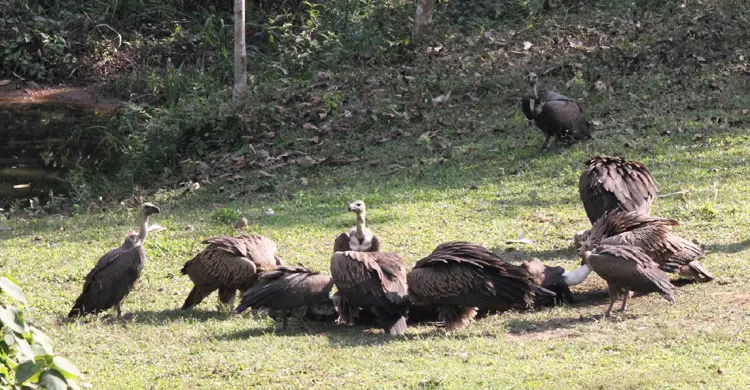
There is ice all around. Their homes are covered in a sheet of snow and food is desperately short. So, to survive, they come to a new destination 2,000-3,000 kilometres away. By the time they reach the plains in search of shelter and food, their strength is almost gone. A body that normally weighs 9-13kg drops to 5-7kg. And when, sick and near death, they come down on the ground somewhere on the plains, a different kind of cruelty begins. Some people throw stones, some tie them up with rope, some break their legs, and some beat them to death.
This helpless creature is the Himalayan vulture, scientific name Gyps himalayensis, known to everyone simply as a vulture. Every year in the last week of November they travel thousands of kilometres from countries of the northern hemisphere to Bangladesh and parts of India.
By eating the flesh of carcasses, vultures protect people from the risk of at least 40 diseases. Only the vulture can eat and digest the meat of a cow that died of anthrax, and the germs of tuberculosis and foot-and-mouth disease are destroyed in its stomach. Vultures can finish off a carcass before harmful germs spread from it.
Six species left
According to the Bangladesh vulture research project, there are 23 species of vulture in the world, seven of which were found in Bangladesh. Of these seven, the king vulture has become extinct, and the remaining six are fighting to survive. On average 100 vultures come to Bangladesh every winter to survive. Two groups have arrived so far this year. The first came on 24 November with 22-25 vultures, and the second on 23-24 December with 40-45.
This week, six vultures from the latest group fell to the ground exhausted and sick in different parts of Gaibandha Sadar upazila, and local people injured them. Unaware people attack these "sweepers of nature" as soon as they see them, and do not hesitate to kill them as well as abuse them.
Before this, a total of 14 injured vultures, including two from Panchagarh, one from Nilphamari, one from Kurigram, one from Bogura, one from Narayanganj, one from Cumilla and two from Sherpur, were rescued and taken to the vulture rescue centre in Dinajpur. At the centre, run by the Forest Department and the International Union for Conservation of Nature, the vultures will be released after treatment.
Call for awareness
On average 20 injured vultures are rescued each year, 100 in the past five years, most of them badly hurt by people. Sometimes they are killed by people. Seemanta Dipu, chief researcher of the Bangladesh vulture conservation project, said: "The king vulture has become extinct in Bangladesh. We must become aware now to keep the other species alive. We must protect the vultures that fly in from thousands of miles away."
He said: "Whenever we hear of an injured vulture, we rescue it immediately. If people were a little more aware, no vulture would die. Wherever in the country there is a vulture, I urge people to inform the Forest Department or IUCN. This much awareness is needed to save this animal, which is so useful to nature."
Seemanta Dipu added: "In the past five or six years we have treated and released about a hundred vultures. For the last two years we have been fitting rings on their legs to track their movements. They arrive in November and go back in March or mid-April."
Source: Jagonews24. First published in Bengali on The Agro News.
Comments
(0)