
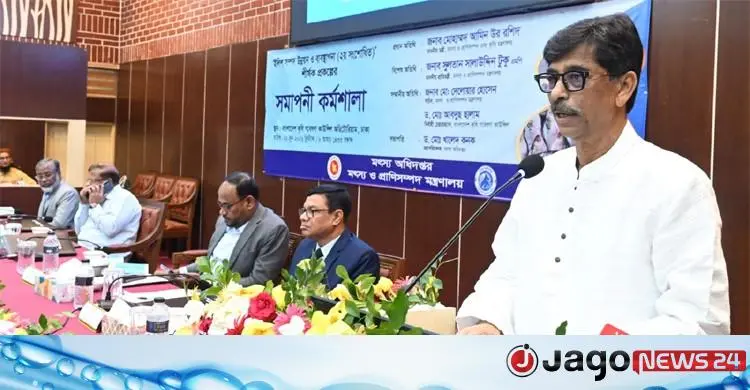
Mohammad Amin Ur Rashid, minister for fisheries and livestock and for agriculture, has said a long-term, sustainable and science-based plan is needed to conserve hilsa, increase production and expand into international markets. Hilsa should not be confined to meeting domestic demand but developed as an exportable resource, and the capacity to export it must be increased further, he said.
He was speaking as chief guest at the closing workshop of the "Hilsa Resource Development and Management (Second Revised)" project, held on Monday (22 June) at the auditorium of the Bangladesh Agricultural Research Council (BARC).
The minister said the natural flow of rivers and water quality must be ensured for hilsa to move and breed safely. All relevant ministries and agencies must work together to stop industrial waste and toxic substances being discharged into rivers.
Tough line on jatka and current nets
The government is taking a tough stance against killing jatka, catching mother hilsa and using current nets, he said. Effective steps are being taken to stop the use of illegal nets, because they are a serious threat to hilsa and many other native fish. Most fishermen live dependent on advance loans (dadon), so the government is implementing practical projects to provide them with alternative jobs and training and make them financially self-reliant, and new initiatives will be needed in future too.
The government is seriously considering forming a special advisory group of researchers, experts and experienced field-level people on hilsa conservation and management, the minister said. Future policy and action plans will be drawn up on the basis of their advice.
Speaking as special guest, State Minister for Fisheries and Livestock Sultan Salauddin Tuku said hilsa tops Bangladesh's food list. About 70 to 80 per cent of the world's hilsa is produced in Bangladesh, so many countries, especially neighbouring ones, take a special interest in Bangladeshi hilsa. Hilsa must therefore be protected for future generations as a national resource through conservation and sustainable management.
Support for fishermen
Stressing research, the state minister said that to survive in today's world, more must be invested in knowledge, innovation and research. There is no alternative to research for hilsa conservation, higher production and sustainable management.
Referring to the government's initiatives for fishermen, he said about Tk 24 crore in support was given to fishermen in the 2025-26 fiscal year, and there are plans to increase it. The government is also working to create alternative jobs for fishermen during fishing bans.
Alongside field drives to protect hilsa, raising awareness among fishermen is very important, he said. Lasting success is not possible without public participation and awareness.
The workshop was chaired by Dr Md Khaled Konok, director general of the Department of Fisheries. Md Delwar Hossain, secretary of the Ministry of Fisheries and Livestock, and Dr Md Abdus Salam, executive chairman of BARC, attended as honoured guests. Project director Molla Emdadullah gave the welcome address.
Senior officials of the Ministry of Fisheries and Livestock and the Department of Fisheries, researchers, experts and fishermen were among those present.
Source: Jagonews24. First published in Bengali on The Agro News.

Comments
(0)