
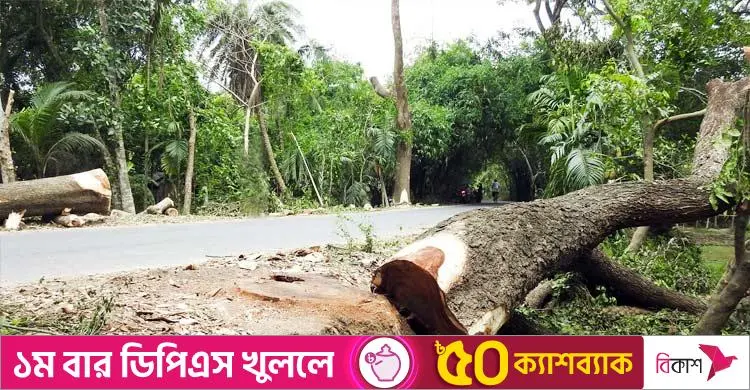
The High Court has ruled that trees planted under social forestry must not be felled, and that planters should instead be paid an amount equal to the trees' value. It also ruled that permission from a special committee is needed to cut any tree in the city corporations, districts and upazilas.
A High Court bench of Justice Fahmida Quader and Justice Mubina Asaf delivered the verdict on Tuesday, 28 January, after the final hearing of a rule issued on the matter.
Advocate Manzill Murshid argued for Human Rights and Peace for Bangladesh (HRPB), assisted by Advocate Sanjoy Mondal and Advocate Selim Reza. DAG Md Shafiqur Rahman appeared for the state.
Background to the rule
HRPB, a human rights and environmental organisation, filed a writ petition in the public interest in 2024 to stop rising temperatures and environmental pollution across the country and to protect people's lives and health.
After hearing the petition, the court on 7 May 2024 issued a rule asking the respondents to explain why felling trees in Dhaka's two city corporations and at district and upazila level should not be declared contrary to human rights; why, instead of cutting trees planted under the Social Forestry Rules 2004, the planters should not be paid the value of the trees; and why approval from a seven-member committee should not be required at every level to fell trees.
After hearing the case, the bench issued a number of directives.
What the court said
In the verdict, the court said that as temperatures in the country rise day by day, more trees need to be conserved. Widespread felling would upset the balance of the environment, which would curtail our right to life.
The court also said Bangladesh does not have the number of trees needed to keep the environment in balance, and protecting these trees is extremely necessary for the environment.
At the hearing, Advocate Manzill Murshid said tree felling in Bangladesh is constantly increasing and the country does not have the number of trees it should. If more trees are cut, it will become a threat to the environment. For this reason, he said, trees planted under social forestry projects should not be cut; instead, those who planted them should be paid their value.
He asked the court for directions to set up an authority in Dhaka and other places to control tree felling, with permission to fell trees to come from that authority.
Committees at every level
In its verdict, the court directed the Department of Environment to form, within seven days, a committee of environmentalists, environmental experts and professors of the environmental science departments of Dhaka University and Jahangirnagar University to grant permission for felling trees.
The senior secretary of the Ministry of Public Administration was also told to issue a circular within seven days to form a committee of the deputy commissioner, the district environment officer, a government college professor, a social worker, an environmentalist, the president or general secretary of the district bar association and the district civil surgeon, which will give permission for tree felling at district level.
In another order, the court directed the public administration secretary to issue a circular within the next seven days to all deputy commissioners to form committees at upazila level made up of the upazila nirbahi officer, a college principal, a social worker, an environmentalist, the social welfare officer, the AC (Land) and LGED's executive engineer, which will grant permission for felling trees in the upazila.
The verdict further said trees planted under the Social Forestry Rules 2004 cannot be felled; instead, planters must be paid the equivalent value of the trees. The court also directed that the Social Forestry Rules be amended to this effect.
The applicants on behalf of HRPB are Advocate Md Sarwar Ahad Chowdhury, Advocate Ekhlas Uddin Bhuiyan and Advocate Ripon Barai.
Source: Jagonews24. First published in Bengali on The Agro News.
Comments
(0)