
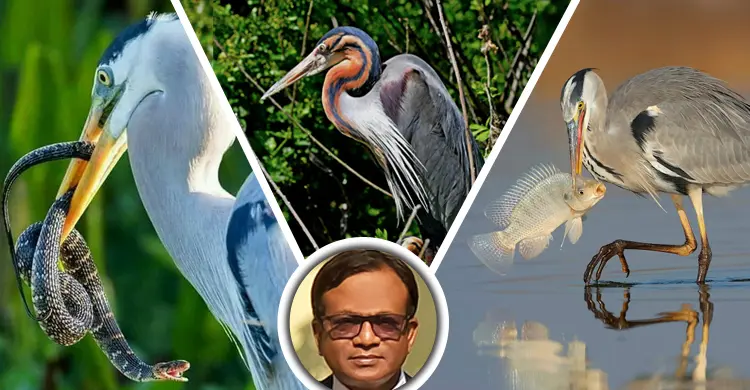
White with a faint tinge of ash grey. A crest on its head, long plumes on its neck, red beak and legs. Long legs, spread slender toes, a snake-like neck, fixed yellow eyes and a beak like a dagger. Four feet tall, weighing five to eight pounds, with a wingspan of seven feet. This is America's largest heron.
It is easily recognised by its tall frame and slow steps as it walks along marshes, lakes and riverbanks. It is a skilled hunter, standing motionless as it waits for fish and striking in an instant when prey appears. It is a very familiar bird all over the country, and is seen across islands in northern South America, Canada and large parts of southern Alaska.
Nesting on Chesapeake Bay
Many tributaries flow into Chesapeake Bay on the Atlantic Ocean, and countless creeks in turn join these tributaries. Along both sides lie vast forests, and this is where the herons live. They build their nests in the branches of tall trees, ten to twenty on a single tree, so hundreds of nests can be seen across the area. They eat small animals such as fish, crabs, snails, mussels, frogs, snakes and mice.
The breeding season begins in early spring. The birds then fly in from all directions and gather on wide stretches of coast or open fields. Both male and female become very bright in colour at this time. They build nests now: many repair the previous year's old nest, while some build new ones. The male breaks off and brings twigs and the female weaves the nest. The nest is needed only for laying eggs and raising chicks.
The female lays one or two eggs at first, then three or four, and later five or six. During this time the birds become very aggressive and let no one near the nest. The chicks hatch in 28 days. A newly hatched chick lies quietly in the hollow of the nest, like a lump of flesh. The parents feed it by regurgitating half-digested food from their own stomachs into its beak. When it is a little bigger, they bring fish, crabs and frogs, tear them apart with their beaks and put them into the chick's mouth.
From chick to hunter
Heron chick mortality is high. The stronger chick in the nest eats most of the food. The chicks need a quarter of their own body weight in food every day, and the weaker ones starve to death. In good weather the parents go out looking for food at night as well, and they are often seen walking along the water on moonlit nights. Within a few weeks the chick grows feathers. It then leaves the nest bit by bit and sits on the branches, moving from branch to branch for seven to eight weeks. Now and then one falls. Once on the ground there is no way back up, and foxes or birds of prey carry it off.
Between nine and twelve weeks the wings grow larger, and the ugly chick turns into a handsome bird. It flies from branch to branch and eventually flies properly to the riverbank to join its parents. For a while it goes about with them, eating food from their beaks and sometimes trying to catch its own. In this period it learns from its parents to catch fast-moving fish and to recognise crabs that have just shed their shells. Then its independent life begins. Everything else in life, nature teaches it as the need arises.
The writer is a science writer and MPhil scholar in the Faculty of Social Sciences, University of Dhaka.
Source: Jagonews24. First published in Bengali on The Agro News.

Comments
(0)