
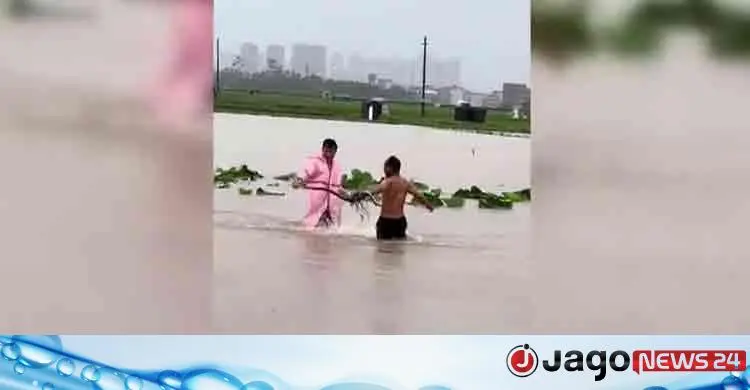
As devastating floods caused by the powerful Typhoon Maysak battered the city of Hengzhou in China's Guangxi province, hundreds of snakes were washed into residential areas. Yet amid all the fear, an extraordinary scramble to catch the snakes floating in on the floodwater was seen.
Video footage published by the US broadcaster CNN shows a man frantically chasing a snake swimming through the floodwater while several others stand around with nets, waiting to pounce. At one point a man in a bright pink raincoat tries to dive on the snake, and another, shirtless, quickly snatches it from the water. The onlookers can be heard shouting excitedly and laughing during the attempt.
Among local residents of Hengzhou, snake meat is regarded as highly nutritious and there is a long tradition of snake hunting in the region. But local authorities and experts have warned that snakebites are extremely dangerous and can be fatal.
Videos posted on social media by frightened residents show venomous snakes swimming effortlessly across the floodwater with their heads raised, looking exactly like moving periscopes. Local authorities at first did not take the threat very seriously, but as the situation worsened they began issuing strict warnings to villagers.
The sudden floods have killed 39 people in the region. One woman is reported to have died from a cobra bite, and several others have been treated in hospital for snakebites.
To bring the situation under control, the local administration has deployed special snake-catching teams. A rescuer named Mr Zhu said his civilian team of seven or eight people had worked non-stop for two days and caught about 2,000 to 3,000 snakes, most of them rat snakes. The snakes usually take shelter in the corners of houses to escape the water. The rescued snakes are being handed over to specialists to be released into the forest later.
Jasmine and a history of snakes
Hengzhou lies in a flat valley in the south-east of Guangxi, surrounded by hills and more than 660 rivers. For the past 500 years it has been known worldwide as China's "jasmine capital" for growing fragrant jasmine, used mainly to make tea. But not only jasmine tea: in recent decades Hengzhou and the whole of Guangxi have become one of the main hubs for commercial snake breeding.
More than 100 species of snake are found in this diverse region near the border with Vietnam.
According to the state-run Guangxi Daily, by 2020 the number of snake farms in the region had passed 14,000, with around 20 million snakes. Today most farms breed snakes for medicine, drug production and biomedical research; cobras and the non-venomous rat snake are the most common.
Zoo animals and pigs missing
The floods did not only bring snakes into homes. A private zoo, Guigang Zoo, was submerged, and many wild and dangerous animals escaped. Two zebras, a humped bull, three miniature horses and two donkeys were among the animals loose in the floodwater.
The zoo's owner, Yin Feifei, told local outlet Hongxing News that as the water rose rapidly, staff risked their lives to lock the cages of the dangerous predators. Unfortunately, three lions drowned inside their cages. "During the flood we could not let the predators get out in any circumstances, because that would have posed a greater risk to public safety," the owner said.
In an emergency notice, the zoo warned the public that other escaped animals such as ostriches, emus and raccoons could behave aggressively towards people if frightened, and asked anyone who saw them to inform the authorities at once. In addition, according to local outlet Shangyou News, more than 16,000 pigs were swept away by the floodwater. Online videos show heavy cranes and machinery being used to recover the pigs from the water.
Rescue work and official guidance
The huge snake-farming industry has now become the biggest headache for local authorities. A member of a civilian snake-catching team in Hengzhou told the Beijing News that the team of seven or eight had worked non-stop for two days and caught about 2,000 to 3,000 snakes, far more than first estimated. Most were rat snakes. After floods, snakes usually hide in the corners of houses or other concealed places. Acting on information from villagers, the team catches them and hands them to specialists for release into the forest.
The state news agency Xinhua has published emergency guidelines to protect residents.
Local hospitals say they hold enough antivenom to treat snakebite patients, on one condition: patients must be brought to hospital in time. Although the floodwater has begun to recede, residents of the flood-hit city remain deeply worried about how long the snake scare will last.
Source: Jagonews24. First published in Bengali on The Agro News.


Comments
(0)